biking the Northwest Branch Trail

The last ride I took on Pearl, back in July before our trip, was up the Northwest Branch Trail along the—wait for it—northwest branch of the Anacostia. I’d never been up beyond University Boulevard, and likely won’t go again. Not because the trail wasn’t nice; it was, even with the stretch of gang-tagged trees making me only too aware of the spate of sexual assaults taking place in our area.

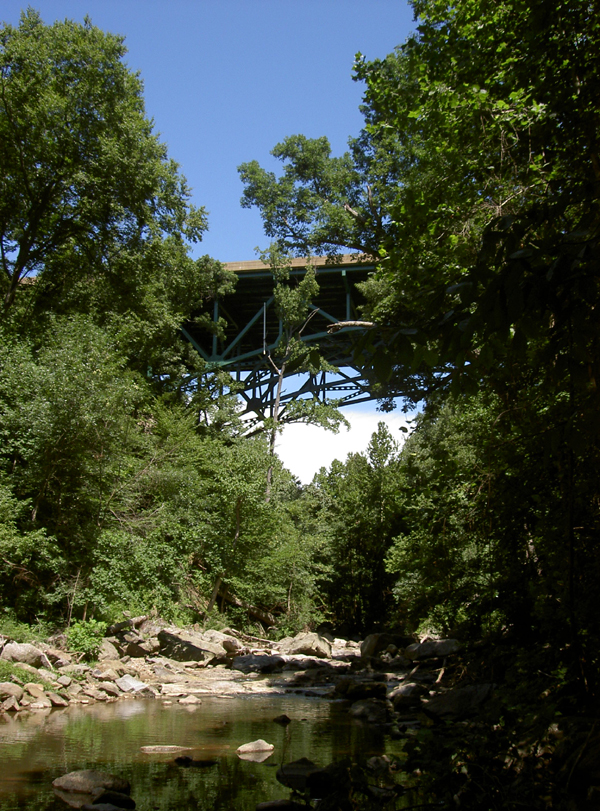
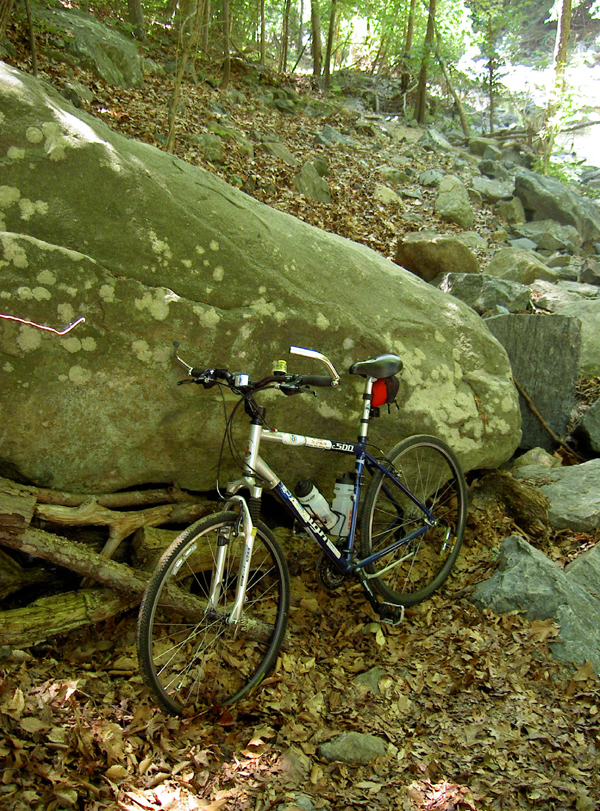
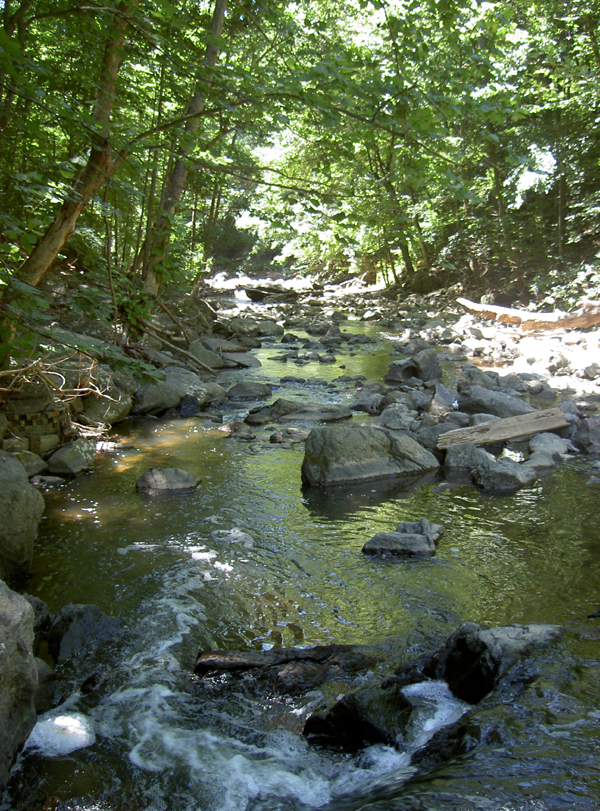
The non-fear-based downside is that the trail ends in rocks only a few miles from my house, at the Beltway overpass, so it’s not really made for a nice long ride. I ended up at the rocks right around high noon, so it wasn’t the best light for photos either, with the stark contrast of canopy and glare. Nonetheless, I parked Pearl—taking the probably unnecessary step of hiding her behind a huge rock—and walked up the trail just far enough to see the small waterfall. I have to admit, I was hoping for something a bit more dramatic when the kid coming out of the woods carrying his bike told me there was a ‘waterfall’ up a bit, but it was nice for what it was.


Pearl and the rock.


Waterfall below.


Beltway above.

As for wildlife, I saw loads of larger birds—flickers, grackles, robins, a thrasher, red-bellied woodpecker, hairy woodpecker—but nary a small one. I’m guessing they were quite a bit higher than the trail, up at the tops of the trees that were growing up the rather steep banks.

biking the Northwest Branch Trail

visits to Lake Artemesia

In an effort to get out into nature more, we walked to Lake Artemesia twice from our house in the weeks before our trip.

The first time, we took a meandering route, first heading to check out the new condos going up in Hyattsville. From there, we walked over to the river, and followed that path north to the lake. On that route, past Linson Pool and up behind the College Park airport, we had several good wildlife sightings. Just beyond East-West highway, I finally spotted and identified a Blue-gray Gnatcatcher, a new life bird. My birding acquaintance had been hearing them nearly every time we were out together, but I hadn’t gotten a good glimpse of one. As we were making our way around the back of the airport, we came across the largest muskrats we’d ever seen chomping away in the grass. Initially we thought it was a groundhog, but as it scuttled off it definitely had the long skinny tail of a muskrat. Finally, once we’d rested and made our way around the lake, we came across a doe on the path back to Paint Branch.

Our second walk to Lake Artemesia was both more direct and less eventful. From our town, we walked to Rhode Island Avenue in College Park and north, crossing Paint Branch to the path where we saw the deer. We brought an early dinner, and had a small picnic on a bench. We saw plenty of birds, although no entirely new ones for me. I did spot a Common Yellowthroat, which I’d only seen a few times before, entirely by accident as I was tracking some Song Sparrows through a bush.

Since those two visits, we’ve been back a couple of times in cars with friends. On our most recent visit together, we spotted several Killdeer, in addition to the general horde of Wood Ducks and the local Great Blue Heron. The most exciting sighting was a pair of Ruby-throated Hummingbirds chasing each other about; I got a good look at the red collar of the male with the binoculars. That sighting marks only the second time I’ve seen hummingbirds away from feeders, the first being earlier this spring at the pond.

It seems that Killdeer are starting their migration, as I also spotted one at the University Hills pond earlier this week. That particular visit was eventful for me, birdwise, as I got a better look at several Blue-gray gnatcatchers flitting around and spotted a pair of Solitary Sandpipers (another new life bird!). The identification of the Solitary Sandpipers was my best guess based on size, behavior, location, and general non-breeding coloring (as best I could tell, neither the bills nor the legs and feet were yellow). Since they were poking about on a freshwater mudflat, that seemed the most likely species, but I’m open to other suggestions. There isn’t usually a mudflat there at all, so I can thank the drought for bringing them and the Killdeer into the neighborhood. A pair of Wood Ducks was also hanging out with the regular Mallards, and several Eastern Kingbirds were darting about. It’s always fun to see these species which, while common in these environments, are unusual to me after my early life in the woodsy Midwest.

I’ve been told that Lake Artemesia is a favorite resting spot of all kinds of birds during migration, so I’m excited to see what I find there over the next couple of months.

visits to Lake Artemesia

cycling expeditions

Over the past few weeks I’ve been out on Pearl for three longer rides, in the range of 15-18 miles. I’m not my friend Frances, who’s been racking up hundreds of kilometers per week on her bike, Lucky. Nonetheless, after those two years when Pearl languished in the back room looking sad as her tires slowly deflated, I’m feeling pretty good about my efforts.

A few weeks ago I accompanied my friend all the way to the Beltsville Agricultural Research Center, instead of branching off at Lake Artemesia as I’d been doing. The ride was good, along a clear route, with plenty of space on the streets to ride out of the stream of traffic. Except for Pearl’s chain coming off when I downshifted too suddenly—my own fault as it desperately needed to be cleaned—everything went smoothly. There are a few decent hills, and I got a workout, as this was the first ride longer than an hour that I’d been on this year. We paused briefly at Lake Artemesia, and were able to see a mother Wood Duck and her brood of ducklings paddling along through the lilies. On the way back I saw some Baltimore Orioles, as well as several Goldfinches, darting around just at the exit of the research park.

The weekend after that ride, I joined a neighbor and her friend for another two hour ride on a Sunday morning. We first went up to, and around, Lake Artemesia, where we were again lucky to catch sight of two Wood Duck mamas with ducklings. From there we did the loop I’d done last month, down the Northeast Branch to the Northwest Branch and back up to the University Hills pond. Along the Northeast Branch Trail, south of Riverdale Park, we spotted a Belted Kingfisher, a life bird for me! My neighbor has seen it (or one of its relatives) there quite regularly, so I hope to catch another look on a future ride. As we went north again on the Northwest Branch Trail, I learned that my neighbor’s friend is undertaking a river bank study that involves reestablishing native plants in the hope of aiding with flood control. I hadn’t realized that aster, which we’ve planted in our front bed, is a wildflower native to this area, so that was a nice piece of information. Later on in the ride, in the stretch near East-West Highway, we heard what my neighbor’s friend identified by ear as a Yellow-Breasted Chat. I really should take my binoculars and field guide back to that stretch of woods one morning, as we saw a Baltimore Oriole not far from where we heard the Chat.

Most recently, I played hookey from ditch digging weed pulling last Friday and enjoyed the gorgeous afternoon from atop my bike. The day before, I had (finally!) cleaned Pearl’s chain and derailleur, so I was spared the guilt-inducing grinding and scraping I’d been hearing more and more. I rode the Sligo Creek Trail from the Northwest Branch (this is the trailhead that I’ve passed a few times, so I knew how to get on it from this point) to Wayne Avenue, and then back from there. The trail itself is fine, if a little winding with all of the switchbacks over the creek which make it difficult to build up speed. Or rather, make it difficult to build up speed without fearing that I’ll steamroll a dog or small child when I come around a blind turn.

I didn’t go quite early enough in the day to avoid all the dogs and small children, nor to miss the beginning of rush hour traffic. At most street crossings I had a light, but the first two (Riggs Road and East-West Highway) were a little hairy. The path itself was relatively deserted when I headed out, but all of the after-work crowd was out two deep on the way back. I did get a cup of pink lemonade from an enterprising child and her dad in Takoma Park. I hope I didn’t scare her too much with my talk about weathering spills early in life. I meant only to extol the virtues of my trusty helmet, forgetting that words like ‘smash’ and ‘crash’ can loom large in the minds of small children.

Despite not really looking for birds, I saw a Baltimore Oriole on the Northwest Branch, in the same stretch just south of East-West Highway where we’d heard a Yellow-Breasted Chat on my previous ride. I haven’t yet seen so many orioles in my life that it’s not a thrill to catch sight of one, so that was nice. The other high point of the ride was my skill at unwrapping and eating a semi-melted Luna Bar without either getting off my bike or littering. A feat which, sadly, no one was around to appreciate.

cycling expeditions

wildlife adventures in University Park

We had no idea when we moved here that we were moving to a haven of sorts for wildlife in this area. The past few weeks have been full of wildlife, in more ways than we could have imagined. We’d heard from our neighbors that coyotes, foxes, and something which might have been a Bobcat had been seen in our town, but I found that a little hard to credit since the area is so densely populated. However, during one of our nightly walks, about a month ago, we were surprised by a Gray Fox running across the road, from one part of the park to another, a mockingbird in close pursuit.

This sighting was the beginning of a string of such events. A couple of weeks ago, we discovered a featherless baby bird on the ground in the park. The nest from which it had fallen was easily identifiable, but there were no signs of parent birds anywhere around, and there was another (dead) baby bird on the ground next to it. I decided to take it home rather than put it back in the nest, and I then spent the next few hours trying to find someone to take it. I eventually succeeded, with Gerda at Wildlife Rescue, Inc., telling us she’d be happy to wait up for us to arrive. The only problem: they’re located about an hour and a half away from DC, and we don’t own a car. Thank you, Flexcar!

By the time we were ready to go, the bird had thankfully realized it was night and gone to sleep, so I didn’t have to keep feeding it (I was feeding it bread soaked in water, which you are not supposed to do, but I didn’t have any dog or cat kibble). On the way up, we didn’t listen to the radio (it could wake up and stress out the bird) or use the air-conditioning (it could cool down and stress out the bird). For all that we were a little bit tense, the directions were easy to follow and the evening was a pleasantly mild one. We arrived to find Gerda waiting for us on the porch. We promptly delivered the bird (identified as a robin) to her, whereupon it woke up and was fed something more suitable: mush. Once the bird was settled, we were given a small tour, and enjoyed seeing the other young birds — wrens, screech owls, a cedar waxwing, and a red-shouldered hawk were the most unusual — and mammals. The little foxes were my favorite, perhaps since I had only recently seen one for the first time, but the baby possums in a pillowcase sack were cute as well.

Before we got back on the road we gave Gerda a hand bottle-feeding the fawns. This consisted mostly of us trying to hold onto the bottles while the baby deer hoovered them and trying not to flail around while the others licked the back of our knees. The experience was something akin to Gonzo eating a rubber tire to the tune of The Flight of the Bumblebee (just replace chewing with little deer licks). On our way back out of the barnyard, I managed to avoid getting head-butted in the rear by the donkey; I will only say that others of our party were not so fortunate. The final treat of the evening was seeing a Red Fox crossing the road on the way back to the highway. Before this month, only other time I’d seen a fox in the wild was over ten years ago, in Europe. We were on the Zürichberg, returning to the tram from the ice skating rink late one night, when the fox walked out onto the middle of the road, stopped and looked at us, and then continued on into the woods. It was snowing that night, and the fox looked silvery; it could have been a silver morph of a red fox, or it could have just been the snow and the light making it appear so.

After that experience, I wasn’t sure how much more wildlife excitement I could handle. Over the intervening two weeks, though, we’ve had two sightings in our yard. One was the gray fox: we heard yowling and came down to turn on the outside lights, and the fox paused by the back door and then ran off to the alley. The second was just a couple of nights ago: I heard rustling at the front of the house, turned on the outside lights, and watched a possum waddle off across the neighbor’s front yard, heading toward the park. I imagine they’re both attracted by the mulberry trees along our side border, as we’ve found fox scat at the side of the house under that tree.

I have to say, having our yard become part of the local fox’s territory has improved (and by that I mean, of course, diminished) the presence of cats in our yard. I can only hope that it’s eating the rats we saw in the autumn and spring, and not preying on our resident birds.
wildlife adventures in University Park

Master Peace Community Garden

One of the projects I’ve become involved with this spring is a new community garden, the Master Peace Community Garden. The garden is a project of the Engaged University garden program at the University of Maryland, and is located at the Center for Educational Partnership in Riverdale Heights. A large part of the space is devoted to a youth garden, with kids from William Wirt Middle School participating in growing and tending the vegetables.

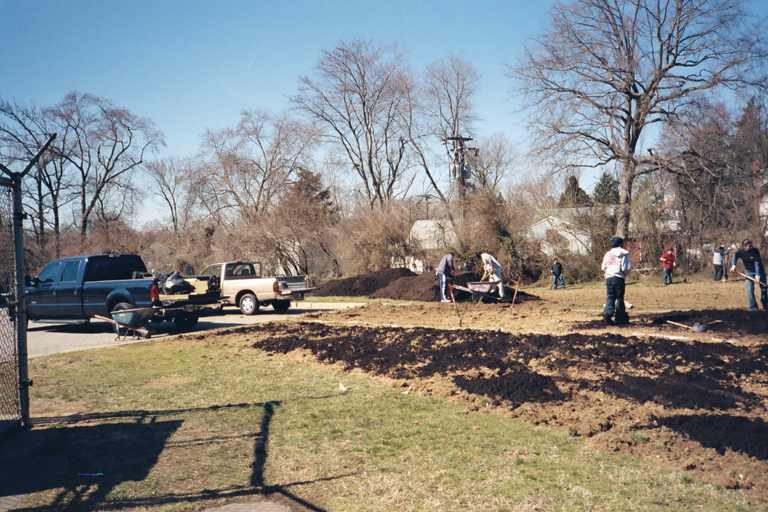
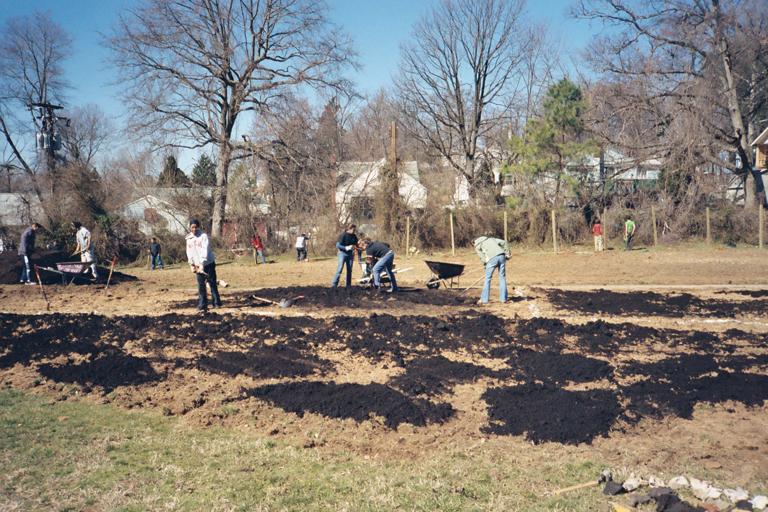
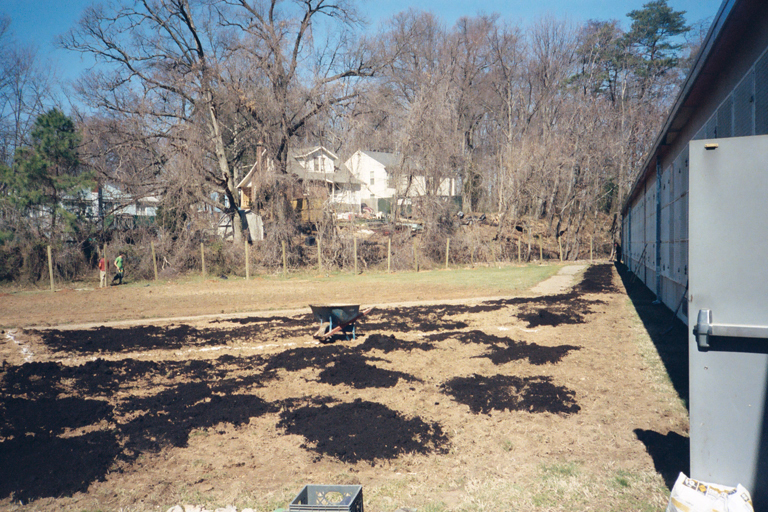
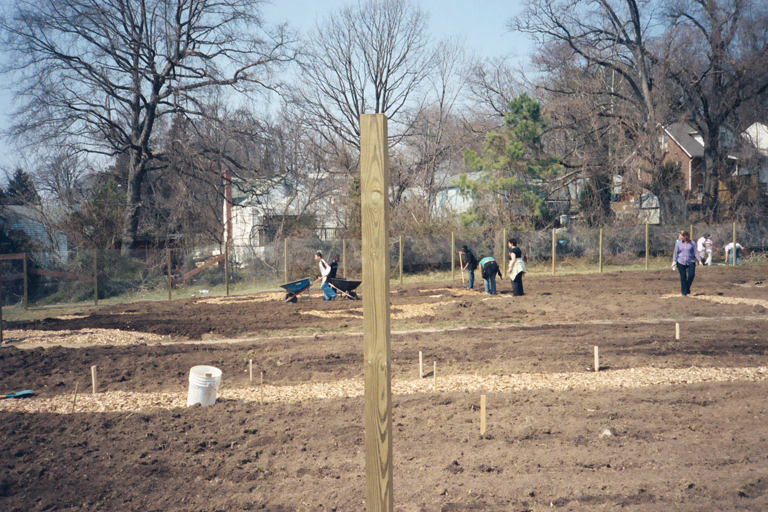
When the project began this spring, the garden space was just lawn, a stretch of grass outside the former elementary school that is now the community center. In March, I and other volunteers worked to clear the grass, lay the plots, put up the fence, and undertake the initial plantings.

Breaking ground in March:

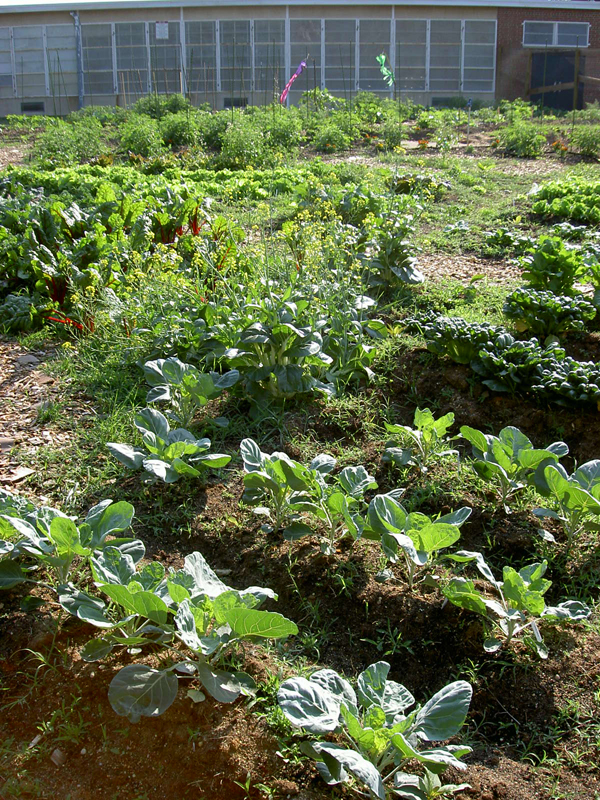
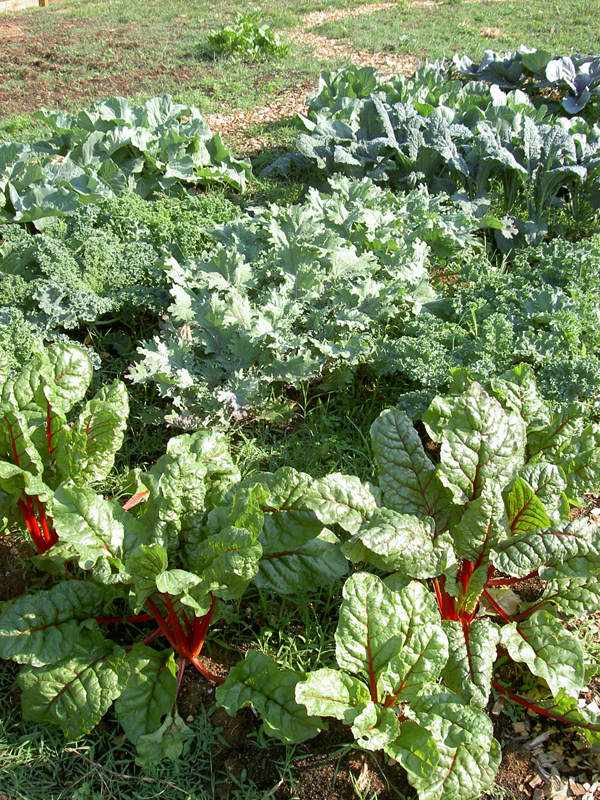
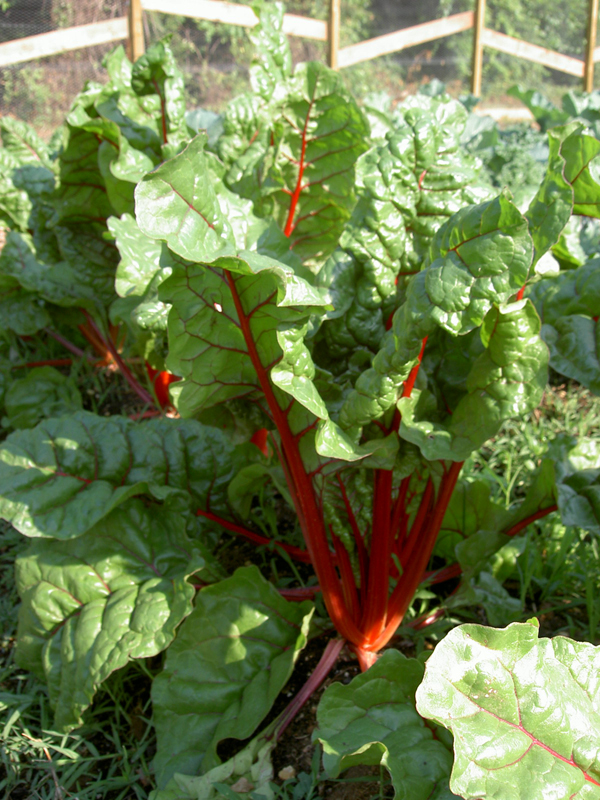
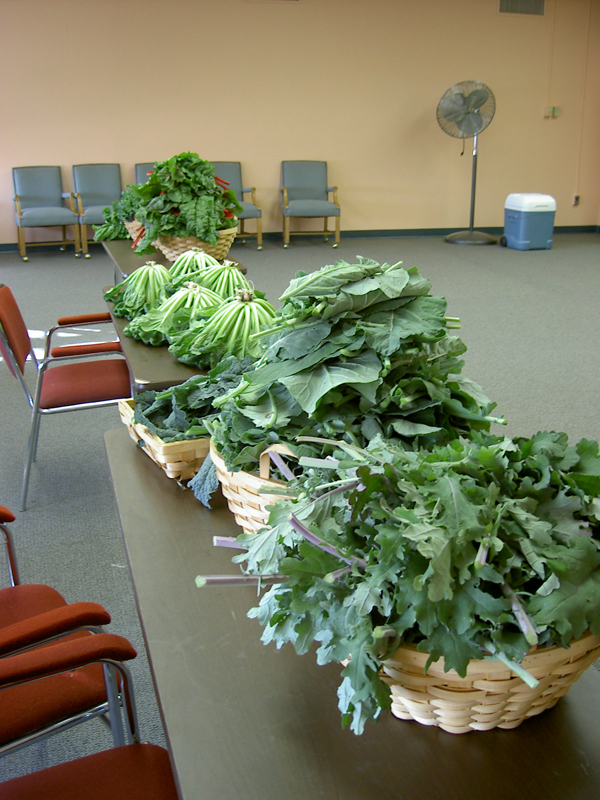
Since March, we community members have received and planted our individual plots and contributed to establishing the youth garden. This week was the first harvest for the youth garden, of produce they’ll be selling at the Riverdale Park Farmers’ Market. The garden looks much different now, green in every direction. The first harvest — of kales, collards, chards, tat soi, and lettuces — hardly made a dent in what’s growing there!

The garden now:

Rows of greens to be harvested:

Chard:

The first harvest:

Our own individual plot is bursting forth with herbs, and I hope to start seeing pepper blooms in a few weeks.

Master Peace Community Garden