new life birds at Patuxent and Lake Artemesia

Since getting the car last week I’ve taken two trips up to the Patuxent Wildlife Refuge to walk the trails and look for birds. Last Monday’s visit was on a rainy day, so I didn’t expect to see much. Not much is still something at a place like Patuxent, though, and the very first birds I spotted were a pair of Wood Ducks paddling around in the creek (the trickle of water that I expect will develop into a fuller marsh if we have a rainy summer). They didn’t appreciate my arrival and left with much hooting and flapping, startling a group of snipes up out of the reeds. The snipes were a new life bird for me, and seemed to have changed names between the publication of my older Peterson’s, where they’re listed as Common Snipes, and my newer Sibley’s, where they’re called Wilson’s Snipes. At any rate: I saw a bunch of snipes! Their distinctive back stripes made them easy to identify, and I was pleased to add another tricksy marsh bird to my list.

The walk through the woods was pleasant, but relatively bird-free. I saw some titmice and a heron wading around at the shoreline. Cash Lake Pier is the endpoint of the trail, and it was nice to sit and take in the view of the lake from up there. The Tree Swallows had returned and were swooping over the lake in large flocks. When I arrived at the pier I discovered a pair of Northern Rough-Winged Swallows just hanging out on the railing. I’d only seen them once before, last year at the University Hills pond, and it had been late enough in the season that I wasn’t entirely convinced they weren’t young Tree Swallows. It was nice to have a firm identification; second sightings are still exciting in my book! On Saturday my partner and I had stopped at Lake Artemesia and discovered a young Osprey hanging around. It also wasn’t a first sighting, but it was the first time I’d seen one close enough to be able to get a good look at the head and wing markings. Other sightings had been from the highway in a moving car, so this sighting marked a more firm identification.

I returned to Lake Artemesia on Tuesday, and was pleased to discover a small group of Pied-Billed Grebes swimming about. Unlike at Bombay Hook, there was no mistaking them this time, and I was thrilled to see them. There’s something about the small awkwardness of grebes that I find endearing. The Osprey was still hanging about, and while I didn’t get to see it dive, it did hover directly overhead a few times, which is always neat with such a large bird. I had assumed it was just passing through on its way to the shore and didn’t expect to see it again; now I’m wondering if it will stay and nest. There are also still groups of Ruddy Ducks and American Coots out on the lake, as well as at least one pair of Ring-Necked Ducks still hanging about.

Yesterday was another beautiful day after a stormy night, so I returned to Lake Artemesia to see if anything interesting had blown in. I wasn’t the only one to have this thought: I encountered two other people with binoculars at Lake Artemesia. The first was kind enough to let me know that Palm Warblers begin to travel through in the company of Yellow-Rumped Warblers this time of year, and the second alerted me to the presence of a Horned Grebe in breeding plumage on the Lake. I had seen the Horned Grebe in winter plumage hanging around, and did see it when I arrived, but I hadn’t noticed the other in among the Ruddy Ducks. This both confirmed my identification of the one in winter plumage—still nice for me with my level of experience—and allowed me to backtrack a bit and catch sight of the grebe with a splash of gold across its head. Since Horned Grebes are migratory, it’s rare to see them in breeding plumage this far south, and I’m thankful for the opportunity. Backtracking also led me to find a single Double-Crested Cormorant out on the water; I’d only previously seen them from afar on the ocean, so getting a good look at the cheek-markings was fun as well. The final gift of the morning was a male Eastern Towhee on the path near the parking lot; I’d seen my first female Eastern Towhee on the nearby Paint Branch trail about a month before. I’d sighted male towhees out west, but this was the first male of the eastern subspecies that I’d seen.

Following such a successful trip to Lake Artemesia, I couldn’t resist the urge to head up to Patuxent and see what had landed on the lake there. I am glad I did, as I had a great time! The first bird I saw was another new life bird, a Swamp Sparrow. I suspect I’ve seen these before, at Point Pelee and the University Hills pond, but this was the first time I was able to be absolutely sure. As I was standing watching the sparrow, I became aware of an overwhelming chorus of frogs. Amphibians are my first love, and so I following a footpath—likely a deer trail—through the grass to the edge of the creek. What to my wondering eyes did appear but a horde of toads emerging from their hibernation in the mud and chasing each other around in attempts to mate. One of my housemates in Ann Arbor witnessed this spring event years ago in a park near where we used to live, and I was so jealous. So jealous! Imagine the nicest material item you’ve ever wanted it being given to the most obnoxious person you’ve ever met, and then multiply that by about a thousand: that’s how jealous I was, not because my friend was obnoxious but because frogs and toads are my first love. At any rate, all that was washed away as I got to stand and watch all these toads acting kooky. As a visual aid, I offer you this photo of one small stretch of the creek (see how many toads you can find in it):
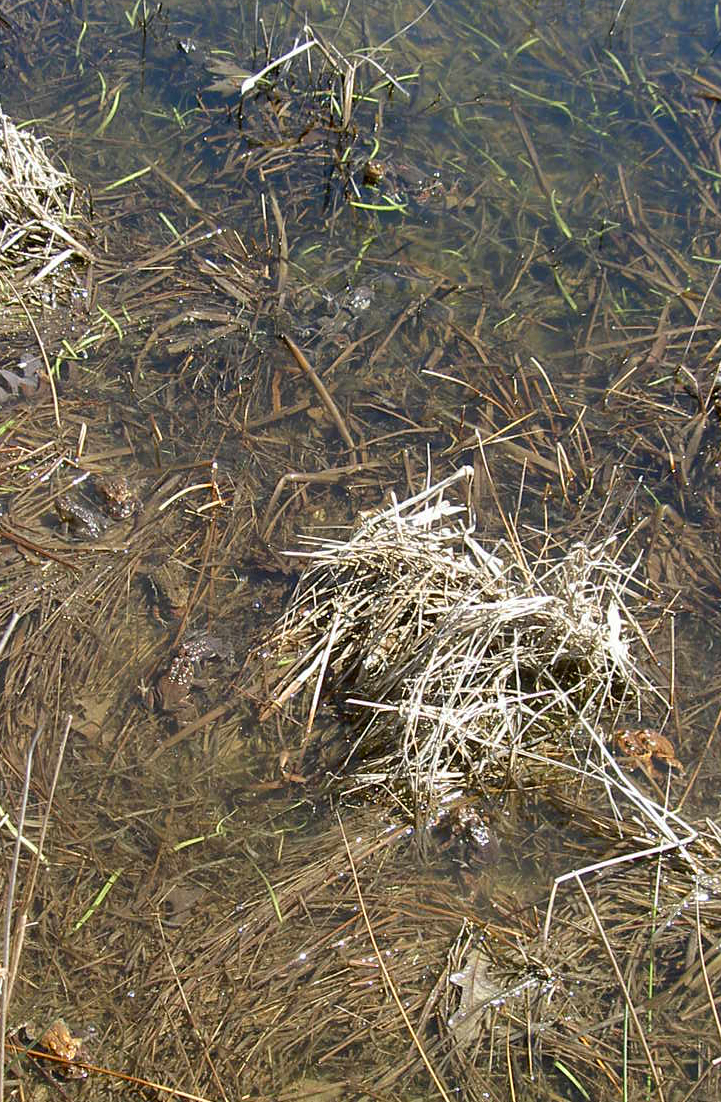

Toads mating at Patuxent.

Following that excitement, I was happy to just walk in the woods and enjoy myself whether or not I saw any birds. Near the trailhead I saw a pair of Eastern Bluebirds hanging about a nesting box; although I know they’re common out here, this was still only my fourth sighting and their bright coloring remains startling. In the woods I encountered an Eastern Phoebe, another bird that I’ve only seen a couple of times before; it was perched above the trail bobbing its tail and singing away. Along the shore there were turtles crowding every rock and log; like the toads, they were coming out of hibernation and seeking the sun. Up at the Cash Lake Pier I found both another Double-Crested Cormorant and a fellow birder—the binoculars give it away every time. I walked over to say hello and he was kind enough to point out a Common Loon out on the lake, another new life bird for me! As with bluebirds, loons had loomed large in my imagination, birds that were never sighted yet deeply loved and exotic to someone raised inland. He also pointed out the nesting platform that the circling Osprey seemed to be using; I look forward to returning through the summer and watching for young birds. As if those sightings weren’t all enough, I saw a Hermit Thrush in the woods on the walk back to the car, another bird that I’d sighted only once before—in the backyard of our most recent house in DC—and I was happy to get a second look.

Trips like these remind me of the positive side of being a relative novice at this birding stuff: I’m almost guaranteed to see something I’ve never seen before on each trip, as many common birds are still new. It also reminds me how lucky I am to have moved to an area with such diverse habitat, within reach of so many parks and refuges. It wasn’t something we took into consideration when choosing our house location, but being on the northeast side of the District in the Chesapeake Bay and Anacostia River watersheds has yielded one pleasant surprise after the other.
new life birds at Patuxent and Lake Artemesia

turning the suburbs into a salt wasteland


Road salt heading to the Chesapeake Bay.

One of the things I hate the most about living out here is the way they deal with winter weather. Or rather, the ways in which they don’t deal with it. During the first year we were here, there was a blizzard. A good old-fashioned three-feet-of-snow-shuts-the-city-down-for-a-week kind of blizzard, of the type that also shut down the east coast in February of 1996. Not surprisingly, DC didn’t have enough salt or sand or plows or trucks or workers to clear the streets in the days after the blizzard. I say not surprisingly not because DC government is a bunch of backwards eejits, but because no government could have had enough salt or sand or plows or trucks or workers to deal with this level of snow. I say this having lived in Pennsylvania during the blizzard of 1996 and having grown up in places where at least once per year two or three feet of snow can be expected; when these things happen, it takes a while to clear the roads. Period.

However, local residents’ expectations did not align with this reality, and so there was a lot of protesting and blaming and complaining and accusing following this blizzard, the result of which was overcompensation with regard to all future winter weather. In some ways, the overcompensation was amusing: schools were closed in anticipation of an inch of snow, snow which sometimes never materialized. As I was teaching at the time, I enjoyed frequent days off. The other way in which people in the area overcompensate, though, remains completely mind-boggling to me, and that is the coating of the roads and sidewalks with salt. Salt which is rarely needed at all, let alone to the degree it’s applied, and which therefore mostly ends up in the local soil and water system.

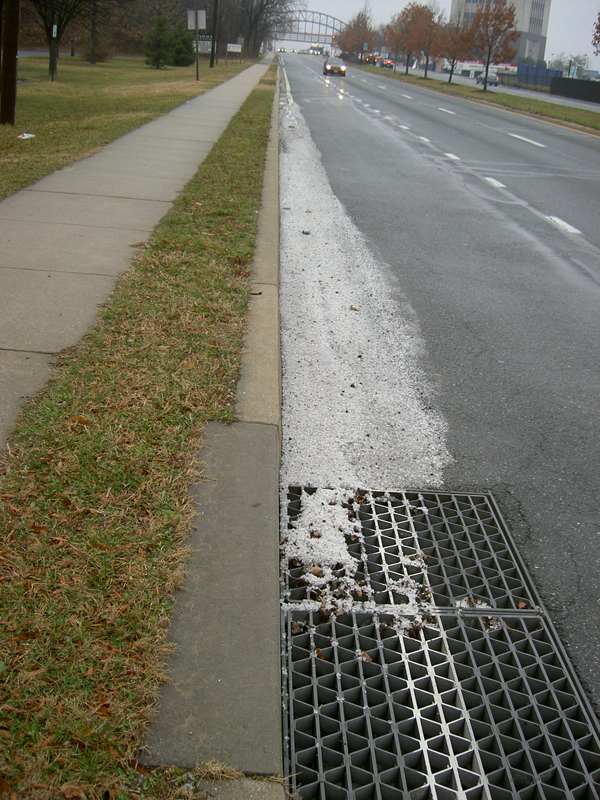
I can’t remember ever using salt on sidewalks except during an actual ice storm. Where I come from, we use a shovel and the sun: shovel the snow, let the sun do the rest. In the rare instances where patches of ice develop we either (1) walk around them or (2) use the shovel to break them up and clear them from the sidewalk. Out here, people either don’t shovel their walks at all or shovel them and then cover the damp surfaces with a layer of salt. Sometimes, as in the photo above, the surfaces are completely coated with salt in anticipation of the possibility of snow or freezing rain that never materializes. As a walker, this means I’m walking in the grass throughout most of the winter to avoid having my shoes deteriorate through constant exposure to chunks of salt. Which is annoying, but not nearly so annoying as seeing buckets of salt heaped at the side of the road and dripping into the storm drains, drains which flow to the Chesapeake Bay.

I took the above photo a month ago, on January 22nd, at the end of the day on which the salt was applied. Much of the pile of salt is still there, six weeks later. I suppose I could be glad that it’s still there, rather than all in the water system; mostly, though, it just makes me angry. I shudder to think what the water in our local creek must be like, and try to remember to fill the birdbath with fresh water each day. I know that other locals are concerned about the chemical runoff into the water system, including members of the Town Council. So I try not to let it get to me and focus on maintaining my little chemical-free soil haven for the local grubs and insects, which in turn feed the local moles and birds, which in turn feed the local hawks, possums, raccoons, and foxes.

turning the suburbs into a salt wasteland

Redheads at Lake Artemesia


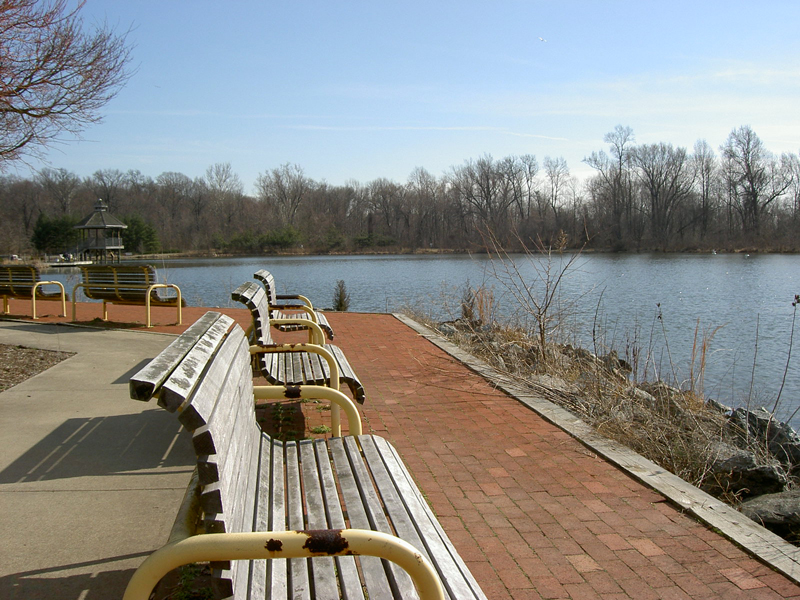
Chilly benches at Lake Artemesia.

This past week I visited Lake Artemesia two more times, hoping to see new ducks or early migrants. My other objective was to determine the quickest and least expensive way of getting to the lake by foot, using public transportation. The quickest way is to take the metro one stop, which involves 2 miles of walking round-trip not including any walking around the lake itself. The least expensive way is definitely to ride the University of Maryland buses, although one of them requires an ID, so it’s not a solution if I wanted to bring friends. This approach takes longer but cuts the travel walking distance in half, as I can pick up the bus one block from my house rather than going the 1/2 mile to the metro. And, it has the added advantage of not costing anything, which is a not-insignificant consideration.

At any rate, the main point was to see new birds and I got lucky on the second trip when I saw a small group of Redheads hanging around in one corner of the smaller body of water. These are common around the Chesapeake Bay, but completely new to me. All the other more common birds I’d seen were still hanging about: Canada Geese, Ring-necked Ducks, Ruddy Ducks, the lone Horned Grebe, and loads of Red-winged Blackbirds, Carolina Wrens, and Song Sparrows. The pair of Killdeer was still chasing each other around on the lawn; I didn’t see the Bluebirds but I remain hopeful for the summer. Late in the visit I noticed a pair of Hooded Mergansers in with the geese; I’d seen a male in Ontario, but the female was new. They were cute, with the male flapping his wings and raising and lowering his crown while the female casually dove for food and pretty much ignored him.

Speaking of mating birds, earlier this week I got flashed by a Ruby-crowned Kinglet as well! We were down along the Potomac by the FDR memorial and the bridge back to the Jefferson, trying to determine if any of the Lesser Scaup were Greater Scaup, and I saw it in the tree. I was able to track it with the binoculars, and had determined that it was most likely to be a Ruby-crowned by process of elimination when I saw the telltale flash of red. That was a treat, and made me laugh at myself only a year ago returning home and reporting that I’d seen a little warbler that seemed to have been marked with orange paint on its head; could that have been for tracking purposes? I solved the mystery of the Ruby-crowned Kinglets not long after that first day, but I still chuckle to think of it. What a difference one year makes!

Redheads at Lake Artemesia

blustery afternoon at Lake Artemesia

Yesterday I spent the afternoon tromping around the Paint Branch Trail and Lake Artemesia. Rather than walking the entire way there and back in the cold, I spared my wonky knee and took the metro one stop to cut the walking distance in half. I probably covered a good three or four miles nonetheless, but I hadn’t used all my energy simply getting to the woods.

Having heard that all manner of waterfowl have been seen on the lake in winter, I was hoping to catch sight of some oddities and add to my slowly expanding lifelist. And, in fact, there were several flocks of ducks of various sorts out on the water. Only one of the species, Ring-necked Ducks, were entirely new to me, but there were some that I’d only seen once or twice before, namely Ruddy Ducks and Buffleheads. In addition to the small flock of Ring-necked Ducks and the larger flock of Ruddy Ducks, there was a flock of American Coots bumbling their way around the place with only one or two Buffleheads sprinkled throughout the group. There was also an enormous (of course) flock of Canada Geese on the far side of the lake, and an assortment of Mallards here and there around the edges.

In addition to the new duck, I saw two woodland species that I’ve never seen before. Just onto the trail from Paint Branch Parkway I saw a female Eastern Towhee rummaging around in the leaf litter. I’d seen the western spotted version, but not previously gotten a firm identification on the eastern species (I suspect I’ve seen one or two in the past, I’ve just never been able to get close enough to conclusively distinguish between either a robin or a thrasher). That path was also good for spotting some old favorites: Carolina Chickadees, a Yellow-bellied Sapsucker, and a male Downy Woodpecker. Once at the lake I saw small flocks of Carolina Wrens, Song Sparrows, American Robins, American Crows, and Northern Flickers (this last group was traveling with a single Red-Bellied Woodpecker). I was also happy to see a male Belted Kingfisher hanging about and making noise from a lakeside perch; I’d seen them flying along the Anacostia, but always from my bike and never close enough to be able to identify gender.

The best surprise of the day was heading back to the trail to make my way to the metro and coming across a pair of Eastern Bluebirds on a nesting box just off the path. Bluebirds are a bird I’ve wanted to see all my life; we don’t get many bright blue birds in the Midwest, and they always seemed like a wonderful bird to be able to come across in farm fields on the east coast. This pair looked exactly like photos of bluebirds always look: the male was perched on the top of a nesting box, with the female a few feet away on a low branch of a small tree. They stayed long enough for me to get a good look and then flitted off in search of food. I hope they decide to stay and nest, it would be great to be able to see them on regular trips to the lake.

The last bird I saw at the lake was a Killdeer, running around on the grass near the trailhead. Maybe next time I’ll hike around to the far side of the lake and investigate the possibility of sandpipers on the mudflats. Yesterday, though, three new life birds in a single afternoon was enough for me.

blustery afternoon at Lake Artemesia

new life bird in the local woods

Last week I saw my first new life bird of the year, a Pileated Woodpecker, in the woods on the north side of town. They’re urban woods; stands of old growth trees, but with buildings visible at every point within. They line the creek that divides the north side of town from the University Campus, and were easily explored this time of year. I imagine that ivy, multiflora, and general temperate jungle shrub will make most of the area impassable later in the year.

As with most of the life birds I’ve sighted around town, seeing the woodpecker was pure luck. I had decided to go through the woods rather than up to the pond in the hope of spotting some owl-sized roosting cavities in the trees. We’d heard rumors of owls in town, but had yet to spot any. Not setting the alarm for 2am in order to prowl the streets probably had something to do with that. At any rate, I investigated sheets of bark raining down from a mostly-dead tree and discovered a ginormous woodpecker. To be fair to my burgeoning birding skills, a few minutes before I’d noticed the smattering of round tree holes and said to myself, ‘This would be a good place to come look for Pileated Woodpeckers during the spring migration.’ Which, you know, makes me glad I didn’t say something like, ‘Gee, I hope that rotten limb doesn’t come crashing down onto my head.’

The other fun aspect of the woods was the discovery of a variety of animal tracks along the sandy creek bed. We were able to identify the usual suspects—raccoon, possum—as well as a few mystery tracks. At the opening of what can only be a decent sized den in the creek bank, we discovered a print that could be badger, woodchuck, or striped skunk. We’ve see gray foxes in town, but the print had a distinct fifth toe, so it seems likely that it was something else. Dog-like prints at a few points in the creek bed led to speculation of the presence of coyotes, although it’s (of course) more likely that they’re just someone’s dog. I made the (compelling, no doubt!) case that domestic dogs off-leash usually run up and down creek beds like maniacs so the few prints crossing over were more likely to be a wild animal than not. And, the prints did differ from standard dog prints, but there is so much variation that I wouldn’t bet my own money absent spotting an actual animal. Nonetheless, a walk in the woods is always more fun when imagining being stalked by invisible beasts than not.

I had hoped to return to the woods this week, but the weather has turned from global-warming-mild to positively wintry, and I’ve hunkered down inside like the tender Southern grub that I’m becoming. Wiping out on the sheet of ice that was the entrance to the Metro and bashing the @#$% out of my knee and rear yesterday also didn’t do much for my desire to go tromping around outdoors. Although it did momentarily restore my faith in area youth, as two young men who witnessed the crash very solicitously inquired after my well-being. Of course, the further dozen young men that gathered in the area during the time I was in the store to loudly guffaw at others sharing my earlier plight somewhat dampened my good opinion, or rather restored my general opinion of the moral compasses of teenage boys.

new life bird in the local woods