Sonic Youth at the 9:30 Club

So, we saw Sonic Youth last night at the 9:30 Club. They were good; we were at the second of two sold-out shows and I’d guess a lot of the audience was repeaters. Except for the times when we were all focused on the woman in the opposite balcony who was first leaning over the railing in her bra, then getting in a fight with her (pretty obnoxious) boyfriend who was trying to control her, and then getting physically dragged out, we were all glued to the stage and happily nodding our heads in time. (We were old, tired, and in the balcony; plus, the band played some pretty mellow stuff.) The performance was solid; I suppose after sixteen albums and tours and thirty years of playing together you get to be pretty comfortable with each other. And, it was actually quite cool to see them produce all the funky sounds they’re known for, using their actual instruments rather than a Macbook.

Before this show, I hadn’t listened to Sonic Youth in fifteen years, and I’d definitely skipped all that 90s stuff (the phase when they became what someone called ‘more experimental’). Everything they played sounded vaguely familiar but I didn’t know any single song well enough to sing along; I don’t actually own any of their CDs despite recognizing their musical greatness. (If I hadn’t already lost my hipster card by not liking The White Stripes and finding The Mountain Goats to be atrocious, now would be the time for it to be recalled.) Which is to say, I can’t tell you what the set list was or how their live performance diverged from their studio recordings or whether the time that Kim had to swap out her instrument because she either broke a string or the tech brought the wrong one was a point when she was actually supposed to be playing.

You can, however, listen to the concert on NPR and answer all those questions for yourselves.

Sonic Youth at the 9:30 Club

Radio Golf at Studio Theater

One of our Christmas presents last year was a gift certificate for The Studio Theatre, on 14th Street just blocks from where we used to live. After investigating the shows playing this season, we chose Radio Golf, August Wilson‘s last play in his Pittsburgh Cycle, completed just before his death in 2005. I had heard of August Wilson’s plays—even before the Obamas flew to NYC to see one—but had never seen a performance. The show last weekend was obviously popular; the theater was sold out and we’d had to bump our chosen performance date back a few weeks in order to get four seats together. The seats were excellent, in the center of the second or third row; definitely worth the wait.

The play itself was superb and engrossing. The actors were completely convincing, and the characters could have been around the corner in an office in DC. Although questioning gentrification itself wasn’t the point of the play, I couldn’t help but notice the similarities to the dynamics that have been going on in DC for the past ten or fifteen years. Old houses being bought up for back taxes, poor and older black folks moving out of their neighborhoods to make way for high rise complexes with doormen and Starbucks ™ on the ground floor. Radio Golf takes that dynamic as the starting point and moves on to questions of ethics, of the ways in which these things move forward whether or not they are above-board in the beginning. The play succeeds at providing completely recognizable late-20th-century middle-class black characters while avoiding stereotypes. Wilson manages to convey the social context that produces the desire to move forward and never look back in a way that allows the audience to remain sympathetic even to the play’s less appealing character, the friend who is willing to be the black face that allows white investors to get a piece of the federal minority-headed project pie. Overall, it was a poignant example of how projects move beyond the control of the creator when big money becomes involved, and a reminder of why I wasn’t comfortable being part of this kind of revitalization by buying in similar areas in DC.

More than anything, Radio Golf made me want to see Wilson’s other plays, and I hope that a DC theater will start to perform the cycle again from the beginning. It’s rare to see such an insightful and accurate portrayal of city life balanced with both humor and compassion. Certainly, August Wilson’s talented eye and voice created the platform, but the five actors made the story come alive. We’ll definitely return for future productions.

Radio Golf at Studio Theater

burned on the Fourth of July

The good news about the Fourth of July is that, as I did last year, I made another delicious cherry pie and shared it with my friends. I’m stocking up on fresh sour cherries at the farmers’ market while they’re in season; most of them are going into the freezer, but a goodly number are going into things we can eat right away. Being, you know, from the north and all, I grew up on cherry pie and am more than happy to bake pies myself just so I can have my favorite dessert whenever I want. This year, I used Gourmet‘s recipe and didn’t bother to make a lattice top as I did last year with the Bon Appétit version. (Both can be found on Tastebook or Epicurious; I prefer Tastebook but not every likes to create a login in order to search.) So, cherry pie, that was good.

The bad news about the Fourth of July is that I went to the College Park fireworks on the University of Maryland’s campus and got hot ash in my eye. We had already moved our blankets farther away from the barrier because a flaming piece of debris caught our bag on fire after nearly landing on my partner’s upturned face. (Not that we were particularly close to start, as I don’t really enjoy fireworks that much; I’m with the eight year old who walked by and said, ‘Mommy, that sounds like guns!’) Anyway, when the ash blew into my eye I poured half my water bottle over my face to try to flush it, but it was still burning and stinging so we went to the paramedics (or EMTs, whichever are the firefighter ambulances rather than the hospital ambulances). A very nice firefighter named Lauren and an older guy whose name I didn’t catch flushed my eye with the official eye-flushing stuff and it went from burning to just feeling like I’d gotten a stick in my eye. Once home—at this point we left, as you might imagine I wasn’t in the most nationalistic of moods anymore—I called our medical advice nurse and she told me that I would be fine since I didn’t have either searing pain or loss of vision, but just to be safe I should stand in the shower and let the water run into my eye while blinking for five minutes. Five minutes is a crazy long time to have water running over your eyeball; I managed two. The first minute I was distracted by the burning in my previously non-flushed eye, which was parched from the smoke at the fireworks and the chlorine at the pool earlier. After that, it was just a matter of white-knuckling it through the creepy feeling for as long as possible, which wasn’t very long in my case.

Happily, my fear that I would wake up the next day not able to see did not come to pass. I can see, and my eye feels no worse than when a twig of a low-bridge town tree gets me in the eye in the dark. (You would think glasses would provide a tad more protection, but apparently not.) However, attending local fireworks displays will now join driving on the Garden State in the category of Never Doing That Again As Long As I Live So Help Me God.

burned on the Fourth of July

Food, Inc. screening

A couple of weeks ago, we went to a pre-release screening of Food, Inc., downtown at the E Street Theater. We’d never been; it’s nice and worth the trip downtown to be able to see limited run films in a contemporary setting. Old theaters have a lot of charm, however there’s a lot to be said for being able to feel your kneecaps when you get up to leave.

The film itself was well done. There wasn’t much new information in it, although I was pleased to see that my favorite parts of Pollan’s book—the bit about the pastured chickens and the section about corn corn corn—were apparently everyone’s favorites, as they were the basis for a large segment of the film. I had a reaction similar to my response to The Omnivore’s Dilemma, which was to think that either I was even more unusual than I realized (there is at least one person in our household who is a proponent of this view) or the authors really misunderestimated their audience’s knowledge. In support of seeing the film even if you already know everything it’s telling you, it’s definitely more striking seeing an aerial view of factory cow farms and an up close view of chickens that are simultaneously too big and underdeveloped to be able to hold themselves up than just reading the book (or watching Chicken Run for the gazillionth time). It’s easy to see footage of bushels of potatoes rolling down assembly lines being cleaned and sorted and be lulled into an easy contentment about how nearly Jetson-like our current era is; it’s nearly impossible to do the same when the potatoes are chickens. Similarly, while reading anything about Monsanto is enraging, the segment covering their persecution of an old Hoosier over his seed-cleaning business made me feel more loyalty to where I grew up than ever before. Also, I wanted to fly back home and personally beat to death (this is hyperbole, FBI) the schmuck of a lawyer who was willing to get his minute of fame stating on camera that losing this case would set a terrible precedent, but wasn’t willing to see it through to the end pro bono. [Insert your favorite ass-word derived expletive here.] Yes, it’s true that every time I see an old guy operating somewhat arcane machinery I think of my grandfather, and that makes me sentimental; it’s also true that the Indiana I grew up in may look the same—miles and miles of corn and soybeans destined for industrial processing—but it’s been totally transformed socioeconomically by Monsanto and that idiotic Thomas-driven decision. (If you’re reading this, Supreme Court, that one is high on the list of ‘stupid things that never should have happened, that we can get down to work reversing just as soon as humanly possible.’)

Besides rousing my ire, only moderately soothed by having had the foresight to wear my ‘Food for people, not for profit!’ t-shirt from the UMD food coop, the film did a decent job of highlighting the way in which our food choices are about more than just the concentration of pesticides in our toddlers’ urine. They are about the way the workers who harvest our food are treated, the health of the communities uphill from the slaughterhouses and downstream from the CAFOs, the economic solvency of the farmers who buy the seeds and rent out the chickens, and the preservation of the natural variety that makes our ecosystems more resilient when faced with pests and disease. This is the part where my partner believes I’m the unusual one, because I think about all those things when I decide how to spend our money, and at this point I’m feeling pretty confident about our mish-mash of choices. I know that we are privileged to have the marginal income to choose to spend on food rather than cable TV, and still pay for health care as well. I know that, and I’m not talking about personal economic choices made by the working poor. I’m talking about the choice to take the time to cook something from scratch, rather than buy the thing that’s full of corn syrup made from the corn grown by a guy in Indiana under the yoke of Monsanto and dependent on federal subsidies. I’m talking about the choice to pay more per gallon of milk to know that the money is going to farmers who are treating their animals well rather than to the shareholders of an enormous company that buys up farms and consolidates them just as soon as organic food starts to look profitable. I’m talking about making this balance work by eating less meat and processed food, and shifting the savings toward the budget for organic vegetables and dairy.

Really, I’m talking about putting your money where your mouth is and making a commitment to a way of participating in the food provision system in this country that reflects your core values about workplaces, environmental impacts, and product quality. Yes, I know not everyone cares as much as I do about whose pockets the profits from my dollars go into at the end of the day (or the quarter), and that’s fine. But everyone cares about something that can be reflected in how we spend our money and obtain our food, and that’s really the larger point that Food, Inc. is making. Figure out what that thing is for you, and let it guide the way you shop and eat, whether it be workers or green spaces or farmers or pesticides. It may take longer and appear to cost more than the alternatives, but we’ll all be part of a happier and healthier society for it.
Food, Inc. screening

Artomatic 2009

The first weekend of June was a busy one for us, and we kicked it off by going to the opening night of Artomatic. This was the first time I’d been to an Artomatic in a new building, and it was a bit odd. The two I’d previously attended had been in buildings that were about to be torn down, which made the whole experience kind of spooky and reminiscent of unauthorized versions of these events that people I knew used to have in abandoned factories and warehouses in Philly in the mid-90’s. This time around, we took the elevator to the ninth floor and had panoramic views of the mall.

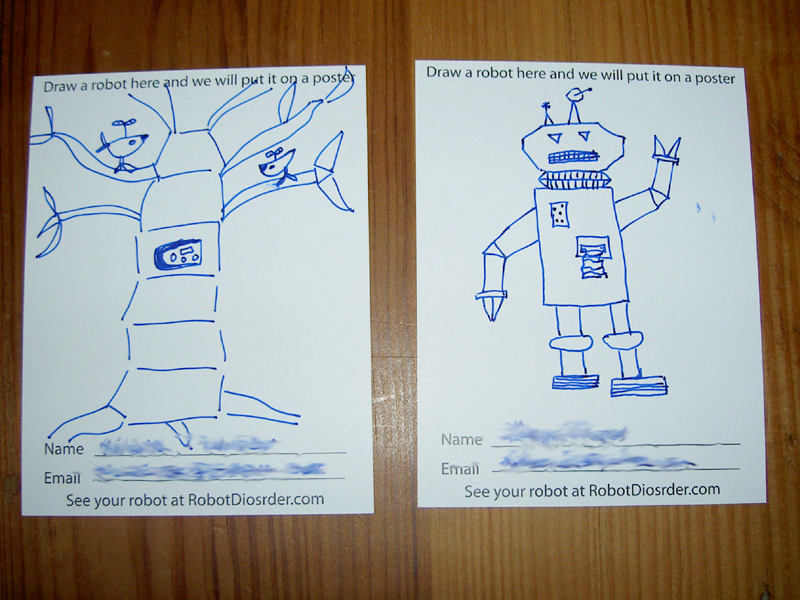
Our first stop was to see our friend Todd’s work—conveniently located on the ninth floor, meshing well with our plan to ride up and walk down. After spending some time stalking him in order to congratulate him on his pieces, we wandered over to the robot drawing area, easily identifiable by the many young children crowded around the tables. As promised, the robots we drew on postcards and submitted to the RobotDisorder folks are now part of an Artomatic poster! (Mine is sixth from the left in the top row and my partner’s is fifth from the left in the second row down.)


Our robots.

While little can compare to getting to draw your own robot, there were several other displays that I particularly liked. I was sorely tempted to purchase an insect with spatula wings, but I couldn’t think of a suitable place to display it. Now that the living room is painted, I’m tempted to go back for one for the unoccupied end of the mantle. Another favorite was the work of Novie Trump, an artist who lives nearby and whose work I’d seen at an Artomatic preview show that Todd took us to inauguration weekend. Her forms are lovely, and she has an excellent ability to mix texture and color in her use of clay; I find her small works melancholy and yet alive. Although I wasn’t moved by all of his pieces, Rick Braswell had a beautiful photograph of an Italian piazza that I could have stood and looked at all night.

The beauty of Artomatic is that there’s truly something for everyone: my partner spent much time with the action figure dioramas of one group of Frederick artists and the comic strips of another, ending the evening by getting his photo taken with the lifesize peep. I wandered down to the PostSecret area, joining the crowd in looking through a pile of actual postcards, but wasn’t brave enough to be recorded as part of the video project even if I could have come up with a secret on the spot.

Since we’re old now, we only got through three floors before it was way past our bedtime. Our plan is to return next before the end of the show, but the weekends are filling up quickly. The beauty of Artomatic is that there’s always more art to be seen.

Artomatic 2009