food : cooking goals for 2010

So far, I have only a couple of cooking goals for the year. One, I want to learn to cook dried beans in my slow cooker. Two, I want to learn to make pizzas. Neither of these will seem like major challenges to most of you, I’m sure, but they are things that I’ve had a block on that I want to get past. To this end, I am soaking my first batch of dried (Great Northern) beans overnight tonight and will be making them in the slow cooker tomorrow. The inaugural cooked-white-beans dish will be Marcella Hazan’s white bean soup, which is essentially white beans, garlic, and parsley. (I finally scored a copy of the original The Classic Italian Cookbook at a local thrift store this weekend and already have about a dozen recipes marked to try; rather than spring for the new version, I’ll now keep an eye out for the equally out of print and well-regarded More Classic Italian Cooking!)

On the second point, we’ve set a date for the 31st of January to make our first homemade pizza (yes, that’s the next weekend day we will have free together after today). Between now and then I’ll be assembling whatever it is we need for pizzas, and polishing up the as-yet-unused pizza stone we received as a wedding gift. (We did request the pizza stone, we just haven’t broken the barrier of actually making a pizza yet.)

In general, I want to branch out into making bread, but I am not yet ready to set a specific goal. I have a strong suspicion that the pizza hump is actually just a foothill of the yeasted-dough mountain by which I remain completely daunted. It’s not even the prospect of either a bread brick or a pot of runny goop that is the specific problem, I am just disproportionately stressed by the whole idea. So, after January 31st, the goal is to make some bread. Sometime. Before 2011. Or maybe not. No pressure!

food : cooking goals for 2010

food : tourtière


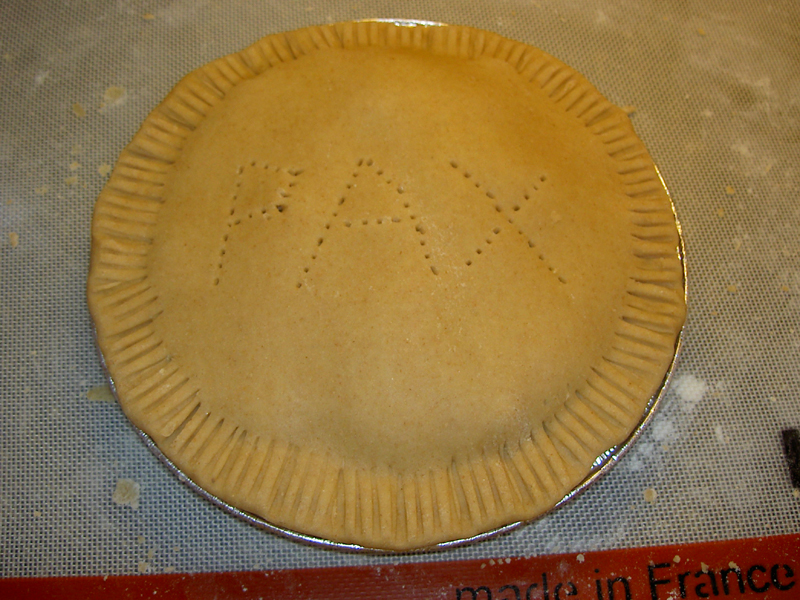
The first pie before it went into the oven (after which it didn’t last long enough for more pictures!).

In preparation for hosting our family Christmas this year, I baked and froze two tourtières for Christmas Eve. Although the pies are the traditional French-Canadian Christmas Eve meal, and I am in fact French-Canadian, I mostly remember them as a feature of my Irish and British grandparents’ celebrations. Which could simply be because that’s usually where we spent Christmas Eve.

At any rate, I grew up with tourtière that included potato (sacre bleu!) and therefore had to do quite a bit of research on the internets in order to find a recipe that suited. In the end, I cobbled together two recipes—a plain version from French Kitchen in America and a ‘pâté à la viande’ with potato from Micheline Mongrain-Dontigny’s website—and tweaked them to my own tastes. Since we had ground venison, I included it and added slightly more garlic and spices to make sure the pies didn’t taste gamy.

Christmas Eve Tourtière (makes 2 pies)

Filling
2 lbs ground pork
1 lb ground venison*
2 large onions, minced
2-4 cloves garlic, minced
2 medium potatoes, peeled
1/2 to 1 c hot water
1/2 tsp dry (ground) mustard
1/2 tsp pepper
1/2 tsp ground clove (optional)
1/2 tsp ground cinnamon (optional)
dash allspice
dash nutmeg
salt to taste
1-2 eggs

*Can be made with all pork.

In a small pot, cover the potatoes with water and boil until soft. Remove from heat and mash coarsely.

In a large skillet or heavy-bottomed pot, brown the meat over medium heat with no oil. Mince the onions and garlic in a food processor, add to the browned meat, and cook over medium heat until soft. Add the mashed potatoes, spices, and enough water to keep everything from sticking and make the consistency that of a thick sauce. Salt to taste and remove from heat.

Cool the filling completely; it may be made ahead and refrigerated 1-2 days. Just before assembling the pies, allow the filling to come to room temperature and mix in at least one egg to help it hold together in the pie.

Crust*
3/4 c white flour
1/2 c white whole wheat flour**
1/2 tsp sugar
1/2 tsp salt
1 stick (8 tbsp) very cold unsalted butter (straight from the freezer is best)
2-4 tbsp ice water

*Four crusts are required for this recipe; I prefer to make them one at a time, as a double recipe is a bit large for my food processor.
**Can be made with all white flour.

In a food processor, combine flour, sugar, and salt and pulse a few times to mix. Cut the cold butter into 1/2 inch cubes, add to the flour mixture, and process until the mixture is coarse contains no butter pieces larger than a pea. Add ice water one tablespoon at a time, processing thoroughly between each addition. After the second or third tablespoon, the dough should appear wet and begin to clump up. Process until the dough is balling up, and then turn out onto a floured surface. Shape the dough into a disc, and then roll out immediately (if the butter and water were not cold enough, the dough may need to firm up in the fridge).

Assembly & Baking
Line two pie tins with crust—I used disposable aluminum ones since I was freezing the pies—and trim the excess dough with a sharp knife. Divide the meat mixture between the two pans, filling the pans to level or slightly mounded in the center. Cover with another crust, trimming the excess crust with a small knife. Seal the pie by turning the edges under, so that the top crust is against the pie plate, and pressing the circumference with a fork. Brush the tops of the pies with egg wash (1 egg beaten with cold water), and cut slits for steam with a sharp knife.

Bake at 350F for 45-60 minutes, until crust is lightly browned and loses its wet appearance and filling is steaming.

To freeze, allow to cool completely. Freeze to hardness on a tray, and then wrap in foil and place each pie in a ziploc bag. To reheat, bake at 350F for 30 minutes and then at 375F for 30-45 minutes, until filling is steaming and a knife inserted into the middle of the pie feels warm.

The end result was very moist (in a good way), although a few eaters voted for less cinnamon. I went with spices because I was concerned about the venison, and in the future I think I’ll make at least one plain pork pie with minimal spicing. Two pies were just enough to get the six of us through Christmas Eve dinner—accompanied by lentil soup, my uncle’s mild chili sauce, our farmer’s Garlic Fire Sauce, and homemade pickled beets—and lunches on Christmas Day, Boxing Day, and the day everyone drove home. Even with the spices, they were good enough that I’m eyeing the remaining ground pork in the freezer and wondering if I can justify making another pork pie with all-butter pâte brisée crust before next Christmas. Probably not.

food : tourtière

food : even more winter canning

I don’t have a picture to share, because I am too lazy to pull all the jars out of the cupboard and clear off the dining room table to take one, but I have even more canning to report! Once the Granny Smith apples came into season, I was able to make the traditional brandied mincemeat that I’d been drooling over in The Ball Complete Book of Home Preserving. We now have eight quarts of it, which should last us a good long while; for one of the batches I used the pear brandy made by the German uncle of my partner’s coworker’s wife. It’s good stuff, but only my father and one of our friends has ever been able to drink a full cordial glass of it, and we suspect that our friend was just being polite. There’s still a bit in the bottle, but there’s more in the mincemeat! At any rate, we should be set on mincemeat for at least a couple of years.

Those apples also went into the Simply In Season chutney, which was the same as last year except I used dried cranberries instead of golden raisins (you’re given a choice in the recipe, I didn’t just make substitutes willy-nilly!). One batch turned out as I remembered it last year, and one batch seemingly spontaneously scorched caramelized so it’s quite a bit darker and thicker. Still good, but not quite as nice-looking in the jar. When I acquired more apples, I also acquired more pears, so I made two batches of pear butter using Elise’s recipe that a friend pointed out to me. I didn’t cook either batch long enough, but the second batch came out slightly darker and thicker than the first. They’re both delicious, just tilted more toward runny and away from sticky.

In addition to the canned products, I used more of the apples to make and freeze three apple pies, one of which we had at Thanksgiving. I used the recipe from the Williams-Sonoma Pie and Tart book that I always do, with just a bit of extra corn starch to help it gel up. The pie baked up well and tasted great, but the crust didn’t survive being frozen and then driven 12 hours in a car. To be fair to the pie, the crust was having some cracking problems even when I was rolling it out, and a large part of the crust looking bad was the apples compressing much more than usual when they cooked (I assume due to the consistency changes from being frozen). So, it had a definite pandowdy ambiance, even more so since it started with a rustic whole wheat flour look. Still good, though; we won’t be throwing the other two in the trash. We still have some apples in the fridge, so there may be more pies coming down the pike.

The last canning I did was a batch of quince jelly. We managed to scrape very few quinces from our yard this year, just enough for two batches of jelly (to contrast, I think I made five or six the first year we learned what they were, and had enough to give some of the fruit away to friends). We may be able to scrape another batch, if we get lucky and the few I have remaining are not rotten at the core. With all the wet weather this year, the fruits that weren’t knocked out of the trees by the high spring winds were largely rotten. Hopefully we’ll have better luck in two years, and maybe even a light year in between.

Besides the jelly, I may can some cranberry-orange relish, but I might also just make it fresh for Christmas. Despite having just acquired many more small jars through the generosity of my parents and grandmother (who I believe thinks I did her the favor!) that will probably be all the canning I do until spring. In the meantime, I have tourtières to make (and freeze) and cookies to bake!

food : even more winter canning

food : summer canning


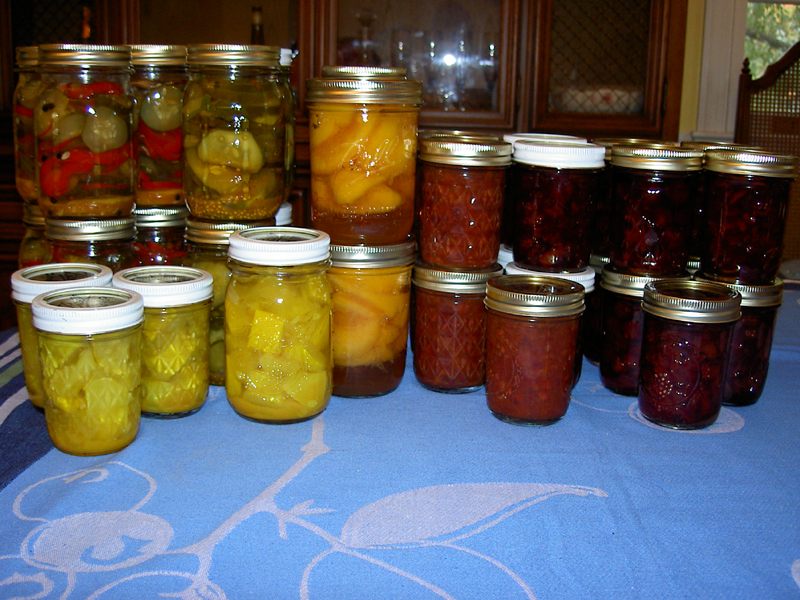
Lemon garlic pickles, spicy bread and butter pickles, brandied peaches, sour cherry-walnut conserve, cherry sauce (with rum), and canned cherries, with pickled summer squash in front.

Now is as good a time as any to report on the canning I did this summer. I had big plans to make cherry jam, or even cherry preserves, however my stubborn refusal to (a) follow a recipe or (b) use pectin landed us only with jars and jars of variations on cherry sauce (something like 13 half-pints in all). I am sure that if we ever make pancakes or eat ice cream it will be delicious, and we have a many year supply now on hand. I did follow a Ball recipe and made 7 half-pints of sour cherry-walnut conserve, which turned out more sour and more grainy than I’d imagined. I’m not sure I like it; I’ll let you know where I stand when we make it through the remaining jars.

Besides the cherry experiments, pickles were my main focus. Using produce from our CSA and the farmers’ market, I made several types of pickles: 7 pints of lemon garlic cucumber pickles, which included sliced red pepper and are canned with a whole garlic clove and lemon slice in each jar; 6 pints of spicy bread and butter pickles, with less sugar and more red pepper flakes than the traditional recipe; 2.5 pints of pickled summer squash, a sweet pickle that’s combined with sliced onions; and 2 quarts of lime-mint cucumber pickles, which are a freezer pickle that I am very much looking forward to thawing this winter. All of the recipes, most of which were from The Joy of Pickling, turned out well; we particularly enjoyed the lemon-garlic pickles, and once I became used to the kick of the bread and butter pickles I ate them regularly on sandwiches. I’m looking forward to using them all (in combination with the pickled beets) for a pickle platter at our holiday party.

Just before we went away on vacation, I also made a batch of brandied peaches using the New York Times recipe. Despite some issues with generating way more liquid than needed, they were delicious and we are hoarding the remaining three pints for the dreary days of winter. We’re forecasted to have a cold wet season here this year, so the alcoholically preserved fruit concoctions should be quite the ticket.

food : summer canning

food : autumn canning


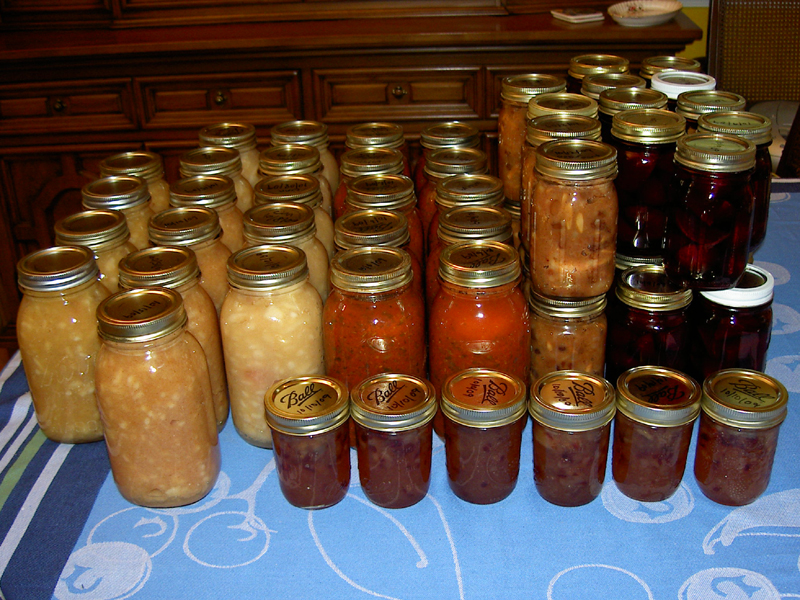
Applesauce, tomato sauce, pear mincemeat, and pickled beets, with spiced pear jam in front.

A couple of weeks ago, we spent an afternoon at Larriland Farm, where we picked our own bags of Stayman apples (48 pounds), beets (20 pounds), and Roma tomatoes (30 pounds). I also bought three smallish pie pumpkins and a box of pear seconds. This last was from Catoctin Mountain Orchard, where we’d hoped to pick apples and were disappointed to discover they were only sold pre-picked from the store (thus the trip over to Larriland). My plan was to turn all of this into canned goods, that we’d eat through the winter while marveling at my foresight and dedication to our tastebuds. Okay, maybe not the last bit, but making the food last a good long time was definitely the plan.

The first day, I made tomato sauce from Barbara Kingsolver’s recipe from Animal, Vegetable, Miracle. The sauce was tasty (we had enough left over for a meal that night), and I have 10 quarts of it to look forward to eating over the next year. I have 10 quarts of it because…well, because the 30 pounds of mostly Roma tomatoes I picked were apparently much denser than the 30 pounds of tomatoes she calls for in her recipe. So I had two big pots of sauce simmering down, which were then combined into one big pot, which was then augmented with another 1/2 recipe of spices, and finally simmered down to 10 quarts. It’s not only that my 30 pounds was more voluminous than her 30 pounds, it was also that I puréed the tomatoes by putting them fresh into a food processor, not by cooking them and straining them and then putting them into a food processor. So whatever liquid was in the tomatoes was in the pot waiting to be cooked off. Nothing I’ve read says that the way I did it was wrong, and I still had a half recipe more than projected, so I’m thinking the larger factor was having all Roma tomatoes. At any rate, come on over for pasta!

After the tomatoes were dealt with, I proceeded on to beets. Over the course of the next three days, the 20 pounds of beets became 19 pints of pickled beets (technically 21 pints, as two went into the fridge and we ate it right away). While this works out to about one pound per pint, the recipe was in cups of sliced beets so it was a bit…exciting…to figure out how many were needed for each batch. In the end, I just boiled pots of beets, skinned them in cool water (much easier than peaches, or tomatoes for that matter), and stored them in the fridge until they could be sliced and pickled in 10 cup increments. I used the Ball Complete Book of Home Preserving recipe, and had to double the amount of liquid to fill the five pint jars per batch. (I found that if I stored the extra beets and liquid from the first batch, and added them to the pot at the end of the second batch, two batches made 11 pints.) Don’t ask me why; maybe my pot had too much surface area, maybe I boiled it too vigorously for too long. Whatever the reason, I needed more liquid (which is how we ended up with 2 pints in the fridge in the first round). Before I started I considered making a variety of flavors of pickled beets, but in the end I stuck with the regular kind, figuring that everyone knows and likes the familiar taste so why mess around with it. So, come on over for pickled beets!

The other major effort was turning the apples into applesauce. These Stayman weren’t particularly great, sort of mushy and not as tart as I remember from previous years, so my plan was to combine them with a few Empire apples (from my market friends at Harris Orchards) and make them all into sauce. About 12 pounds of apples goes into four quarts, and with the combination of the two kinds I had plenty for four batches with some left over. I started off following the Ball recipe, but quickly abandoned it as it uses far more sugar than I like. (It also calls for a tablespoon of lemon juice for each quart; I forgot to add it for one batch, which led us to do some research and learn that the USDA does not require lemon juice for canning apples, as all apples on the market are acidic enough to safely can using the water bath method. I still added the lemon juice to the last batch, but don’t worry if the recipe you have doesn’t include it or you forget.) The first batch I made with half the amount of sugar and some cinnamon, and it came out way too sweet (I’m sure my partner will slurp it up like the candy it is). The second batch I made with only 1/2 cup of sugar, the way I like it, and the third I made with more cinnamon (2 teaspoons) and 1 cup of sugar (which still made it a very sweet dessert sauce). The last batch was back to the 1/2 cup, and the apples were old enough by that point that even the added lemon juice couldn’t keep them from browning up quickly. It still tastes fine, but doesn’t look as nice in the jar (which destines it for early consumption). Now that the sauce is out of the way, I’m looking forward to another round of tart apples (such as Granny Smith and Braeburn) to make into other things, like chutney and mincemeat.

Speaking of mincemeat, that’s what I made from the pears. Two kinds of mincemeat (one with rum and currants, and one with port and regular raisins) both from the Ball book. The pears were overripe and very juicy, so I’m not sure that the consistency is quite right on the mincemeat, but they both tasted delicious (if a bit overly sweet; for a person with a sweet tooth, I seem to be at the low-sugar end of the range). I’m sure they’ll be a hit at Christmas, and their beef-free status makes them worth their weight in dried fruit. These two recipes were also by volume (10 cups of chopped pears each) rather than weight, and I neglected to weigh the fruit ahead of time, so I don’t actually know what we acquired for our six dollars. Enough to make 8 pints of mincemeat and another 7 half-pints of jam. The jam was the first attempt at using pectin, and I have mixed feelings about it. On the one hand, the jam gelled up beautifully. On the other hand, the jam seems cloyingly sweet to me, although that’s somewhat cut when it’s actually on toast and not just being taste-tested from a spoon. It’s a nice recipe, though, with cinnamon and dried cranberries for a bit of a spicy-tart undercurrent. Of course, as soon as I’d used all the pears this way, a friend pointed out that Elise put up a pear butter recipe at Simply Recipes, so I’m tempted to get another box of pears and make pear butter next week. The downside is that it involves cooking the pears then putting them through the food mill, a process that I generally dislike. The upside is that it looks delicious!

Now, I just need to cook, purée, and freeze the pie pumpkins and the kitchen dining room will be cleared and ready for the next round of apples. Just as soon as I find a place to store all the filled jars.
food : autumn canning