Dark Days : season of peppers


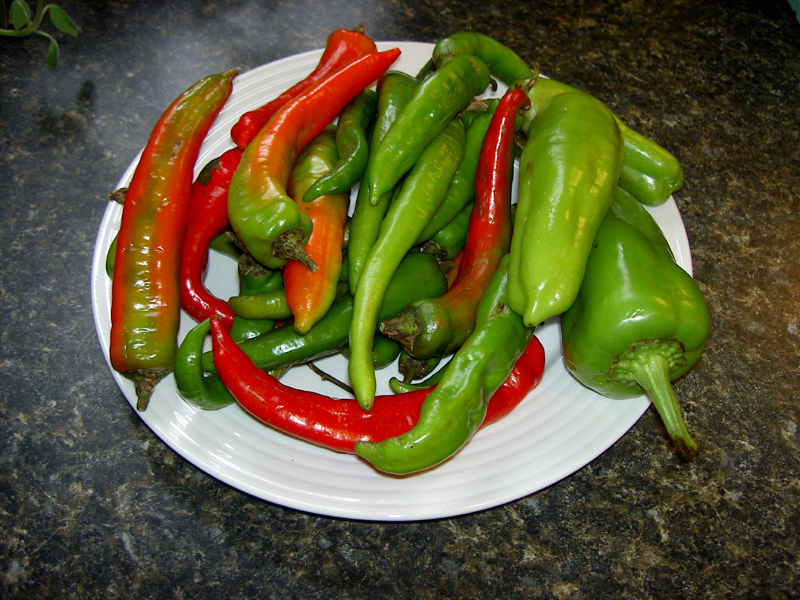
Peppers! The last vestiges of summer, Italian sweet peppers and Cubanelles.


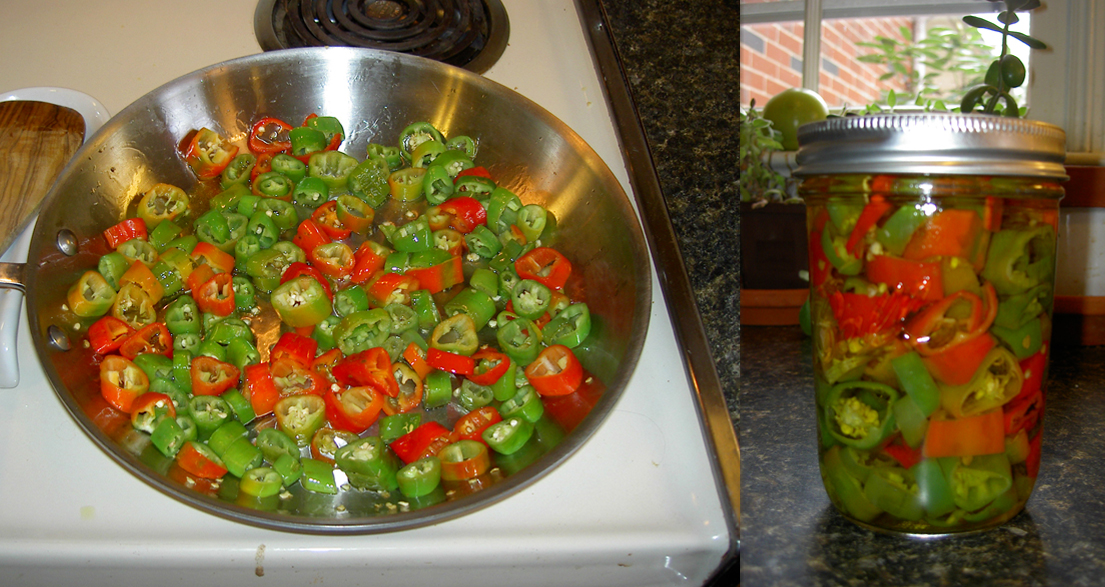
Italian sweet peppers, sautéed and covered in oil (for the fridge).

With both our winter and summer CSAs, I have been most challenged by the abundance of peppers. Bell peppers are manageable, as we generally just slice and eat them raw or include them in ratatouille. It’s the hot peppers and the less common sweet peppers that pose a challenge. Some of them we sauté and pack in oil to be used in making pepper rice; sadly, most of last year’s batch languished in the fridge and had to be thrown out after we just didn’t cook as consistently through the winter. Others, like jalepeños, we struggle to use in even small quantities let alone in the volume that we receive in from the farmers; most years they go into the chutney and not much else.

This year we worked hard to use what we got, which required us to add to our recipe roster. To use up the jalepeños, I made two large batches of corn salad (which also used up a couple dozen ears of corn as well as onions and tomatoes) and one batch of tomatillo salsa (which was tasty, but more than we could handle in the time period before the fresh salsa went off; it did mark the first time we successfully used our tomatillos, though). The corn salad was delicious, and we’ll definitely make that in any future years when the corn is flooding in. In the end, we had more jalepeños than we could use and I donated some back into the CSA swap box. The green chilies were a big hit, though: we received Anaheim peppers for the first time, and learned that they are the green chili beloved by those who love green chili sauce. A little online research provided us with the preferred skinning method (place in a plastic bag to cool after roasting; the steam will loosen the skin) and we were able to make use of them. We made chicken in a tomatillo sauce twice, channa masala once, and I made my first batch ever of green chili cornbread. The cornbread was probably quite a bit hotter than it was meant to be since I used both rice milk and tofu sour cream: the fat from the dairy products was therefore only present in the cheese. I loved it, though, and we shared a pan for dinner one night.

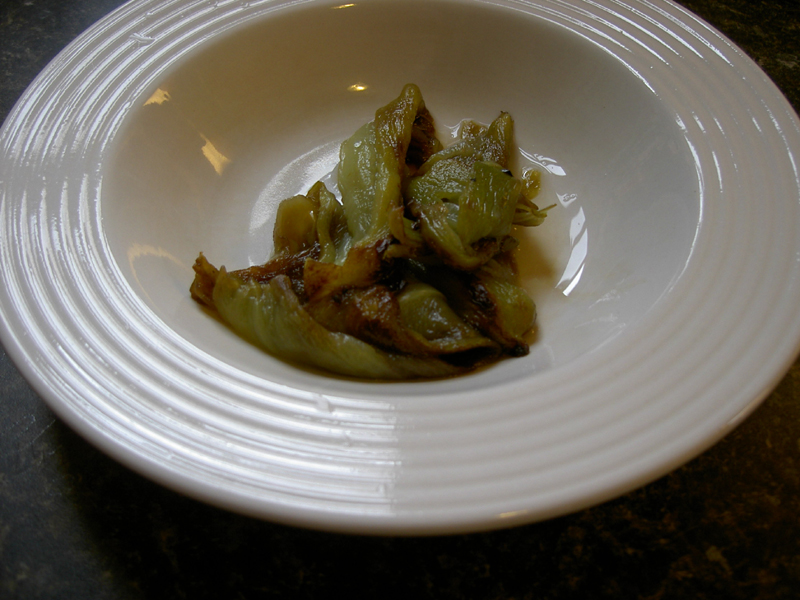
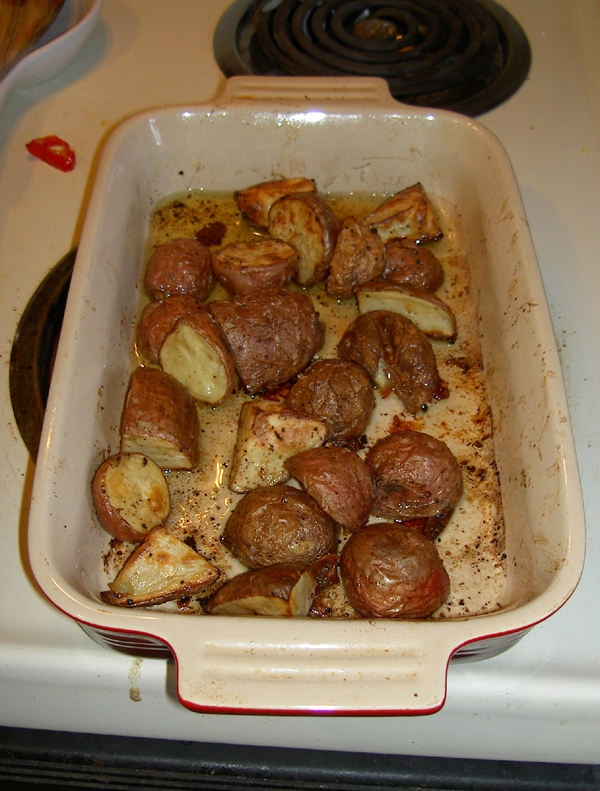
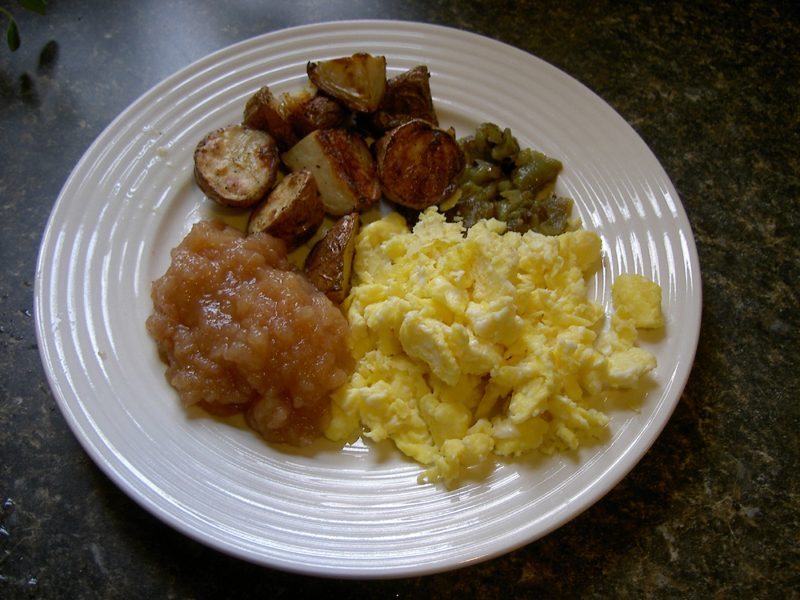
Kicking off the Dark Days Challenge this week, I still had peppers in the fridge. We were looking at a large bag of Italian sweet peppers and about a half dozen Cubanelles. For the Italian sweets, I fell back on last year’s plan (sauté and pack in oil in the fridge) with a resolution to actually use them this year. I incorporated the Cubanelles into the meal for Week 1 of the challenge: scrambled eggs with roasted Cubanelle purée and roasted potatoes. Yes, it’s a breakfast meal, but we had it for lunch. We sourced the food as follows: organic eggs from a Pennsylvania farm via our local organic market; Cubanelle peppers from our summer CSA and Thanksgiving Farm via the Greenbelt farmers’ market; red potatoes from our summer CSA; seasoned salt from last year’s winter CSA; and last year’s home-canned applesauce with apples from Larriland Farm. Roast peppers, peel and chop coarsely (I didn’t actually bother to purée them); dice potatoes, toss in olive oil and seasoned salt, roast at 425F for 40 minutes, stirring halfway through; and scramble the eggs. Serve and eat!


Roasted peppers.


Roasted potatoes.


Lunch: scrambled eggs, roasted Cubanelles, roasted potatoes, and applesauce.

Dark Days : season of peppers

food : Dark Days Challenge

What better way to kick off the month of December than join in a local food challenge! It’s dark, it’s cold, the growing season is over, right? Wrong! At least, not completely so. Thanks to Even’Star Farm‘s commitment to year-round farming, we receive a CSA through the winter. It consists of cooking greens, salad greens, and root vegetables (turnips, rutabaga, sweet potatoes, and radishes). As a result, we are cooking with local foods all through the winter; historically, the challenge has not been finding the food but rather finding new recipes to make that take us beyond our beans-and-greens rut.

For the purposes of the Dark Days Challenge, I am going to work on minimizing the non-local ingredients used in my cooking. The challenge is not only to use local food, it’s to keep as many ingredients as what the originator refers to as SOLE: sustainable, organic, local, and ethical. In this framework, the staples I buy that can’t be (easily) sourced locally fit the bill. Our organic oils are from Spectrum; I am particularly committed to their canola oil, in an effort to push back against the GMO-rapeseed that has become dominant in the United States. Sugar is certified fair-trade and organic, supplied by Wholesome Sweeteners; cocoa and coffee are also certified fair-trade and organic, from Equal Exchange. Organic spices are from Frontier, a member cooperative; butter is from Organic Valley, a regional farmers’ cooperative (milk, eggs, and cheese are from specific local farmers). Organic flour is from King Arthur, a regional company if you count Vermont as at all local to DC (I don’t necessarily, but still value East Coast products over West Coast ones); Bob’s Red Mill is another option for a (now) worker-owned company.

To supplement the vegetables in our CSA, I’ll visit the year-round farmers market in Takoma Park and shop the local items at My Organic Market (typically from Pennsylvania, from many of the same farms who supply our summer CSA). Already I know that I want to make a sweet potato pie, and am hoping that my favorite made-in-Philadelphia gingersnaps qualify as “local” for the purposes of the crust. Truly, with a new little person in the house, I don’t have the time or energy to go searching out more local sources for flour and grains and the like. For me, this challenge is about making the most of what we have readily available to us in the winter and instituting some regularity in blogging about it. For inspiration, I can always turn to recipes tried out by those who’ve done this before.

To start us off, I’ve compiled a list of the produce we already have on hand in the house:

  • sweet potatoes (orange, cream, and Japanese purple)
  • shallot, garlic, and onions
  • green tomatoes
  • Italian sweet peppers and Cubanelle peppers
  • potatoes (red and white)
  • squash (butternut and acorn)
  • greens (arugula, Chinese thick-stem mustard, salad mix, stir-fry mix, and parsley [more of them were destined for the composter than I realized])
  • turnips, carrots, and radishes
  • apples (Pink Lady, Gala, and Stayman)
  • mushrooms (cremini and shitake)
  • cranberries
  • lemons (organic, but not local)
  • pumpkin and squash puree [frozen]
  • persimmon puree [frozen]
  • tomato puree and juice [frozen]
  • chopped kale [frozen]
  • blueberries, cherries, rhubarb, and peaches [frozen]

There are probably things I’m forgetting, and we’re getting more tomorrow (our last summer delivery) and Thursday (our regular winter delivery). But that will do to get started.

food : Dark Days Challenge

food : apple time is here again

As in previous years, I could not resist the allure of apples in season. In deference to my dramatically diminished ability to process and can, we only picked sixty pounds of apples rather than the hundred-plus pounds that we typically bring home from Larriland Farm. Sadly, this was not a good year for local apples, and we weren’t able to get any Granny Smiths. Truthfully, we were only able to pick Pink Ladies and ended up buying some Stayman from the stand to complement the flavors (in order to follow the rule of always using at least two kinds of apples in any recipe). We still ended up with a fair number of apples, as we receive a bag of assorted eating varieties each week from the fruit share portion of our CSA.

What I usually do with all these apples is can a couple of batches each of sauce and chutney. This year, though, we don’t need sauce as we’re still working our way through a half dozen quarts from last autumn, and I don’t have the time to make chutney, what with all the chopping and stirring that entails. Instead, I’m making pies and muffins for the freezer and crisps for us to eat. We probably don’t need such a steady infusion of baked sugary goodness in our sleep-deprived state…oh, wait, of course we do! I plan to make a cake or two, possibly also for the freezer, but the big addition to the apple roster this year was apple butter. I used my crock pot for only the third time in ten years to slow cook the apple butter, which made it super easy to deal with. The canning is not onerous, now that we have all the supplies and have been through the routine dozens of times. With the slow cooker it’s not necessary to stir the pot constantly to keep it from scorching, and we set it up to cook overnight. I did end up letting it cook with the top off for an additional two hours, as it was still pretty runny in the morning. It’s delicious; I’ve been having it on toast and will probably make another batch this week. Once that’s done, the rest of the apples will be for eating; the beauty of the Pink Ladies is that they keep in the fridge forever and provide something fresh for my partner’s bag lunches for most of the winter.

As an aside, the chutney recipe I use is from one of my favorite cookbooks, Simply In Season. When I went looking for it online, I came across a person who spent last year cooking all the recipes in the book. She blogged about it , and it’s fun to read through and see how recipes I’ve made or thought of making turned out for her. I have to say, it’s also nice to see one of these make-everything-in-a-cookbook-in-a-year blogs that uses a regular cookbook rather than a coffee table book from a gourmet restaurant. Not that there’s anything wrong with those, they’re just not ever going to be what I use in my kitchen.

food : apple time is here again

food : the surprising hostility toward organics

Maybe it’s just parenting forums, or maybe it’s just the DC area, but I continue to be surprised by the hostility and derision directed toward people who make it a priority to buy organic food. (I won’t even get into the purchase of other organic products, like toiletries or linens.) I understand that the cost of organic food makes it difficult to directly substitute for conventional food; making that kind of shift in a fixed budget requires making different choices and taking out entire categories of food (for us it’s been packaged food and eating out, for example). The critics aren’t usually (only) focused on the logistics or the financial challenges, though: there’s a way in which the entire commitment to organic food is suspect. Now, maybe this is just the contempt of the majority for the minority, since organic food still makes up only a small percentage of the food sold and consumed in this country. But there’s a component of the judgment that’s puzzling to me, that suggests that people who buy organic food are stupid: they’re getting suckered into paying more for something of lower value (or at least not of a greater value commensurate with the increased price).

Certainly, some of the price of organic food must be driven by demand in some parts of the country where more people want more organic food than is available. I am willing to accept that premise. I don’t believe, though, that most of the basis for the price is inflation based on scarcity; there just isn’t enough demand on a scale that would make such an approach generally profitable. Now, I know that some organic dairy farmers have chosen to “dump” their organic milk in the conventional market in order to keep the price of labeled organic milk at a certain level, but I don’t (personally) believe that’s a choice driven by greed. Instead, I understand that to be a move that’s necessary if the farmers want to have the price of milk stay at a level that allows them to stay in business, in the face of competition with large factory farmers like the ones who supply Horizon milk. If large commercial farms were taken out of the equation, by the government enforcing the pasture requirement differently (for example), small organic dairies would have no need to take artificial measures to keep the price of milk high because demand would naturally compensate (milk being one of the most desired organic products these days).

To bring this back to my original point, it seems that people perceive organic food to have an artificially high price point. All the public awareness and information campaigns that have been undertaken have failed to convince these folks that conventional food is artificially cheap due to subsidies and questionable labor practices. Which brings me to the crux of why I am committed to organic food: I grew up in farmland, and I am not interested in having my money go to people who exploit farm workers through low wages and insecure jobs, or to people who endanger the lives of those workers and their families through the injudicious use of pesticides and herbicides. I am even less interested in having the people who make and sell those pesticides and herbicides profit from my food choices. I hardly ever see these arguments about organic food being made, though, and it’s probably because we can never know for sure that farm workers aren’t being exploited (which is why I don’t believe agricultural workers should be exempted from the federal right to unionize nor from the minimum wage laws, but that’s a whole different discussion for another day). We can and do know that the chemicals used in conventional and industrial farming don’t just poison the water systems, they make people sick. And I don’t mean the people who eat the food, I mean the people who plant, weed, harvest, and process it.

This last issue seems to be at the root of another element of the contempt for a commitment to organic food: there’s little evidence that the food is better for the consumer, and most people take a narrow view of what their own interests are. Yes, there are not many studies that support a higher nutrition value of organic produce, but there are increasingly many that suggest negative outcomes from the consumption of pesticides. Still, there are foods that don’t retain as many pesticides as others, and people seem happy to save their money for the worst offenders. The same rationale applies to genetically-modified organisms: there’s little evidence that they are dangerous to our health. The knowledge that they are made and sold by the pesticide companies, or that they are contaminating traditional crops and thereby further limiting the diversity of our food supply, does not factor into people’s consumption choices. Because there’s little evidence to justify buying organic solely on the basis of an immediate physical benefit to the consumer, a person has to take a larger view of what’s in their own interest. You have to believe that it’s in your interest to protect the health of other people’s families, to protect biodiversity, and to minimize the application of chemicals, even when they’re not being applied in your region. You also have to believe that all of those things are worth paying more for what appears to be the same stuff: organic food is not easily identified in and of itself, and is invariably more expensive if you are substituting products one for one in your family’s eating plan.

So, I get that people might not care enough about these things to spend money on them and might simply choose not to buy organic food. What I don’t get is why there’s so much hostility directed at those who do. Now, it may be that folks are just afflicted with the inability to see another person’s divergent behavior as anything other than an attack on them and what they’ve chosen to do in their own lives. I certainly know more than a few people like this, and go out of my way not to engage them in conversation about anything personal. This is what I thought was going on, but lately I have been thinking it has more to do with money. If organic food costs more, to buy it you either have to have more money or stop buying something else. In either case, it becomes just another consumer item that can signal status. Of course, it can only signal status is people know you’re buying it, and unlike your gold Lexus SUV, it’s not something that is immediately obvious. So, if you are buying organic food as a status marker, you would have to let people know by talking about it. Which would be annoying, just as annoying as the person who talks about the thread count of their sheets that they had to have imported from France (or wherever) because otherwise how the hell would you know to be impressed with what they were sleeping on. That kind of talking about organic food would get annoying, so I could see how listeners would become hostile. I could also see how you would think it was a stupid thing to spend money on, if your goal were to gain status, since not only do you have to talk about it all the time but you eat it and then it’s gone. If I had limited funds and were concerned about signaling status, I’d probably get a flashy car and a recognizable handbag, too.

After all this circular talking, we seem to have arrived at: some people care about the practices behind organic food to buy it regardless of price and some people only buy organic food because of what they think the price says about how much money they have. Apparently I only know people in the first category, aka hippies, because I’ve never heard someone put forward their consumption of organic food as a way to impress me (or someone else impressive who might also be listening).
food : the surprising hostility toward organics

breaking the long silence

Things, as we know, don’t always go as planned. The big news around these parts is that I’m pregnant, expecting a baby in October. That’s not the unplanned element; the unplanned part was the way in which this situation (and all the accompanying ailments, small and large) coincided with a terribly hot spring that has continued into into a miserably hot summer. As a result, I’ve done very little over the past few months in the way of the sorts of things I normally write about here: cooking, hiking, gardening, birding, et cetera. Since I don’t plan to turn this into a parenting chronicle, I’ve been silent.

All of my plans for the garden have fallen by the wayside: it’s hanging in there (thank you, drought-tolerant natives), but we’ve done little to encourage or develop it. The rose for which I had such high hopes (and for which I bought the pyramid trellis, about which I never blogged because I was absorbed with other things) has turned out to be only a sprout of the stock variety, not the vigorous New Dawn climber we were expecting. So, we’re going to uproot it and move the Blaze climber from the backyard to the trellis this autumn, after adding more compost to the soil over the course of the summer. It won’t be as striking as the pale rose would be, but it should be nice enough. I had great plans to use the excavated dirt from the dry well that was installed as part of the completed basement project (another event I planned to write about this spring but never did) to grade the side of the house where the worst water problems recur, but we haven’t gotten around to that and now it’s just too hot and dry to undertake a project of that nature. On the positive side (hah!) the two little struggling azaleas in that spot totally gave up the ghost this past month, so that’s fewer plants we’d have to worry about relocating. In all seriousness, we just haven’t had the mental or physical energy to make a plan for a new garden on that side of the house, dig up the turf, move the plants at the side of the house, layer the dirt, and then reseed or replant or do whatever it is that we’ll do for which we don’t yet have a plan. I’m not sure what that means for the future of the pile of dirt, but it does mean that the side of the house will be grass that slopes toward our house for one more year.

On the food front, we’re trying a new farm share this summer, through Lancaster Farm Fresh Cooperative (LFFC). We’ve generally loved subscribing to Even’Star Organic Farm (and hope to be allowed back into the winter share), so the choice to try something new in the summer was a tough one. We were swayed by a few factors: LFFC is farther north, and I hoped that would mean that we might see more of the crops that Brett struggles to grow organically in the local heat and humidity; they offer a half share which we thought might be more manageable, especially as my interest and energy for cooking has waned these past months (more on that momentarily); and we were able to also purchase a fruit share, which I again hoped would be less pesticide-laden than what I can get from local farms due to the difference in location and climate. So far, the variety has been different (made possible in part by having a number of farms as suppliers) and the volume has been similar to that of our full share; not quite what we expected! The fruit shares start this week, and I’m greatly looking forward to that; I’m hoping to see an overall cost savings in our budget as fruit is something that we normally purchase at the markets all through the summer. In terms of keeping up with the cooking, I’ve had more energy the past month or so, but my partner picked up the slack for the first six months of the year, and it wasn’t always pretty. We created very high-quality compost with the greens that just got away from us at times, and it took us a while to get back into a rhythm. We’ve been doing well lately, although meals have consisted largely of turkey burger (or chicken sausage) plus cooked vegetable plus raw vegetable plus lettuce (which I think we’ve probably seen the last of in this regional heat wave). Healthy, yes, but not particularly creative. At the moment, we have a stockpile of several varieties of sweet(ish) onions and many zucchini. We’re working our way through the zucchini (sautéed each night and made into muffins at least once a week), have a couple of eggplants waiting to be made into baba ghanoush, and I plan to make onion relish this week (tomorrow, if I can get organized early enough in the day). So far it’s early enough in the season that plain sliced cucumbers and tomatoes are still refreshing; soon we’ll likely need dressing and herbs and a variety of other flavors to spice them up. And, with the acquisition of our new chest freezer (another exciting event that went totally unremarked upon), we’ve frozen almost all the bunches of kale we’ve gotten this summer and will deal with them at some point in the future. Likely they’ll find their way into soup or lasagna or something else that can be prepared, frozen, and then reheated in the fall when we’re definitely going to be struggling to find time to eat, let alone cook.

With regard to the rest of the house, we’ve been working like mad people to create space for another human being. That’s entailed putting everything back into the basement post-repair and moving everything out of the shared office (into the attic, basement, or family room), which leaves us with a family room that is going to need some rearranging and redoing. It has also left us with an empty room, however; my partner has painted and installed a new light fixture, and we’re working on the next step of acquiring furniture and blinds (while the paper blinds from Home Depot have worked fine for us in the upstairs for four years now, I figure this is a good excuse to start getting real ones installed). We have been blessed with generous friends and bountiful thrift stores, so we are fairly well-stocked in the baby clothes department, at least in the sizes up to three months. Getting a dresser into the room will go a long way toward clearing some of the clutter in other parts of the house, where stacks of minuscule outfits are accumulating. Getting the bed will go a long way toward me not wondering where the heck we’re going to put an actual baby. At any rate, at the end of this preparatory process we hope to have new fans, working smoke detectors, and a much more organized house (out of necessity more than anything else; we’re not living in the largest space over here, although the family room addition goes a long way toward improving that).

Now that I’m simultaneously more energetic and stuck mostly inside because of the heat and smog, I expect to have at least a few more updates before the end of the summer. I may even fill you in on what we accomplished this spring, but don’t hold your breath.

breaking the long silence