Boordy Vineyards Wine & Herb Festival

Last Saturday we drove up to Boordy Vineyards, north of Baltimore, for their annual wine and herb festival. I was imagining something ‘a little more California,’ as my friend’s mother would say: linen trousers, platters of complimentary artisanal cheeses with crusty bread, and music wafting on the breeze. It was not like that. What it was like was paying an entrance fee for the opportunity to spend more money, a construct that I’ve never really found appealing.

Although it’s not something I would have attended had I known what I was getting, the festival as structured was fine. There was a live band, a dance floor, and a varied selection of local products available for sale. However, besides bringing in the additional vendors and the music, Boordy didn’t provide anything that couldn’t be had by visiting the vineyard during regular hours. There were no special rates and no complimentary drinks or food beyond the usual 1/2 ounce tastes of their regular products. This was the largest digression from what I’d imagined we were attending; for the $12 dollar entrance fee, I expected more than I could have gotten at any of the free Taste of [fill-in-the-blank-with-your-favorite-city] events I’ve attended over the years.

The major disappointment of our visit, however, was the discovery that most of their wines were just plain bad. I’ve had their Riesling several times and enjoyed it; my mistake was assuming that a Riesling would be on the lower end of what they had to offer. Quite the opposite: the Riesling is by far their nicest (i.e. most authentic) selection. Granted, this was the first time I’d gone to a tasting of Maryland wines, and it probably shouldn’t have been surprising that the flavor and body were so consistently what I can only describe as young. I imagine this is an artifact of growing grapes in this climate, but I was still taken aback by how unappealing I found them. They were no competition for New York or New Jersey wines, let alone even moderate choices from California or Oregon vineyards. I suppose that people who enjoy California wines and don’t have expectations based on the French originals might find these local cabernets and pinots palatable; I certainly did not.

Another element that I wasn’t prepared for was the prevalence of flavored fruit wines. When did coolers in a wine bottle become something consumed by anybody over the age of 20? I truly did not consider myself a wine snob before this weekend, but either the norms have changed dramatically in the past decade or my tastes have matured much more than I realized, because I was kind of appalled to see what people were drinking by the case and pronouncing excellent. I’m no stranger to fruit wines: Michigan produces lovely cherry wines, I’ve had delicious blueberry wines in Ontario and New Jersey, and my aunt bottles a refreshing peach flavored wine at her local DIY shop that’s perfect for a summer evening. I guess that’s the problem: I didn’t expect to find flavored wines worse than what my family can make on their own being touted at the local vineyard.

The upshot is that the wines were really not worth the trip, and it’s good to know what to avoid in the future. We did come home with several herbs for our garden — rosemary, ‘Italian oregano,’ and mint julep — courtesy of Putnam Hill Nursery, and two new honey selections — cranberry and blueberry — from the folks at Bees on the Bay. So, the trip wasn’t a total wash, and now we know.
Boordy Vineyards Wine & Herb Festival

Even’ Star Organic Farm party


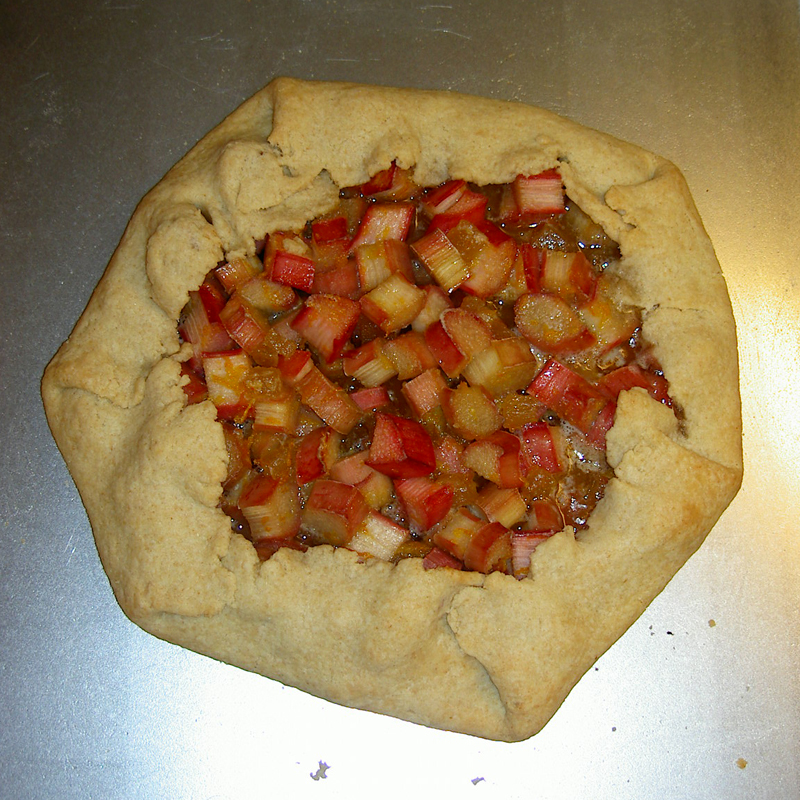
Rhubarb Ginger Galette, round two.

We celebrated Memorial Day by attending a party at ‘our’ farm: Even’ Star Organic Farm, where we’re members of the CSA. We’d had a fun time at the autumn party and enjoyed the drive down, which included stopping on the way for pumpkins and honey at a farm stand in Dunkirk. This time we drove straight through, and arrived for a gorgeous afternoon.

Having taken the farm tour last autumn, we opted for eating the delicious food, drinking the tasty Weiss beer, and lounging around. My contribution to the desserts was a Rhubarb Ginger Galette with a half-whole-wheat crust; it was meant to be all whole wheat, but I mistook the bags of flour and dumped the remaining white flour into the bin by mistake. I was glad that I had planned to make and bring two galettes, as that meant I already had a backup plan in place when the first one wasn’t ready for prime time: I forgot to strain out the excess liquid from the fruit and inadvertently omitted the butter that would have thickened the filling, which combined with a small tear in the crust to create a gooey puddle around one half of the pan. This first round also helped make clear that the galette needed to cool on the sheet; once we’d let it cool that way overnight it slid off onto a board without a problem. Probably the French have some large flat galette-removing spatula-type implement, but I certainly don’t.

Having an afternoon party meant no bonfire, but it did mean that we could explore the woods a bit more. Once we’d eaten, we trooped off in search of new birds. As promised, we sighted several Indigo Buntings in the fallow fields near the house. Buntings, like bluebirds, are common in the right habitat in this region, but I’d yet to see one. I still haven’t gotten over the surprise of seeing such blue birds, so it was a thrill to see them popping up over the grasses. On the drive in we’d seen a true Black Vulture in a group that was devouring something on the grassy median of the road. It was unmistakable with its deep black plumage, gray face and white beak, and it was a thrill to get such a good look at it on the ground after years of peering into the skies hoping not to see the flash of red on the faces of what always turned out to be Turkey Vultures. In addition to those long sought after life birds, we lucked out and spotted a mature Bald Eagle circling over the treeline. It was only the second time I’ve seen an eagle in adult plumage, and the first for my partner, so that was a great treat. No trip to a farm is complete for me without sighting a few amphibians, and the best part of the day was seeing a juvenile salamander that the kids had collected from the stream. The frogs and tadpoles were lovely, of course, but the little guy with gills still on was particularly nice.

On the way back home we stopped to check on Solomon’s Island Winery, which is quite small and run by a couple basically out of their home. The property is smaller than my family’s blueberry farm, which means that it would be virtually impossible for them to grow their own grapes. The wines were largely low alcohol fruit-flavored varieties—coolers in a bottle seem to be a popular item in Maryland—with only a couple of serious labels. The Meritage was decent and tasted like a Bordeaux, as advertised. The Icewine was also a fine dessert wine; we bought a bottle, and it made me regret not tasting the Eisling when we were at Boordy Vineyards earlier in the weekend. Overall, though, I would recommend sticking with wines by actual vineyards, from regions where the terrain is more suitable to growing grapes.

Having fulfilled our farm-related duties for the season—sent in our check, attended the party—we now sit back and let the food come to us. Not too shabby!

Even’ Star Organic Farm party

The New York Times promotes vegetarianism at long last

I found it highly amusing to open The New York Times this weekend—okay, to browse the ‘Week In Review’ online—and discover an article enumerating the reasons not to eat meat.

I don’t have any disagreement with the content, neither on grounds of data nor ethics. My amusement stems from the simple fact that these reasons are the same ones that led me, and many of my friends, to stop eating meat 17 years ago as teenagers. The negatives of meat consumption haven’t changed; if anything they’ve become more widespread in the United States since 1990. Ill animals crowded together on mounds of their own waste; land and water resources used to grow grain for animals rather than people; huge amounts of fertilizer and—let’s just call it what it is—poop running off and leaching into water systems. Back then, the factoids—’about two to five times more grain is required to produce the same amount of calories through livestock as through direct grain consumption,’ for example—were distributed in photocopied zine-like publications hand to hand; they were what we brandished to explain and justify our choices to those around us who didn’t understand the lure of going vegetarian.

Oops, did I say vegetarian? Silly me! The New York Times managed to run an entire article about the general benefits of vegetarianism—that is what not eating meat is, right?—without ever printing the dirty word, and there I go busting it out in the second paragraph. Well, not quite never: the article’s author takes pains to clarify that he is not one, despite having published a vegetarian cookbook. Which I’d think would make some readers question his authority on the subject of vegetarian cooking, but that’s neither here nor there. My point: it seems odd that an entire article lauding the virtues of meat-free eating would shun the term used to describe such a dietary choice.

It could be that Bittman is simply being exacting in his terminology: if one doesn’t give up meat entirely, then one is not technically a vegetarian. The inverse of this truism—if one is a vegetarian, one also doesn’t eat the less attractive animals like clams—is something all of us have had to explain at one point or another to a well-meaning (and frequently elderly) relative, so it’s possible. It’s possible, but its seems—to my jaundiced sociological eye—that something more is going on here. It may be becoming more hip and classy to eat less meat, but it is just as un-hip as ever to identify as a vegetarian outside of certain established subcultures. We seem to be moving away from a definition rooted in the core ethical foundation for vegetarian choices, and toward one focused on a minute tally of each eating decision. In this framework, nothing less than perfection is ‘allowed’ to label itself vegetarianism, and every imperfect manifestation is open to being lambasted as hypocritical (‘how can you refuse to buy CAFO beef when I just saw you eat that salmon?’). In this way, vegetarian becomes a dirty word, code for a judgmental snob at best and a snarking hypocrite at worst, a label that no normal person in their right mind would willingly take on.

The truth is, though, that vegetarian—like organic—is a word that reflects a multi-faceted philosophy of interaction with the natural world. It encompasses systematic beliefs about resource management, human labor, compassion in life and death, moderated consumption, and respect for the balance inherent in natural processes. Any particular conviction will be of differing priority for each person, but the collective manifestations of holding them are similar and recognizable. They are, generally speaking, visible to an outside observer as the choices recommended by Bittman in The New York Times. Eat less meat, as little as you’re willing to. Buy meat and other animal products from people who have raised and killed the animals humanely, cleanly, healthily, and with minimal impact on the surrounding environment. Don’t waste a lot of other natural resources getting that food to your table. Eat things that improve your own general health, such as fresh vegetables, legumes, and whole fruit.

It would be accurate to say that I am a vegetarian and I eat meat. Fifteen years ago I wouldn’t have been comfortable enough with my dietary choices to be able to say that, nor would it have been accurate; my consumption of animal flesh back then would have been completely accidental. Over the past decade my choices have changed, though, and I’ve slowly incorporated more meat into my eating. Some of the times I’ve eaten meat in the past decade have stemmed from my inability to resist a slice of mouth-watering pepperoni pizza. Most of them, however, have been the result of more purposeful and systematic choices. My ethics and beliefs have never wavered, and the actions they recommend remain the same. However, in the intervening years since I first swore off animal flesh, I’ve gained additional information about my own physiology that has led me to reconsider certain choices.

I still don’t eat beef or pork (pepperoni lapses aside), because I believe the consumption of resources necessary to raise the animals and their generally poor quality of life to be too great a cost for me to be willing to pay. I make a different evaluation about various types of wild fish and chickens raised by my local organic farmer. I choose not to eat soy in order not to exacerbate the symptoms of my thyroid disease, a choice which dramatically limits the prepared vegetarian foods available to me in the United States. I make similar choices regarding where I get our eggs (our farmer) and milk (the Organic Valley cooperative). All of these are within the context of a web of interrelated considerations related to global economics, environmental impact, labor, and animal welfare.

The end result is that every day—ethically, philosophically, and politically—I am still a vegetarian. And, a couple of days a week as an eater, I am not.

The New York Times promotes vegetarianism at long last

nog: the original protein shake

I love egg nog. I always have. I remember my grandfather making it fresh, blending an individual serving out of milk, eggs, and sugar. As a child I was, of course, prohibited from drinking my grandfather’s egg nog, out of fear of salmonella poisoning. Which was probably a smart thing. Being prohibited didn’t mean I never tasted it, though, and having tasted it, I never got into the commercial pre-made versions.

Until Silk Nog came along, that is. All the milk drinkers I know think Silk Nog is disgusting. I’ll concede that the addition of rum make it very chalky, so it’s not the best party drink. However, all the non-milk drinkers I know think it’s great. I guess if it’s been so long since you’ve had real nog, the sugar and fake-egg fake-creamy overtones are enough to get you by.

This year, though, I had a hankering for real nog. While I could buy some premade stuff and pop a bunch of Lactaid pills, I decided to go one better. I bought Lactaid milk and made my own from scratch. The eggs I use are purchased from a single farmer with a small flock. I know they’ve been tested for salmonella in the past, but of course you can never be totally sure. Which is to say, I would never consider making nog from any eggs I could buy in any store. I decided to take the risk with these eggs, and promised my partner that if I get salmonella, I’ll never make nog like this again.

Having embarked on this path, I have a few observations. Nog is good. Whole milk isn’t cream, but it’s plenty creamy (for me) without it. As I make it for my mid-morning snack, I don’t use alcohol. Nog is also, if you don’t have a cholesterol problem, nutritious. If eggs are nature’s perfect food, a drink made of eggs blended with a little more protein and fat with a spoonful of sugar and a dash of vanilla is the perfect presentation. Drinking raw eggs, even in such a time-honored and festive form as nog, is also funny. It calls to mind associations with extreme training regimens; I’ve been nicknamed ‘Rocky’ by my partner, and I’ve voiced the question of why people don’t just drink delicious nog instead of those nasty protein drink mixes. Salmonella, apparently (I had to be reminded).

Because I’m not actually a big dairy consumer, I haven’t been using the Lactaid milk on my cereal (I like the way rice milk tastes, actually). Which means that to go through a half-gallon of milk in a week means nog every day. Which is fine, I suppose, since I’m conceptualizing nog as a meal. In the future, though, I think I’ll hold out for the quart-sized container. It’s quite likely, though, that after drinking nog every day for a week straight there won’t be much nog in my future. We’ll see; it’s only day five.

nog: the original protein shake

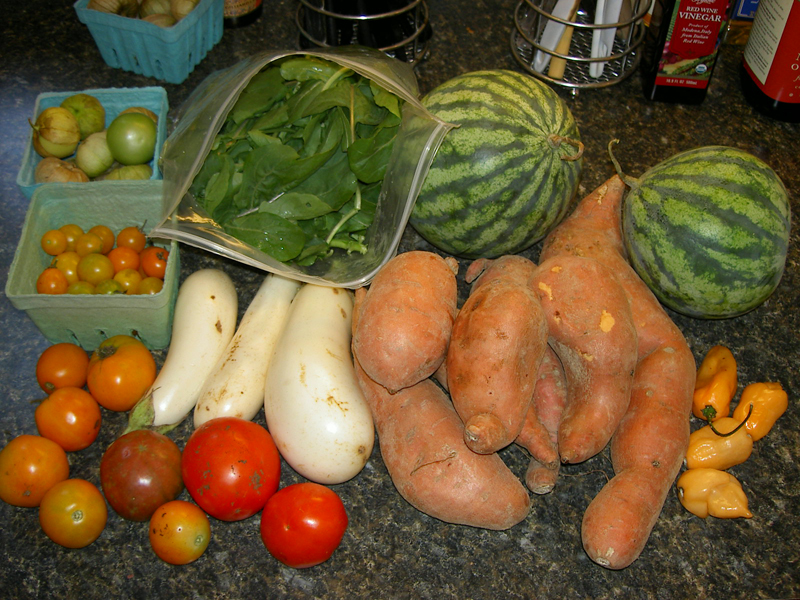
last summer farm subscription box


Rear: tomatillos, arugula, and watermelons. Front: tomatoes, eggplants, sweet potatoes, and ‘Peachy Mama’ peppers.

Today I picked up the last box of our summer farm subscription (one of the food sources described in an article co-written by our neighborhood drop-off coordinator). This week’s box was one of the most bountiful of the summer, and more representative of what our winter boxes were like. With the drought that hit Maryland earlier this summer, the summer subscription didn’t match our experience in the winter. Even with the intellectual knowledge that low returns were due to crop failure, and the consolation that everyone we knew with a CSA was experiencing the same thing, it was a bit disappointing. We were quite glad that we’d experienced the winter subscription first, as we likely wouldn’t continue after this year’s admittedly unusual experience. However, we did experience the winter subscription first, and having done so we’ll likely give next year’s summer subscription another try to see what a non-fluke-low-year is like.

For now — and by ‘now’ I mean the six weeks until our winter subscription picks up — we’ll rely on the farmers’ markets to supply us with our fresh food (once we eat all that stuff from our box, that is). Because we don’t have a car, we aren’t able to get to the market where our farmer brings his produce, but there are several other small and local farmers to support at the markets we can get to by foot or bike or train (or some combination thereof).

With the apples in season, I’ll be making sure not to miss my weekly trip, even if we do have eggplants, watermelons and sweet potatoes coming out our wazoos. I won’t be making as many pies this year, with our cholesterol-busting plan in full swing, but I can’t wait to get my annual fix of crispy tart Braeburns. I’ve sworn off grocery store apples this year, for reasons of cost and perpetually disappointing taste, so these will be the first we’ve had in a long time. With a little luck, I won’t have to go all the way in to the Dupont Circle market downtown to find apples that are minimally sprayed.

Maybe it’s a function of growing up in food farming regions, but I didn’t realize until recently that my approach to eating had become something of a ‘movement’ and that there was a cute phrase attached to the idea that it’s always best, economically as well as gastronomically, to buy your food directly from the person who grows it. Or, at an even more basic level, that food is grown not manufactured, and the quicker it gets to you, the fresher it is. Food coops, local organic stores, and farmers’ markets have been the mainstays of my food supply for over 10 years now, since my post-college days of belonging to the coop around the corner from my house in West Philly. It’s still a little odd to find myself part of a way of living that now has regular publications and gets national press.

But, you know, really: as long as I can eat what I like and walk to get it, I’m happy.

last summer farm subscription box