food : canning applesauce


Applesauce!

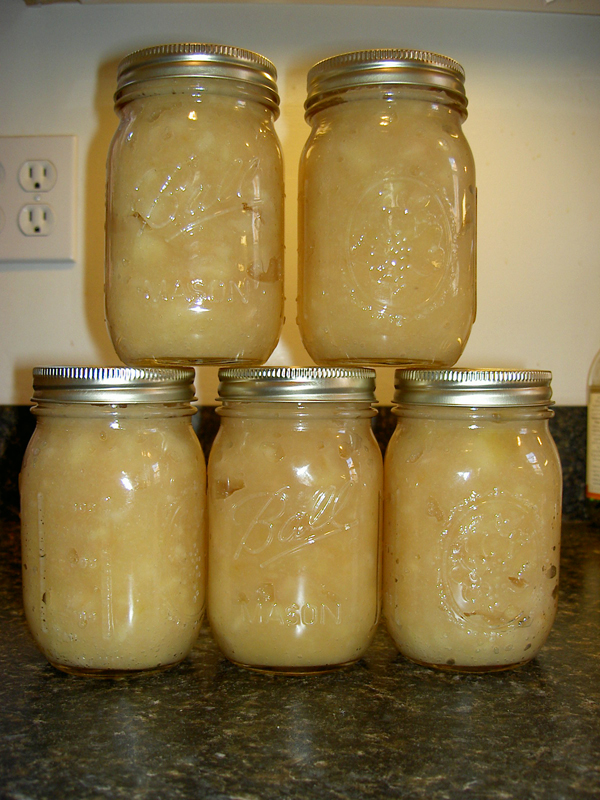
In order to preserve for future use the 30 pounds of apples acquired on our first apple-picking expedition, I chose to make applesauce. As with the apple pie filling, I used a mix of Stayman, Braeburn, and Empire. I used a recipe that called for 1.5 pounds of apples, 1 tbsp. of lemon juice, and 2 tbsp. of sugar per pint. I used about 1/3 cup of sugar for the whole batch, and mashed the cooked apples with a potato masher until uniformly chunky. Then 25 minutes in the hot water bath and I was done. The result was a bit tart, but very tasty. We’ve eaten two of the seven pints already!

We’re planning another trip to the farm, and I’m thinking I’ll make some applesauce mixes the next time. Maybe rhubarb (I have a lot of that diced in the freezer) or cranberry. I can’t find a cranberry applesauce recipe I like, but I’m thinking of just adding a cup of fresh cranberries to the whole batch and seeing how that works out. I’m also considering making apple chutney or something along those lines. We’ll see how many apples I end up needing to make something with. Regardless, the pints and half-pints are much easier to process, and I think I’ll stick with that size until I get a more authentic canning setup (I’m currently using a stockpot and a steamer tray).

food : canning applesauce

apple harvest


Apples!


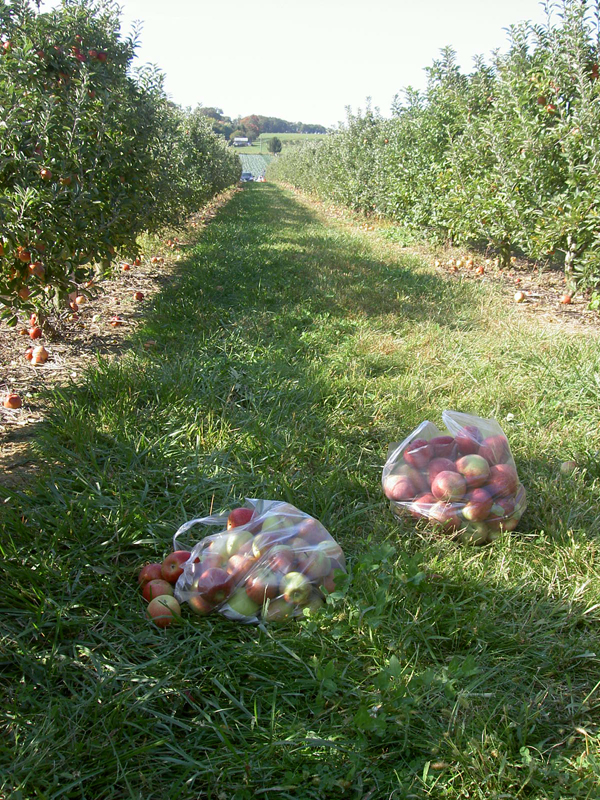
All the best ones are out of reach.

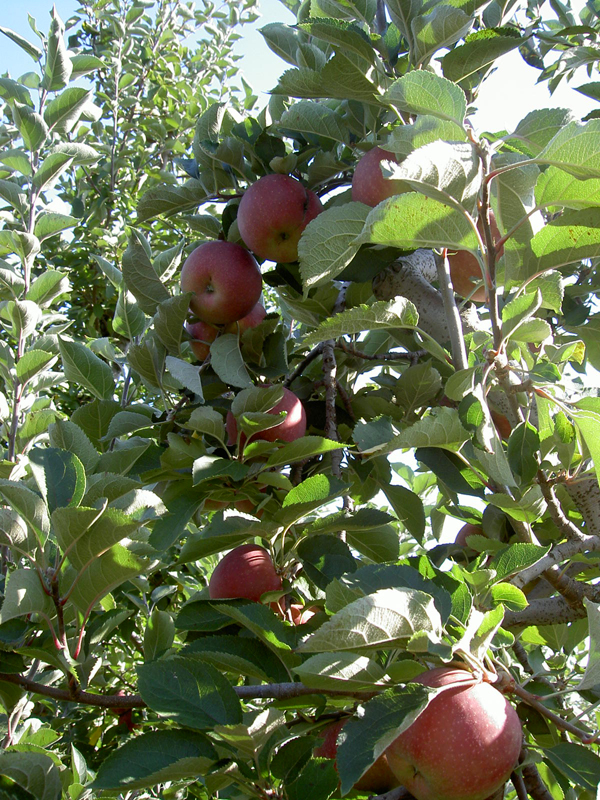
Last weekend we drove up to Larriland Farm in Howard County to pick apples. I remember picking apples as a kid, but it wasn’t something we did every year. What I don’t remember is what we did with all the apples we brought home! We discovered this year that it’s easy to fill up on apples quickly when each of you have a bag that holds 15 to 20 pounds and there are rows and rows of trees before you. In retrospect, it’s hard to believe that I was nervous there wouldn’t be enough: we could have filled our entire car and not made a noticeable dent in the orchard’s bounty. We also brought home beets, spinach, and more pie pumpkins, again taking only the smallest portion of what they had available.

After much deliberation we decided to pick only two of the three varieties available, Stayman and Braeburn (my two favorite kinds, which weighed heavily in the decision-making process). I like tart crisp apples, which I’ve learned are typically late-season apples. My partner eats apples with his lunch, sometimes two or three per day during local apple season. The smaller and slightly more sweet Braeburn were designated for that purpose, leaving me with about 15 pounds of Stayman apples to use as I wished. After making a couple of the requisite pies — my usual contribution to dinners where we’re the guests — I decided to put some of them up in jars for use later in the winter. To round out the firm apples with some that would mush up — that’s a technical term — when cooked, I picked up some Empire from my regular farmers’ market suppliers, the folks at Harris Orchard.

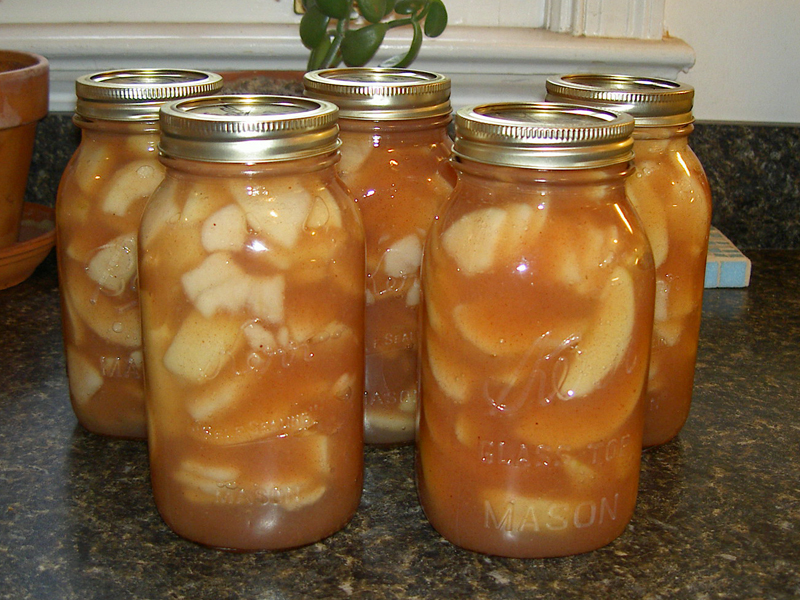
In an effort to use some of the interesting quart jars I received this summer — some of which are nearly antiques as they’d been collected from estate sales over the years — I started with pie filling. Not only have I never canned pie filling before, I’ve never made a pie from canned filling, so this was a new experience all around. I found a recipe online, cleaned and sterilized the jars, and started processing the apples using the handy peeler-corer-slicer I bought with our one of our last lingering wedding gift cards. (As an aside, I have been happily using all of the kitchen items we’ve received as gifts; having the proper tools and large enough bowls makes cooking all of our meals every day so much more enjoyable!) Of course, things didn’t go entirely smoothly: I didn’t peel enough apples initially, and had to conscript my partner to do that while I kept the sauce from scorching and the quart jars were a tight squeeze in my stockpot, as I have a bit of a rigged up water-bath setup. Everything seems to have turned out fine, though. Only one of the jars didn’t seal, so I stuck it in the fridge to be the test pie in a couple of weeks. I’m considering giving the pie filling as gifts to a couple of people (shh, don’t tell!) and want to be sure that it makes a decent pie before doing so.

Next up: applesauce. I’m sure that the combination of fewer ingredients and smaller jars will make me feel like a canning pro.


The finished product.

apple harvest

grocery choices in a price-inflated world

For the first time, this week, I made active changes in what I was buying at the store as a concession to inflation. I had been conserving and trimming luxuries for a while, but yesterday marked the first time I downgraded in the selections I was making. It’s not that we haven’t been making changes for a while; the biggest shift we have made in our household since I (voluntarily) stopped teaching has been in the way we eat. We no longer eat out, for primarily budget reasons, and I cook almost everything we eat at home, primarily for health reasons. For the first year of our plan, my partner still frequently bought lunch or coffee at work and we would eat out with friends. We joined a CSA in order to receive organic produce on a weekly basis, nearly all year round. As our savings dwindled and inflation started climbing we’ve trimmed luxuries, like cookies and soda and juice (not that we purchased these frequently, but we now purchase them only in times of desperate need). When we learned my partner’s cholesterol levels were dangerously imbalanced, we cut out the purchased lunches and I began cooking nearly everything we put into our mouthes in an effort to change the cholesterol profile through diet (which we did).

Through all of this, though, I have remained committed to certain principles of food purchasing and consumption. I don’t buy industrial meat, and with the higher cost of free range and pastured or organic meat we hardly ever eat it. From the local organic market, we buy basics — oils, flour, légumes in bulk, peanut butter, milk, butter — and fair trade items when they’re available — coffee, sugar, and spices. Several of the companies we support are cooperative businesses, namely Organic Valley, King Arthur and Frontier. While I’d likely be choosing their products anyway, it’s important to me that our household dollars are going to support ethical labor practices and helping to keep workers and farmers in control of their own livelihoods (yes, all my bank accounts are with credit unions, too).

With the close attention I’ve been paying to cost, I’ve noticed that the local market is consistently less expensive than Whole Foods for the items I buy regularly; not that Whole Foods is inexpensive, it’s just usually the only option for processed organic food. For our household cleaning supplies, we use almost exclusively Seventh Generation products: in addition to being free of fragrances and dyes, they are vegetable-oil based and use a large amount of post-consumer recycled paper and plastic. I could draw you a map of which stores carry them at the lowest prices: toilet paper at the Giant (by about $3 per package, surprisingly); dishwasher detergent at Whole Foods (only because they are the only store to carry the larger size since Target stopped stocking the products); Whole Foods again for paper napkins (because the organic market stopped carrying the brown option in larger packages); dish soap, trash bags, paper towels, laundry detergent and bathroom cleaners, all at the local organic market. I won’t bore you with the list of what we use for shampoos and soaps: suffice it to say that they all cost the least at the local organic market, too. When I buy produce beyond what comes with our farm subscription, I get it from the weekly farmers’ markets (fruit, mostly) or the organic market (onions, mostly).

The non-organic things that I buy at either the Giant or the new competitor are all related to my partner’s new cholesterol-busting diet: Cheerios (it really does help lower cholesterol, we’ve found), pretzels (the no-fat alternative to corn chips), bread (Roman Meal Double Fiber has the best fiber-to-sugar ratio of sliced wheat bread), and egg substitute. This week, for the first time, I chose the store brand egg substitute over Egg Beaters: it was a dollar less expensive per container. It’s not like the Egg Beaters chickens are any less crowded and warped than the store brand, right? Industrial egg products are industrial egg products. I also bought, for the first time in years, regular garlic at the Giant rather than organic garlic at the market. It’s garlic, right? Also, it was less than half as much.

Neither of these are major substitutions, but the fact of the choice I was making gave me pause. While I admire people who stretch their family budgets by buying in bulk or clipping coupons from the Sunday circular or stocking up on food close to its expiration date, that isn’t me. I keep — and use! — store coupons for the things we buy regularly, but I’m not going to switch to mac and cheese dinners (or ramen noodles) just because they’re 10 for a buck this week (they’re not, as far as I know, by the way: no need to rush to the store). I would prefer to winnow down to an ‘all lentils and brown rice all the time’ diet rather than buy the processed crap that’s the cheapest.

Over the past two years I’ve already learned that I’m willing to do a lot more cooking, and the attendant lot more dish washing, than I previously realized. I’ve always liked to cook, but never before have I had to make such a stark choice to commit to more labor in the kitchen to gain the freedom from laboring for someone else, as well as the resources to spend on the products I value. Garlic at $6 per pound, I learned this week, is apparently not one of them. I’m not ready to say that I’d get a job in order to keep buying fair trade organic sugar, but I’m also not sure that I wouldn’t.
grocery choices in a price-inflated world

squash baked with apples and walnuts


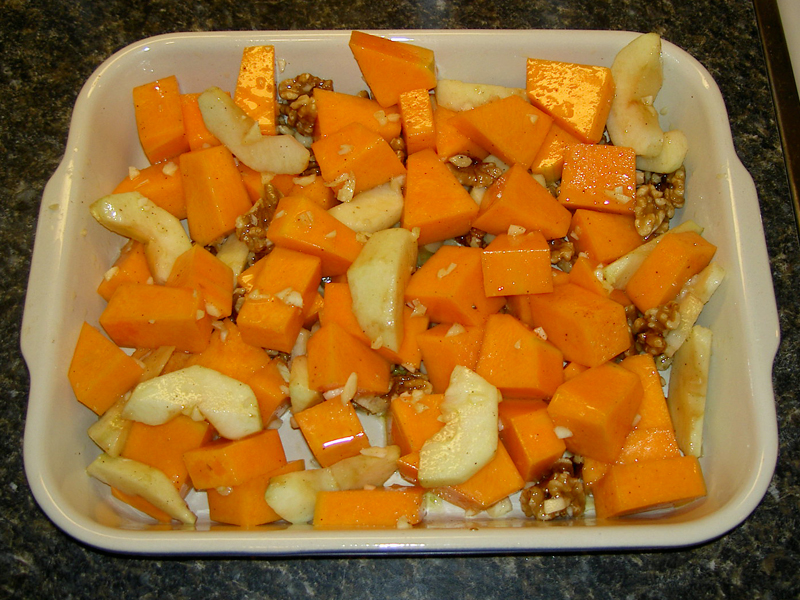
The whole kit and kaboodle, pre-baking.

I think I’ve mentioned that I’m dealing with a bit of a squash situation? Right. Last week’s efforts involved an upgrade of squash-baked-with-garlic that was inspired by a recipe at Simply Recipes (a site I use as a starting point for both new ingredients and classics that I just never tried to make before). I was planning to make the recipe as written, with adjustments to the butter and sugar, but because we live Down South, cranberries aren’t available in the grocery stores yet, even though it’s been autumn for three weeks. (Maybe this is unfair and you don’t have fresh or frozen cranberries available Up North yet, either?)

My version: toss together peeled and chunked squash (I used courge longue de Nice), peeled and chopped apples (I used Stayman, because I wanted them to keep their shape), minced garlic (I used about 4 or 5 or 6 cloves), whole walnuts, olive oil, and salt and pepper (I could have used more salt), and then bake at 375F for about an hour (until the squash gets soft). It was, I have to say, pretty good.

squash baked with apples and walnuts

persimmon cookies


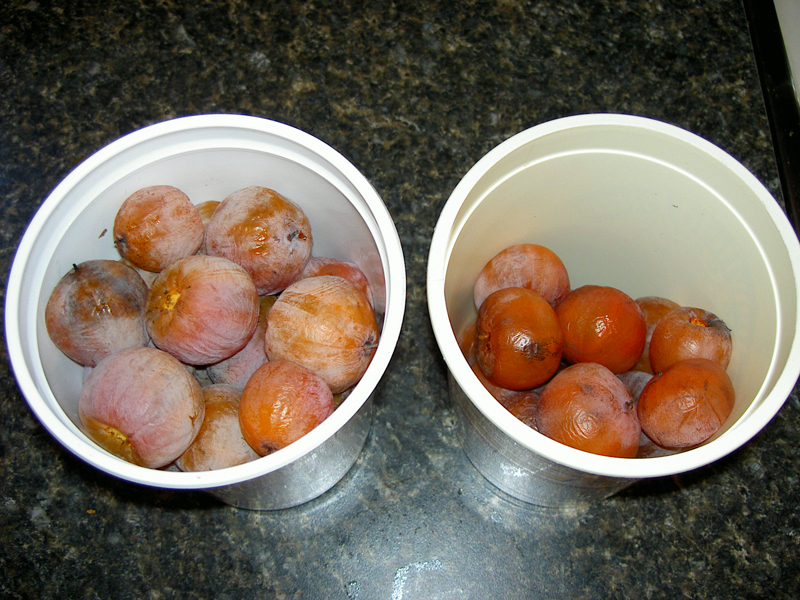
Wild persimmons.

Last year we foraged wild (American) persimmons from an undisclosed location in our county. All the hippies we know seemed to be wild about the fruit, and having stumbled across a few trees we decided to give them a try. Persimmons being extremely astringent when not quite ripe, it was hard to gain a sense of what the fruit actually tasted like. But I collected them, made sure they were soft, and mushed them through a strainer (a process that took several hours to glean a total of two cups of pulp, making me suspect that the thrill of the chase has more to do with their underground popularity than any aspect of the fruits themselves).

Having collected the fruit in that way, I stuck the pulp in the freezer and tried to find out what to do with them. There seem to be two ways to use persimmon pulp: (1) in an English-style Christmas pudding and (2) in cookies. Because the pudding recipes I could find were heavy on the milk and best served with whipped cream, I was hesitant to go there. I didn’t want to waste my hard-scavenged persimmon pulp on a modified recipe that risked being terrible, but neither did I want to commit to something that I wouldn’t be able to eat. Also, cookies seemed kind of boring.

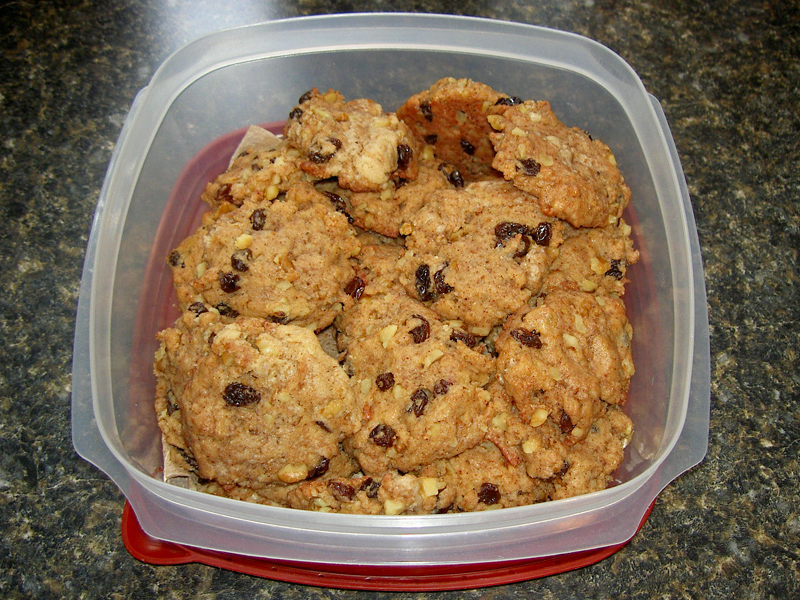
I stayed in this persimmon limbo for a year, and finally decided that I needed to make something with the pulp, if only to decide whether to forage again this year. After scouring the internet — by which I mean ‘using Tastebook‘ — I came up with two recipes for my first attempt. One is an English-style pudding, liberal on the brandy, which I’ll test when it gets cold and possibly make for my birthday (just as soon as I figure out how to rig up the steaming container). The other is a spice cookie recipe, advertised as ‘an old family recipe’ which I am hopeful means it was designed for use with native persimmons. The cookie recipe I made last night, with much effort — I locked up my touchy shoulder mixing up the dough; I recommend a mixer — and not a small amount of trepidation. The cookies turned out well, though, much to my relief. Substituting in canola oil and egg beaters worked fine; the persimmon flavor is not strong, but the texture is nice so even just as a spice cookie they’re enjoyable.


Persimmon cookies.

persimmon cookies