When we bought our house, in April of 2006, we acquired a yard that was both totally overgrown and full of flowering plants. The following is a catalogue of what we’ve discovered as we’ve cut back and pulled up the ivy and other invasive weeds. After three years of dedicated killing, 2009 was the year we actually introduce large numbers of flowers to the garden! Having discovered that the empty foundation bed is really quite sunny, I ordered plants from Springhill Nursery (which I don’t actually recommend) in the hopes of having a three-season flower garden. Many of them died, mostly because of my lack of care and poor siting. This summer we’ve turned the side yard into a bed and moved around those plants that did survive. I’ve added some native shrubs and eradicated (I hope) the orange spreading daylilies.
flowering shrubs
|
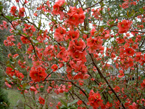 |
Japonica (flowering quince) Chaenomeles japonica
In the backyard, near the corner of the house along the south fence. Flowers are a gorgeous salmon. |
 |
Clethra (“Ruby Spice”)
Added to the new side bed this year as part of our going native project. |
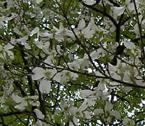 |
Flowering dogwood Cornus florida
Two trees, along the south fence, both with white flowers. The one at the side of the house is quite healthy, while the one in the backyard is less so, overly shaded by the neighbor’s maple. I cut the deadwood out of both of these trees in 2008 to encourage new growth. |
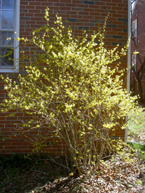 |
Forsythia (golden bell bush) Forsythia
One large healthy plant at the back of the house, on the southwest corner of the addition. A mass of spindly unflowering ones in the northeast corner of the backyard were removed as part of clearing the weeds from the north border of the backyard. This plant was fairly warped by the blizzards in December 2009 and February 2010, and our attempts to prune it were somewhat butchering. I’m planning to take it out entirely at some point and replace it with a native that I like better. |
|
Winterberry
Added to the front bed, near the porch, this year as part of our going native project. I purchased three of these at a local native plant sale (and PTA fundraiser) and have no idea which combination of male and female plants I have. I am hoping to get lucky and have two females (for near the porch) and one male (for near the basement steps) but only time will tell. I foresee a winterberry exchange down the line in a couple of years. |
|
Inkberry
Purchased this year as part of our going native project, one at the PTA sale and one from the nursery (to replace a PTA sale one that died). I was planning to use this to anchor the bank bed, but I’m having trouble visualizing that and will probably put one or both of them in the back by the basement steps. |
|
Crape Myrtle Lagerstroemia
After cutting down what we believed to be a dead shrub the first year we were here, we’ve discovered that what we actually have is a Crape Myrtle that just needed a hard prune and a lot more sun. We’ve eliminated its competition by pulling out the invasive shrubby mess of other plants in that area and limbed up the hollies so that it now gets decent sun. Each year its grown more and is now starting to become a respectable little plant. |
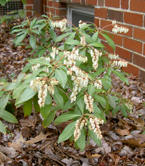 |
Pieris Pieris
On the northeast corner of the house, in the front bed. Was overly shaded by the maple and cedar that was somewhat on top of it; since had the maple cut back from the house and removed the cedar, it’s filled out nicely. I was pleased to discover that it’s a native variety and will remove it from the list of ‘these plants must go’ as part of the great native conversion that I’m undertaking. |
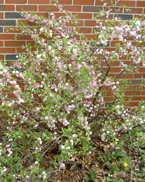 |
Ornamental cherry (Russian dwarf almond) Prunus
At the back of the house, on the northwest corner of the addition. Rather spindly, but healthier in 2008 as we sprayed for Eastern tent caterpillars which love it (and all the other cherries in the yard). This plant is destined to be removed (even though it’s grown crazy big this year) because I want that spot for something else (a blueberry bush, most likely). Also, I kind of hate it. |
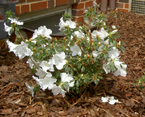 |
Azalea Azalea
One white azalea in the foundation bed, to the right of the porch, which is filling out this year as it’s no longer completely shaded by the maple. One deep pink (just shy of fuschia) around the corner of the house, on the south side, just in front of the fence. I cut this one back quite a bit to encourage denser growth (and to get at the poison ivy growing up in the middle of it), and it seems to be filling out somewhat. Both bloomed in 2007, about a week or two later than others in the neighborhood. In 2008, I planted two white Girard Pleasant azaleas in the foundation bed to the left of the porch, which we moved around the corner to (what I thought was) the shadier south side of the house. They both died in the baking sun, and that area is the new side garden bed. The end. |
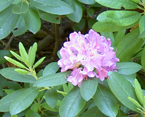 |
Rhododendron Azalea
We had two plants that were destined for new homes, due to our allergies and their location. The larger is in the corner made by the addition and the main house, and has bloomed this summer. That location is slated to be graded to drain better and covered with a patio, at which point the plant will move to the yard of our friends in Virginia. The smaller plant was in the front bed to the right of the porch, behind the azalea; it was never very healthy and it finally gave up the ghost this year, allowing me to replace it with a much happier oakleaf hydrangea. |
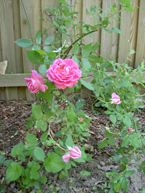 |
Rose Rosa
There are four rose bushes around the backyard, three red varieties and one pink. All of them did better in 2008 after I aggressively cut them back; I let them grow all summer to see what their natural shapes are. As far as I can tell, I have a small Crimson Glory and a large Blaze. I believe the pink rose is a Louise Odier, and it’s likely that the bush by the garage is a second much smaller Blaze (red with yellow stamens and no scent).
The Crimson Glory needs to be moved to get both more space and more sun, as it’s suffering from black spot in its current location between the forsythia and the dwarf cherry. The Blaze along the fence is crowded by the flowering quince; I plan to move it just a few feet to a trellis on the south wall of the addition. For the time being the bush at the garage can stay where it is, but it will need to be moved eventually when we redo the garage foundation. |
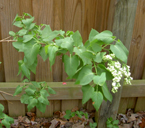 |
Lilac Syringa
We have one white lilac along the south fence, between the larger dogwood and the rose (and flowering quince). When we moved in, it was completely pinned to the ground by ivy; this year it produced one white flower cluster. It appears to be recovering in its current location, but I still don’t like it very much so it’s being given to a friend. |
|
Viburnum
Added to the front corner of the house this year as part of our going native project. |
bulbs, tubers & rhizomes
|
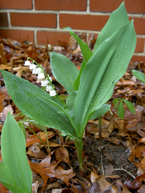 |
Lily-of-the-valley Convallaria majalis
Along the rear of the addition, under the ornamental cherry. Also along the east side of the garage, under the rose. |
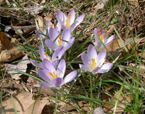 |
Crocus Crocus
In clearing out the invasive weeds in the front beds near the house, I discovered dozens of crocus bulbs. Smothered by the liriope and shaded by the neighbor’s enormous magnolia — which she removed in summer 2007 due to its proximity to the house — they’d remained unnoticed during the first two springs we were here. This spring, with the liriope cleared and a nice layer of leaf mulch covering the beds, they all sent up shoots. I created a small bed for them around the front light post and moved most of them there, where they’ll both be out of the way and provide a nice accent to the adjacent bed of later-flowering daylilies, assuming any of them survive the squirrels. |
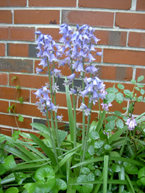 |
Bluebell Hyacinthoides
This spring, I moved the bluebells (also known as wood hyacinth) from around the rose bush to the north side of the house with the hostas. I wasn’t able to dig out the bulbs at the foot of the holly, but plan to do so eventually when the ivy from that bed is more thoroughly killed and eradicated. |
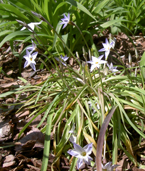 |
Spring star flower Ipheion uniflorum
I’ve been given several clumps of these lovely little flowers by my neighbor, who acquired them on Martha’s Vineyard years ago. I look forward to moving them all around the yard as they grow. |
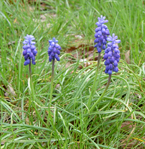 |
Grape hyacinth Muscari
I moved the flowers from under the maple, right at the point where the grass begins, into the crocus bed I created in 2008. They were the only thing to flower the following spring, and I had about a dozen blooms this year. |
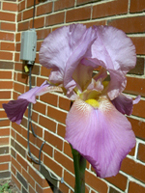 |
Bearded iris Iris germanica
I received an assortment of bearded iris from the Women’s Club’s plant exchange in 2008, and this year I had yellow, white, and pale lavender blooms. At our autumn plant swap, I obtained more irises (I just can’t say no!) and am hoping they’ll bloom this summer and waiting to see which varieties they are. |
|
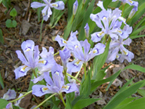
Siberian iris Iris
From the neighbor across the street, I received a number of the reedy garden irises (which she received in turn from the former owners of the house next to her, many years ago). I’ve planted them under the living room window on the south side of the house and under the smaller dogwood in the backyard. I don’t know if that’s where they’ll stay permanently; those were the spaces I had when it was time to plant them. |
 |
Flag iris (dwarf) Iris versicolor
I bought these local shade irises a few years ago, to become groundcover in the area under the small dogwood that we’d cleared of weeds. Last spring was so wet that we didn’t get very many good flower days, but the plants themselves expanded. This year we had many blooms, both of the taller blue variety and the shorter all-white type. |
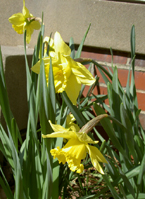 |
Daffodil Narcissus
The first year, there were several daffodils just to the right of the front steps, and a single flower along the south side of the garage, under the cherry tree. After leaving the leaves all summer, I had 10 buds in the front bed last spring, as well as a dozen more bulbs sending up shoots. I cleared the liriope from that bed and will leave the daffodils there, as they seem to get enough sun to flower when left to themselves. This spring I was the beneficiary of my neighbor’s overabundance of daffodils, and received easily 100 bulbs of about a dozen different varieties. Most of them went into the front daylily bed, and the rest found a home under the azaleas on the south side of the house. |
flowering perennials
|
|
Michaelmas daisy Aster
These pink flowers were given to us by a neighbor when we first arrived in 2006, and have filled in well. After three years next to the front steps, they’ve been moved into the new foundation flower bed where they’re threatening to take over (although they block the view of the gas meter quite nicely). I’ll thin a couple of clumps out and take them over to our community pool. |
|
Snowdrift aster Aster
It is my hope that these short white asters will fill out and help define the front border of the foundation flower bed. I expected them to bloom in the autumn, but they put out flowers in early summer when planted in 2009. This spring they’re quite lush, so I may be able to divide them and use them to edge the entire bed (a role that clover from the lawn is currently filling). |
|
White aster Aster
These white flowers popped up at the edge of the lawn and flowered in June. I planned to move them into my flower bed but never got around to it; if they come back this year, I’ll think about actually doing so. |
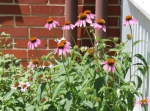 |
Purple coneflower Echinacea purpurea
These arrived at the same time as the pink aster, and made the move into the foundation flower bed in spring 2009. They were joined there by an assortment of other coneflowers that did not grow taller than six inches, let alone bloom. This year the foliage is filling out, so I have high hopes for them (not least of which is that they are varieties other than the standard pinkish purple). |
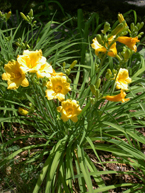 |
Daylily Hemerocallis
We have two rows of daylilies in the front bed along the sidewalk; we were given the lilies by two neighbors and created the bed last spring to house them. The top row, along the top of the bank, is the shorter yellow variety (Stella d’Oro). The lower row, anchoring the bank itself, is the taller orange variety. Now that they’re established, the hardest task is keeping the orange ones contained. I donated a few of the yellows to our community pool in 2009, to make room some other colors that were given by a neighbor. All of the yellows could use a good dividing again. |
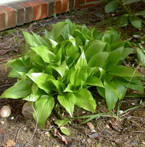 |
Hosta Hosta
I’m not a huge fan of the hosta, as is evident by my initial classification of them as ‘groundcover’ rather than ‘flowering perennials’ which is what they truly are. Hostas are prolific in all their varieties in our town, likely due to the overwhelming number of shade trees. We had two in the back yard; I split and moved one to the north side of the house and haven’t yet decided what to do with the other. |
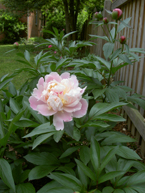 |
Peony Paeonia
The yard came with one peony at the back of the yard along the south fence, which I believe to be either a Lady Alexandra Duff or a Bridal Veil. It was just at the edge of the weed patch in the southwest corner of the yard that I’ve spent the past year struggling to clear. The peony survived the vigorous applications of Round Up to that part of the yard (there’s a resilient patch of poison ivy nearby), and is flourishing this year, since the competing weeds and ivy have been pulled out.
Last spring I transplanted several other peonies donated by our neighbor into the stretch of fence between the pink rose bush and the original peony. They have mostly survived the transplant, but produced only one bud this spring. I’m hoping that over the next few years they will spread to create a drift against the fence and am looking forward to identifying the new varieties when they eventually do bloom. |
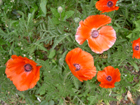 |
Poppy Papaver orientale
There is a patch of poppies on the north side of the back path, just in the middle of that stretch of the yard. In 2006 I cut back the holly trees, and I’ve let the poppies self-seed each year. They’ve come up strong again each spring. We don’t currently have plans for that part of the yard beyond eradicating the ivy, so I’ve decided to just let them do their thing. |
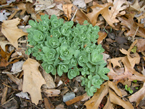 |
Sedum Sedum spectabile
There’s a patch of this along the south fence, previously directly under the rose bush that’s there. I moved it a little farther away when I transplanted the peonies in the first summer, and put a little sprig in the front bed between the two rows of daylilies. Since then, I’ve moved the entire plant to the front bed and now have three strong clumps of it there. |
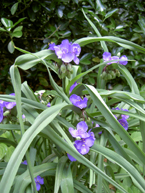 |
Spiderwort Tradescantia
A clump of this has sprung up in the northeast corner of the backyard. They’re quite pretty flowers, and I’d like to find a more nurturing place for them. At the moment, they’re fine where they are, but when the great grading-and-patio-creation project takes place, they’ll need to be relocated. As part of our inability to say no to free plants, we accepted more spiderwort from a neighbor in 2009, which we plunked by the corner of the garage for lack of a better plan for them. |
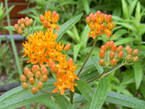 |
‘Gay Butterflies’ Butterfly Weed Asclepias tuberosa
These were planted in the foundation bed in 2009, and we have one orange and one white plant. (The third was a darker orange but doesn’t seem to be coming back this year.) As advertised, they did attract butterflies (and milkweed aphids and other orange bugs)! |
|
Swamp Milkweed Asclepias incarnata
These were another freebie from a neighbor that we plunked by the garage in 2009. We have three sprouts this spring, and I’m hoping a monarch will find them. If we get even one caterpillar, I’m inclined to let them go to seed in the back area there in future years. |
|
‘Alaska’ Shasta Daisy Leucanthemum
New in the foundation flower bed in 2009. They didn’t flower last year, but the foliage is going nuts and needs to be divided into several clumps. |
|
Delphinium Delphinium
New in the foundation flower bed in 2009. We did get a few blooms from these last year, but so far this year only one out of four has returned. Thankfully, there is a lifetime warranty on the plants! |
|
Early Red Hot Poker Kniphofia
New in the foundation flower bed in 2009, finally bloomed for the first time this year. |
|
Clustered Bellflower Campanula glomerata
New in the foundation flower bed in 2009, and one of the few plants that flowered that year. |
|
Globe Thistle (small) Echinops
First planted in the foundation bed, then moved around the corner of the house to the new side garden bed. |
|
Black-Eyed Susan
First planted in the foundation bed, then moved to the new side garden bed. |
|
Bee Balm Monarda
First planted under the living room window on the south side of the house, now growing in the front foundation bed. |
herbs
|
 |
Garlic chives Allium tuberosum
A single clump, on the south end of the front bed, between the two rows of daylilies. These were another donation from our neighbor, and they’re quite a peppy little plant. We’ve used the chives in salads a couple of times this year, and enjoyed the flowers last fall. |
|
Chives
In the front foundation bed, next to the lavender. |
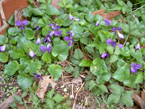 |
Violet Viola odorata
These grow throughout the left side of the front yard, and sporadically through the backyard, both the violet and lightly striped white forms. I was told by our neighbor that they’re a sign of poor drainage, which I don’t doubt, and by a friend that they make the yard look ‘exactly like the South of France,’ which you can imagine pleased me to no end. |
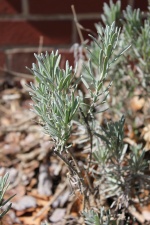 |
Lavender Lavandula x intermedia
I purchased a ‘Provence’ plant at the Hard Bargain Farm plant sale in 2007 and started it in a pot. I planted it out just to the left of the porch steps, after clearing the area of liriope and mixing peat and lime into the soil first. It got huge, then it got leggy, then a bunch of it died in the winter of 2010. I’ve now pruned it back and am hoping it will bush out again. I purchased a different variety for the new side garden bed (note to self: mix some lime into the soil).
|
|
Greek oregano
In the front foundation bed (for now). |
|
Rosemary
In the new side garden bed. |
|
Sage
In the new side garden bed. |
|
Savory
In the new side garden bed. |
|
French Tarragon
In the front bank bed (for now). |
|
Lemon Verbena
In the new side garden bed. |
|
Woodruff
In the new side garden bed, under the pink azalea. |
groundcover
|
|
Liriope Liriope muscari
I hate this extremely invasive plant. It’s scattered throughout the backyard and in every side bed to various degrees. I’m planning to eradicate it along with the ivy, and look forward to the day when I can remove it from the catalogue of what’s in my yard. Sorry to burst the bubble of my love for every plant under the sun: it’s just not meant to be. |
|
Creeping phlox Phlox stolonifera
Around the new wee white azaleas, I also planted this shade-loving phlox variety. It’s my hope that they’ll fill in the area without being too extremely aggressive as lawn invaders, and that I’ll be able to divide and introduce them under the larger azaleas on that side of the house as a suitable replacement to the English ivy. |
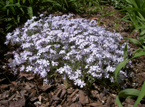 |
Moss phlox Phlox subulata
In an effort to introduce evergreen foliage to the front bed, I planted two clumps of a regional variety of moss phlox, that becomes covered with lovely lavender flowers in the spring. With the spring star flowers in bloom at the same time, they produce a lovely light wash effect on the area between the two enormous rows of daylilies. |
|
Sedum Sedum
I added a regional variety of stonecrop that produces lots of little white flowers. It wasn’t too happy through its first winter but appears to be coming back in this spring. |