In April, 2006, my partner and I bought our first house. We live in Prince George’s County, Maryland, about three miles from the border of the District of Columbia. With the house came a yard and a single-car detached garage. I summarize below the work we’ve put into the property; you can also read the more detailed accounts of what we’ve done on the house and in the garden.
Year 1
Since moving in, we’ve been engaged in house-related projects both large and small. On the ‘large’ side, we’ve had to make extensive repairs to the roof, for which we hired some people with roofing skills. They did an excellent job, and in the process of arranging for those repairs we discovered that our house is located in an historic district, making it eligible for the Maryland Rehabilitation Tax Credit program, administered by the Maryland Historical Trust. The program is documentation-intensive, but well worth it for our house, that has several projects left to do. We’ll continue to work with the Trust as we prepare to repair the leaking foundation of the garage and brick over the hole in our back wall currently housing a non-functional air-conditioning unit.
Beyond these few repair projects, we have been tackling the standard interior work of grouting, caulking, plumbing, and painting. For a home built in 1938, it’s in quite good condition, and many of the jobs we’ve undertaken have been largely cosmetic or preventative. After years of doing minor repairs on rentals, we’ve become quite handy, and are pleased to be able to do much of the work on our home ourselves.
This summer and fall, I’ve also done quite a lot with the yard. My ultimate goal is to have our backyard certified as a Backyard Wildlife Habitat through the National Wildlife Federation. To that end, we have been working to eradicate the invasive ivy from the ground and trees, pulling out weeds, and pruning back the scrub. Over the next few years, I plan to put in new fences, a small pond, kitchen vegetable and herb gardens, sand-packed flagstone patio, wood chip paths, and–of course–a wide assortment of native plants. In terms of basic maintenance, we hired a tree company to prune the large sugar maple in the front yard, cut some dead branches from the maple in the back, and clear the vines from our cherry tree.
Year 2
We kicked off our second year in the house with water pouring into our basement. Granted, it was a big rainstorm, but we were more than a little peeved, especially since the seller (a real estate agent) claimed there was no history of water in the house. The flow of water revealed points of previous (poor) repairs and erosion, confirming our belief that his claim just wasn’t true. At this point, it’s our house, and we’ll deal with the drainage on the property; we just don’t recommend buying a house from this guy and are happy to discuss the myriad reasons, small to large.
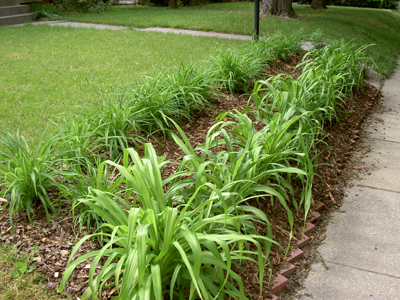
With the appearance of a small river of water running through the basement, grading the yard became a higher priority. We continue to work on clearing the weeds and covering the side beds with mulch. In April, we were much engaged with drowning Eastern tent caterpillars and banding the cherry trees, hoping to avoid such an infestation next year. The peonies seem to have survived the great poison ivy spraying campaign of last fall, and I’ve added some additional specimens donated by a neighbor. It’s my hope that they will develop over the next few years into a nice drift along the side fence.
Throughout the summer we successfully cleared the weeds from the rear weed patch, most notably the pokeweeds. We also removed several small bushes and saplings that had sprung up under the holly tree and cleared the liriope from half of that bed. It’s my plan to naturalize lily-of-the-valley in the bed under the holly once the liriope is good and gone. In the fall, I collected leaves from our neighbors’ yards via wheelbarrow and created what I hope will be a killing mulch layer over the English ivy in the beds that edge the backyard. I also covered the weed patch, which had started to regenerate in late summer. While we weren’t successful at clearing the entire yard — digging out weeds on this scale takes far more time and effort than I’d imagined — we did manage to get a mulch down and I have high hopes for next year.
In addition to the work in the yard, we made slow but constant progress on the interior. We — and by ‘we’ I mean ‘my partner’ — caulked and regrouted the main bathroom upstairs. We removed the drop-down ironing board and cabinet from the family room wall and patched the hole, removed the electric heater from the wall in the downstairs bathroom and patched the hole, and removed the vent between the downstairs bathroom and the family room closet and patched the hole. We painted (most of) the family room an airy sky blue; we need to paint the rear wall but are waiting until we complete the removal the in-wall A/C unit. We have been persistently thwarted in our attempts to get that repair done: we have been unable to get a mason to actually come out to the house and give us an estimate for the job, or in some cases to even return our calls. So, if you are a mason who works on historic brick in the College Park area, send me an email!
I rounded out our second year in the house by working on the yard. We did buy a composter, and have been dutifully filling and rotating it. After much talk, I cleared and prepared the left foundation bed and planted two white azaleas under the living room window. It appears that I might have chosen a smaller variety than intended, but we won’t know that for a few more years. I made progress in clearing the weeds and liberated several plants — hostas, spiderwort, crocus, daffodils — from the stranglehold of liriope and ivy. Never fear: there’s still plenty more to do in the coming months.
Year 3
The beginning of this year brought rain, rain, and more rain. While this was great for the garden, it dashed our hopes of being able to put off the foundation repairs for several more years. We interviewed contractors and collected estimates, and are hoping to get that work done in early 2009. The MHT Tax Credit program has apparently been inundated with applications, either because word has gotten out or the economic crunch makes the paperwork more worth the effort or both, and it now takes about four months to approve a new project.
In the interim, we’ve completed several other projects for which we received MHT approval. Our least glamourous but most appreciated renovation was new ‘commodes’ (I learned quickly not to speak the word ‘toilet’ to the folks at the Historical Trust!). Going from 1930s gushers to sleek Japanese low flow appliances in one fell swoop made me feel a bit like a Jetson! We were also pleased to be able to find a mason to brick over the hole in the back wall where an ancient air-conditioning unit was removed. He did an excellent job, making the work nearly invisible unless you know exactly where the new bricks begin. This was a repair we’d had on our list since day one, so it was a wonderful feeling to be able to finally have it completed. On a cosmetic level, we plan to charge ahead with the room painting in the early months of 2009.
In addition to physical work on the house itself, we spent an enormous amount of time and energy this year moving stuff around in our house. The water in the basement displaced all of the boxes of our precious childhood belongings and mementos we’d carefully stored down there, in addition to our (fake) Christmas tree and ornaments, and various other odds and ends. We do have a full attic, and to make it usable we pulled all the crumbling tin-foil-and-shredded-paper insulation from the rafters, spending hours using a borrowed (thank you, friends!) shop vac to clean up the mounds of paper debris and dust. After two rounds of bug bombing and several more hours mopping, all of which work was done in our spare time over the course of several months, the attic was ready to be a storage space. We now have the piles of boxes out of our living room, hallways, and offices, and neatly organized on pallets up in the attic.
Moving all of that stuff out of our living space allowed us to rearrange the furniture in all of the rooms on the first floor, an activity made necessary by the acquisition of several large items of furniture during the year. Most notably, I received my grandparents’ china cabinet and dining table and chairs set, which bumped the old table to the family room, which bumped the family room table to the garage. The new dining room arrangement also edged out the hope chest that was serving as a sideboard, which relocated to the living room, necessitating the moving of the bill-paying corner desk to the family room. A bookcase in the dining room also made its way to my office upstairs, making homeless the shelf that was already in that room; it is still roaming the upstairs waiting to be taken in to new quarters. Our annual cookie-themed holiday party was a good motivator to do all this rearranging, and we are quite happy with the new arrangements. We only hope to have some leisure time in the next year to enjoy the rooms!
My work in the yard this past year remained the same: kill, kill, kill! With the help of my partner, I made excellent progress in this regard. We uprooted nearly all the liriope in the front, side and back yards, and made decent progress on the ivy. Several invasive patches of shrubbery met their ends, creating more space and light for the crape myrtle and magnolia along the north border. During the summer I sprayed nasty poison all over the poison ivy thicket under our neighbor’s trees, with limited success; this will have to be revisited in the spring. If not for the degree to which small birds such as our resident Carolina Wrens love to eat and redistribute poison ivy berries, I’d be more content to leave it be. In the interest of not having it perpetually crop up in my own yard, I’m going to work on the nearest source.
We did not take the step of preparing new beds for the roses this autumn, so that will have to happen next year. I’ve made the acquaintance of a very skilled gardener neighbor, and he has graciously offered to come over and consult on our yard come spring. With his help I hope to move the rose bushes next year and start the work of designing and preparing the side beds for planting beginning in the spring. I’ve had some success in identifying the four rose bushes that came with our house, in order to assess their space and trellis needs; now that our neighbor has removed her towering magnolia tree, the south side of our house gets quite a bit of sun through the day, making it a good possible site for the climbing rose. Not that I know much about roses, but I’m learning in order to preserve these nearly-antique plants. Next year we will also need to make the difficult decision about grading around the house; if we decide to go ahead with that we will lose some trees and have to dramatically cut back the two very old azaleas that are right up against the south wall. While it seems absurd to tolerate water around the foundation for the sake of some trees and bushes, it’s been surprisingly difficult to decide to sacrifice such established plants.
Finally, we finished up the year by knocking a couple of rooms off the to-paint list in February. We did the bedroom and the main upstairs bathroom (with the black and white tile, for those of you following along at home). The bedroom color had been decided for some time, a nice light brown that makes you feel (with the white ceiling) that you’re lying down in a cappuccino when you go to bed, which is a surprisingly relaxing feeling. After much consideration and rejection of various earth tones, we went with a soft blue for the bathroom which looks great with the black and white tile and provides a really nice background for the white period light shade with the little stars on the sides.
Year 4
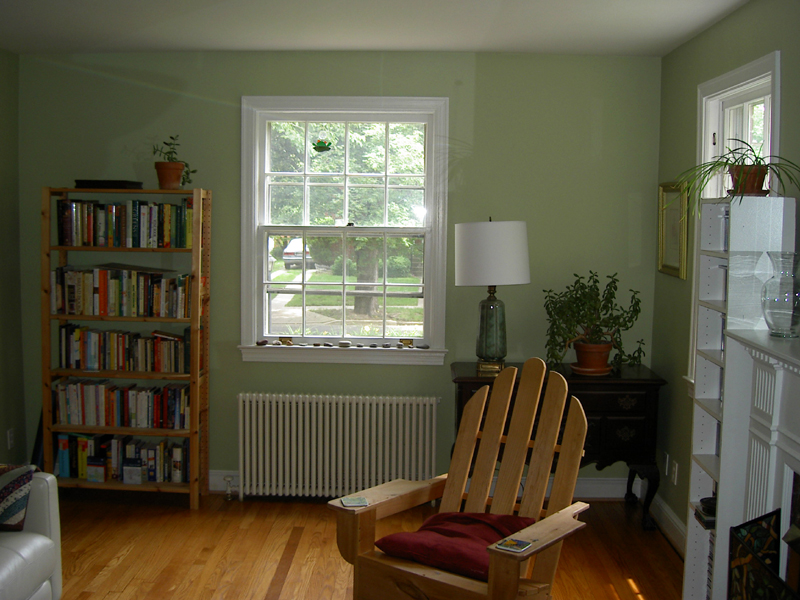
We started off the year by planting a flower garden and painting the living room, two things I’ve been wanting to do for a while. The living room is a soft green; I just went ahead and painted it a color that was available in the low-VOC line and seemed inoffensive. It’s not my favorite room or color in the house—that’s still the yellow dining room, which looks even better with all the mid-tone walnut furniture that’s now in there, if I do say so myself. However, it does make the room very mellow, with the white sofa and dark wood accents. It works for my partner whose favorite color is green, and will work better for me when we get a rug that’s not also green and some chairs that aren’t made for the porch. Don’t hold your breath for that, though: at seven years and counting no one even blinks anymore at coming into our house and sitting in them.
On the outside of the house, the flower garden is a work in progress. The flowering perennials are growing, but we planted them so late that we won’t really be able to tell how they’ll look together until they come in full-size next spring. We added a rain barrel to one of the back downspouts, which cut down significantly on the mosquitoes on that side of the yard. We continue to have limited planting space due to the weed eradication that the backyard is undergoing; our neighbors tell us that we’ve made great progress and praise my green thumb and the tidiness of the yard, but I don’t see it. For the most part, we got the beds cleared and mulched by the first frost and the spring cleanup after the extreme winter weather wasn’t as bad as all that.
Our biggest achievement was definitely getting the basement repair completed! We now have an interior trench, two sump pumps, and a drywell in the back of the yard (not something I wanted to do, but required by the town for approval of our permit). After years of a wet and mucky basement, it will be great to look forward to a dry spring and summer. Not to mention the benefits of having a usable workspace again (free of non-functional antique appliances and warped cabinetry). Now it’s just a matter of carrying everything back downstairs, reassembling the shelves, and unpacking the art supplies.
Year 5
I cannot believe we’re at the beginning of another year in the house. As I say every year, we have only a few more projects on deck that fall outside the realm of decorating or renovating, categories we haven’t even begun to tackle beyond the level of paint. There are a number of small electrical and plumbing issues that need to resolved (outlets that are miswired or need to be moved, light fixtures that need to rewired or replaced, faucets that drip), for which it’s mainly a matter of making time to make a couple of trips to the hardware store and take care of them. We’ll be putting an exhaust fan into the upstairs bathroom, which will require a hole to be cut in the roof, and one into the kitchen above the stove, which will require the hole that’s been sealed over in the exterior wall to be opened up again. Once those repairs are completed, allowing us to put the batteries back into the smoke detectors on each floor without having them go off every day from steam, we plan to sit back and enjoy our home (novel concept!).
What enjoying our house means is devoting more time and energy to the yard! We have another rain barrel to go on a second downspout at the rear of the house, and I’m hoping to take out the scraggly forsythia and bizarre flowering almond shrub and finally plant an herb garden when we get to that project. With the (largely clay) dirt that was excavated from our backyard to make the drywell, we plan to properly grade the uphill side of our house and redo the plantings there, possibly creating a bed along the property line (which will be the low point where our grading meets our neighbor’s). True landscaping and gardening in the backyard remains a bit of a pipe dream, as we are still years from having the fence replaced, the garage foundation repaired, and the walks redone. (Any uncles or cousins or childhood friends who want to take a fence-building vacation are of course always welcome!) There are some areas where that could begin, though, and there’s always more weeding and cutting back and mulching and poison-ivy-killing to be done to maintain the progress we’ve made.
Did I mention that we had a baby? Well, I had the baby, but we prepared the house for it. I think it’s fair to say that any and all painting, organizing, decorating, and repairing that happened in the house was oriented around preparing for his arrival. It’s clear who the important person in the house is: the one with the dimmer switch, blinds, and new area rug in their bedroom!
Year 6
We have a side garden bed! More on that project to follow.