new life birds at Bombay Hook

This past weekend we took advantage of nice weather and an unscheduled day to drive to the wildlife refuge at Bombay Hook in search of new shorebirds. Shorebirds are the other glaring weak spot in my birding — warblers being the first — and I’ve vowed that this year I will improve my skills. Our trip revealed that I’m getting better, but for little brown birds running around on mudflats at a distance, I really could use a stronger pair of binoculars. The ones I have do fine for large birds at a distance and small birds in the woods, but sandpipers and waterfowl across the marsh at dusk all blur together.

Technological limitations aside, we spotted about thirty species on our trip, with seven new life birds among them. The first birds of the trip were two birds of prey along the road into the refuge: a Rough-Legged Hawk hovering over a field and a Northern Harrier taking off from a telephone wire. The harrier was also the first life bird of the day; it felt like an auspicious beginning to see something new before even reaching our destination. Just inside the gate we promptly spotted some familiar friends: Eastern Bluebirds, grackles, robins, starlings and mockingbirds. At the nesting houses outside the visitors’ centre were the first Purple Martins of the year; we got a nice good look at them as they staked out their ground against the starlings. Although shorebirds were the goal, I couldn’t make myself drive quickly past the other habitat on the way to the flats, and as a result we caught sight of the second life bird of the day, a Ring-Necked Pheasant making its merry way along the edge of the field just at the start of the driving loop. I know these are common birds, somewhat disdained for being introduced and descendants of domestic escapees to boot, but I hadn’t seen one in North America before. In the same stretch of fields I spotted a couple of Horned Larks mixed in with the hordes of Red-Winged Blackbirds, starlings and robins, and in the pond beyond we found a handful of gulls, including our old Chincoteague nemesis, the Laughing Gull.

Moving on to the first pond, we unintentionally flushed a Great Egret and a Snowy Egret from the marsh opposite and caught a Great Blue Heron flying in overhead. As luck would have it, a Black-Necked Stilt landed at the edge of the pond just as we arrived and we got a good close look at it poking around. We’d seen a couple at Chincoteague during the spring migration three years ago, but this was a great second sighting. Also in the pond were Northern Pintails, Northern Shovelers, and Green-Winged Teals, birds I’d seen on my trip up last month but which were new to my partner. Circling overhead was a tern that I would swear was a Roseate were (1) they not so rare and (2) I a more confident birder. The bird had a crisp black head and nape, a black bill, and the longest outer tail feathers I’ve ever seen on a tern. Later in the day we did see Forster’s Terns, so it’s possible that the light made the bill of this one look black. I would love to know if any Roseates have been sighted along the Northeast coast recently, though, as the tail was striking enough that I retain my doubts. Even with an inconclusive identification, the tern was exciting to see!

On our way to the mudflats, we found a pair of Blue-Winged Teals mixed in with some Green-Winged Teals dabbling around in low tide. I believe they nest at Bombay Hook, but I had failed to find any on my previous visit, so they were a good surprise. The other neat surprise, after peering after Greater Yellowlegs and Lesser Yellowlegs — new to me but not particularly challenging to find or identify — and hordes of Dunlins in various stages of breeding plumage, was an American Golden-Plover running around on the flat closest to the road. Its back and head were in full breeding plumage, with the belly still filling in, but it was glowing and sharp looking nonetheless. With its white undertail coverts and white flank stripe it most resembled its European cousin, but the fact that the vast majority of North American sightings of those birds occurred in Newfoundland (thanks again, Sibley!) — and much peering through our binoculars with our elbows propped on the roof of the car — swayed us to the belief that it simply hadn’t gotten all its summer feathers yet. It was still a good catch of a less common — and good-looking! — native bird, so we were pretty pleased with ourselves.

The rest of the trip yielded nothing new, but as we made our way around the rest of the loop we spotted a Killdeer, several Black-Crowned Night Herons roosting in the trees with the Snowy Egrets and Great Egrets, and a single Cattle Egret hanging out on the edge of the marsh with a Snowy Egret. Our very last sighting of the day was a young Bald Eagle wading around in low tide, surrounded by several shorebirds that seemed not at all concerned about being eaten. I suppose in a place with an abundance of ducks, shorebirds are a little skimpy for its taste. Either way, it was funny to see such an obvious predator landed in the midst of what I would certainly have tagged as prey.

By the time we left the sun had definitely gone down, the mosquitoes were out in force, and we had to wait for the automatic gate to release us. It was a good day, though, and if I didn’t see the teeming and varied masses of sandpipers I was hoping for, there’s always next month (or year).
new life birds at Bombay Hook

new life birds at Lake Artemesia and Patuxent

In order to try to catch sight of some of the migrating warblers coming through this area, I visited Lake Artemesia at what seemed like an unreasonably early — and cold! — hour this morning: 7:00am. When I first arrived, only the larger birds were active: Cardinals, Blue Jays, Robins, Mockingbirds, and Starlings were all making loads of noise, as well as a single male Eastern Towhee camped out at the top a tree singing its little heart out. Out on the water, a bunch of Coots, several pairs of Canada Geese, and the threesome of Wood Ducks were paddling around (there must be another male around somewhere, right?). By the time I reached the bridge to the peninsula, though, the smaller birds were starting to get going: I saw a goldfinch, loads of chickadees, and a Tufted Titmouse. Just over the bridge, I was geeked to see a Green Heron up in a tree. I know, intellectually, that they nest in trees, but it still strikes me as odd to actually see them up in the branches. I was also unduly excited to spot a Snapping Turtle in the lake near the bridge. It wasn’t as impressively large as the one I saw at the University Hills pond last year, but it was large enough to be clearly identifiable, especially with its long tail in view.

The peninsula yielded two new life birds, although not any of the warblers I was hoping to see. Near the restrooms I found a Field Sparrow, a bird I’d been told was around but had yet to spot. Nearby, along one of the ‘paths’ cut into the grass, I discovered a small group of Savannah Sparrows. They were neat, with their yellow head stripes and lovely streaky colors. The flash of yellow gave me hope that I had found a warbler, but I was just as pleased to find a type of sparrow I would never have been looking for. I did see some warblers in the trees along the bank of the peninsula, but only Yellow-Rumped ones. I spotted a Blue-Gray Gnatcatcher catching gnats and the male Bluebird hovering around yet another new nesting box; I suspect that he keeps getting bullied away from the boxes by the Tree Sparrows, and I’m hoping that doesn’t mean the pair will move on completely.

I wasn’t too bent out of shape about not seeing any new warblers, as I’ve already seen two new ones at Patuxent this month: a single Pine Warbler and a few Palm Warblers; the latter were traveling with a large group of Yellow-Rumped Warblers, as I was told they likely would be. In a stroke of luck, I completely lost track of time and was sitting on a bench on the lake trail after the trails were supposed to be closed, which was exactly the point in the late afternoon when all the little insect eating birds became active again. I think I also saw a Black-Throated Green Warbler, but I wasn’t able to conclusively identify it. It wasn’t until the ranger directed me to return to the parking lot, via the bullhorn on the jeep from across the lake, did I realize how late it had gotten.

The Pine Warbler sighting was the result of sheer determination, and not a little neck-crunching. I had taken my partner up to Patuxent to show him some of the birds I’d seen there that were new to him (namely the bluebirds and the loon that had been hanging out on the lake), and we doggedly tracked the noisy little bird through the woods and then he stood patiently by while I peered at the very tops of the tallest trees following the little blur of yellow. In the end, I confirmed the identification by behavior, which seems to be the case more frequently as I move out of the most common birds into the still-pretty-common-in-the-right-habitat birds. Which is why I’ve switched to using Sibley’s as my primary guide: I find the behavior, habitat, and song descriptions to be more thorough and easier to understand than in Peterson’s.

In an effort to keep adding mostly-common birds to my lifelist, we’re planning to visit Bombay Hook this weekend to try to see the shorebirds that should have returned by now. I imagine it will be quite busy on a weekend afternoon, but I’m looking forward to it.

new life birds at Lake Artemesia and Patuxent

new life birds at Patuxent and Lake Artemesia

Since getting the car last week I’ve taken two trips up to the Patuxent Wildlife Refuge to walk the trails and look for birds. Last Monday’s visit was on a rainy day, so I didn’t expect to see much. Not much is still something at a place like Patuxent, though, and the very first birds I spotted were a pair of Wood Ducks paddling around in the creek (the trickle of water that I expect will develop into a fuller marsh if we have a rainy summer). They didn’t appreciate my arrival and left with much hooting and flapping, startling a group of snipes up out of the reeds. The snipes were a new life bird for me, and seemed to have changed names between the publication of my older Peterson’s, where they’re listed as Common Snipes, and my newer Sibley’s, where they’re called Wilson’s Snipes. At any rate: I saw a bunch of snipes! Their distinctive back stripes made them easy to identify, and I was pleased to add another tricksy marsh bird to my list.

The walk through the woods was pleasant, but relatively bird-free. I saw some titmice and a heron wading around at the shoreline. Cash Lake Pier is the endpoint of the trail, and it was nice to sit and take in the view of the lake from up there. The Tree Swallows had returned and were swooping over the lake in large flocks. When I arrived at the pier I discovered a pair of Northern Rough-Winged Swallows just hanging out on the railing. I’d only seen them once before, last year at the University Hills pond, and it had been late enough in the season that I wasn’t entirely convinced they weren’t young Tree Swallows. It was nice to have a firm identification; second sightings are still exciting in my book! On Saturday my partner and I had stopped at Lake Artemesia and discovered a young Osprey hanging around. It also wasn’t a first sighting, but it was the first time I’d seen one close enough to be able to get a good look at the head and wing markings. Other sightings had been from the highway in a moving car, so this sighting marked a more firm identification.

I returned to Lake Artemesia on Tuesday, and was pleased to discover a small group of Pied-Billed Grebes swimming about. Unlike at Bombay Hook, there was no mistaking them this time, and I was thrilled to see them. There’s something about the small awkwardness of grebes that I find endearing. The Osprey was still hanging about, and while I didn’t get to see it dive, it did hover directly overhead a few times, which is always neat with such a large bird. I had assumed it was just passing through on its way to the shore and didn’t expect to see it again; now I’m wondering if it will stay and nest. There are also still groups of Ruddy Ducks and American Coots out on the lake, as well as at least one pair of Ring-Necked Ducks still hanging about.

Yesterday was another beautiful day after a stormy night, so I returned to Lake Artemesia to see if anything interesting had blown in. I wasn’t the only one to have this thought: I encountered two other people with binoculars at Lake Artemesia. The first was kind enough to let me know that Palm Warblers begin to travel through in the company of Yellow-Rumped Warblers this time of year, and the second alerted me to the presence of a Horned Grebe in breeding plumage on the Lake. I had seen the Horned Grebe in winter plumage hanging around, and did see it when I arrived, but I hadn’t noticed the other in among the Ruddy Ducks. This both confirmed my identification of the one in winter plumage—still nice for me with my level of experience—and allowed me to backtrack a bit and catch sight of the grebe with a splash of gold across its head. Since Horned Grebes are migratory, it’s rare to see them in breeding plumage this far south, and I’m thankful for the opportunity. Backtracking also led me to find a single Double-Crested Cormorant out on the water; I’d only previously seen them from afar on the ocean, so getting a good look at the cheek-markings was fun as well. The final gift of the morning was a male Eastern Towhee on the path near the parking lot; I’d seen my first female Eastern Towhee on the nearby Paint Branch trail about a month before. I’d sighted male towhees out west, but this was the first male of the eastern subspecies that I’d seen.

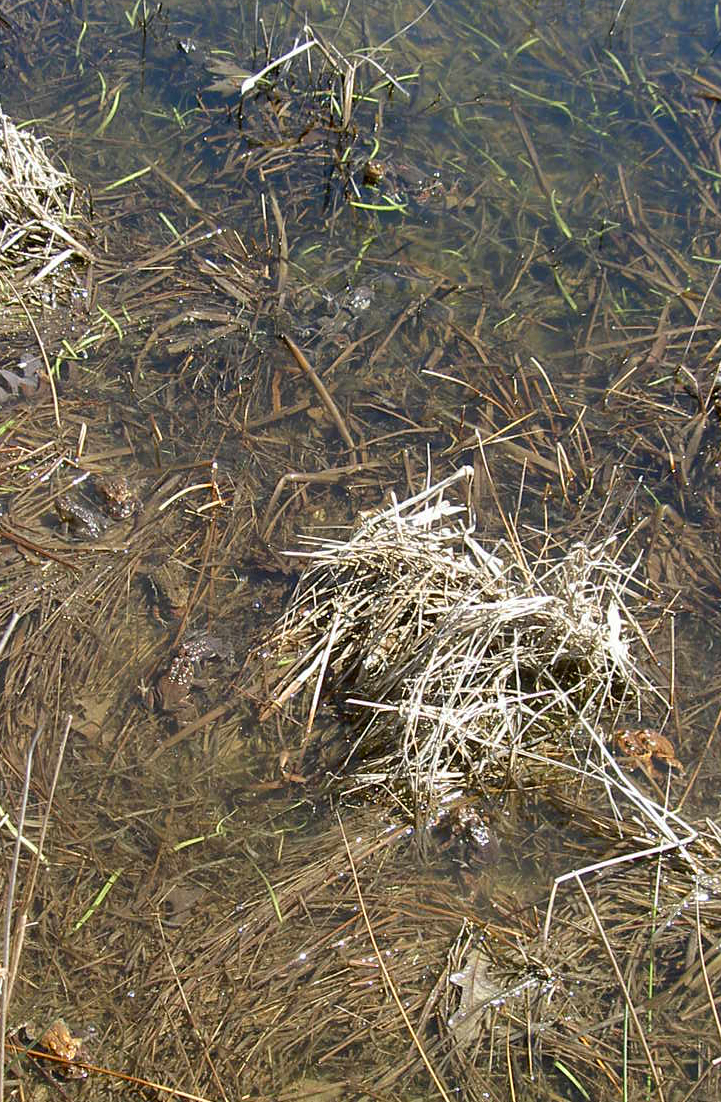
Following such a successful trip to Lake Artemesia, I couldn’t resist the urge to head up to Patuxent and see what had landed on the lake there. I am glad I did, as I had a great time! The first bird I saw was another new life bird, a Swamp Sparrow. I suspect I’ve seen these before, at Point Pelee and the University Hills pond, but this was the first time I was able to be absolutely sure. As I was standing watching the sparrow, I became aware of an overwhelming chorus of frogs. Amphibians are my first love, and so I following a footpath—likely a deer trail—through the grass to the edge of the creek. What to my wondering eyes did appear but a horde of toads emerging from their hibernation in the mud and chasing each other around in attempts to mate. One of my housemates in Ann Arbor witnessed this spring event years ago in a park near where we used to live, and I was so jealous. So jealous! Imagine the nicest material item you’ve ever wanted it being given to the most obnoxious person you’ve ever met, and then multiply that by about a thousand: that’s how jealous I was, not because my friend was obnoxious but because frogs and toads are my first love. At any rate, all that was washed away as I got to stand and watch all these toads acting kooky. As a visual aid, I offer you this photo of one small stretch of the creek (see how many toads you can find in it):


Toads mating at Patuxent.

Following that excitement, I was happy to just walk in the woods and enjoy myself whether or not I saw any birds. Near the trailhead I saw a pair of Eastern Bluebirds hanging about a nesting box; although I know they’re common out here, this was still only my fourth sighting and their bright coloring remains startling. In the woods I encountered an Eastern Phoebe, another bird that I’ve only seen a couple of times before; it was perched above the trail bobbing its tail and singing away. Along the shore there were turtles crowding every rock and log; like the toads, they were coming out of hibernation and seeking the sun. Up at the Cash Lake Pier I found both another Double-Crested Cormorant and a fellow birder—the binoculars give it away every time. I walked over to say hello and he was kind enough to point out a Common Loon out on the lake, another new life bird for me! As with bluebirds, loons had loomed large in my imagination, birds that were never sighted yet deeply loved and exotic to someone raised inland. He also pointed out the nesting platform that the circling Osprey seemed to be using; I look forward to returning through the summer and watching for young birds. As if those sightings weren’t all enough, I saw a Hermit Thrush in the woods on the walk back to the car, another bird that I’d sighted only once before—in the backyard of our most recent house in DC—and I was happy to get a second look.

Trips like these remind me of the positive side of being a relative novice at this birding stuff: I’m almost guaranteed to see something I’ve never seen before on each trip, as many common birds are still new. It also reminds me how lucky I am to have moved to an area with such diverse habitat, within reach of so many parks and refuges. It wasn’t something we took into consideration when choosing our house location, but being on the northeast side of the District in the Chesapeake Bay and Anacostia River watersheds has yielded one pleasant surprise after the other.

new life birds at Patuxent and Lake Artemesia

garden log : new composter & blooms a’bloomin


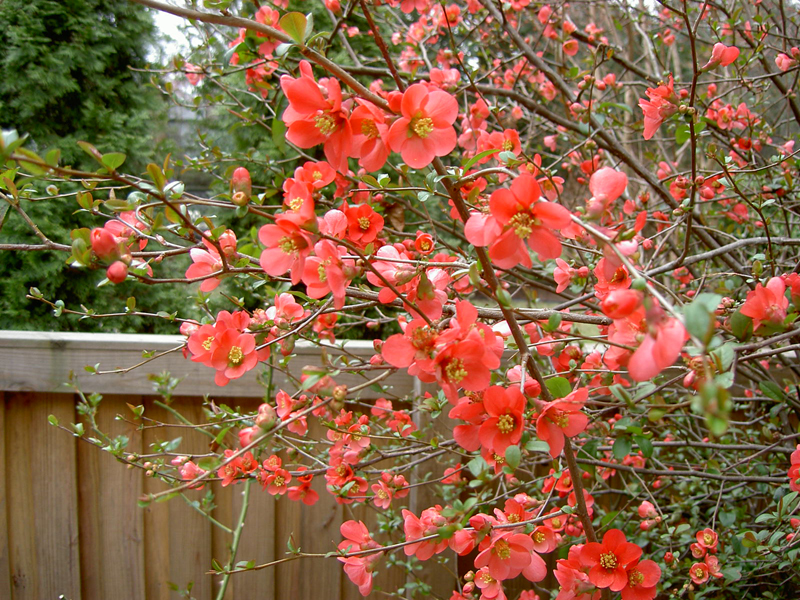
Bloomin’ quince.

With the official coming of spring, plants are bursting into bloom all over the yard. The flowering quince has been in full bloom all week, joined yesterday by the forsythia and the opening of the daffodils. The flowers were a nice reward for the work I’d put into clearing the beds, and I was pleased to see that a liberal sprinkling of cayenne pepper was successful in blocking the attempts of the squirrels to dig to China and treat the crocus bed as a lunch buffet.

The outdoor work of this past week was decidedly less appealing than the flower rescue of the week before. We pruned the Eastern tent caterpillar egg sacs out of the small cherry tree, only just ahead of the appearance of the caterpillars themselves. I am loathe to have the trees sprayed, but the caterpillars really creep me out. If there are nearly as many as there were last year I may go that route. We also discovered that at least one of the cherry trees is diseased; I’m going to have our arborist advise us on whether it will recover or if we should think about just having it removed.

Our other main project was cutting deadwood out of the large quinces and cherry trees that form the north property border. While we were there we—and by ‘we’ I mean my partner—wrestled a six-foot high ‘stump’ covered in ivy out of the back corner of our neighbor’s yard. When we moved in the upper half of the ivy-covered trunk of this dearly departed tree had fallen and landed on our garage, held in the air by the vines. Having cut it free and wrestled it to the ground the first year we were here, we had some idea of what removing the stump would entail. Thankfully, the public works employees in our town are wonderful, and they took the whole thing away without us having to saw it into smaller bits. Earlier in the week I’d cut down three saplings that were crowding the larger trees, and they also took those trunks without a problem.


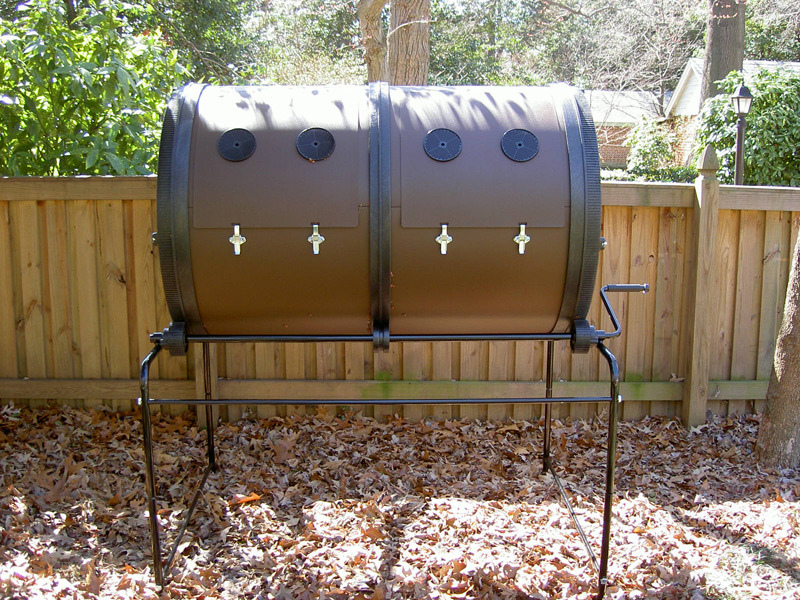
Our new double-barreled tumbling composter.

The other big development in the garden this week was the arrival and assembly of our new tumbling composter. I’ve always wanted to compost, having become fascinated with the process as a young child, and I persuaded my partner that it would be both possible and financially advantageous to do so in our small suburban yard. In selecting a composter, I was concerned with minimizing animal access and being able to do the manual work of turning the compost myself; he was concerned with odors and having an overly visible contraption that made us the laughingstock of the block. The selection that best met most of our needs was the Mantis ComposTwin, a high-tech tumbler that cost the most upfront but seemed most likely to be workable for us in the long-term. To address the visibility and mocking concerns, we chose to place it under a tree and behind the neighbor’s bush, on the south side of the yard. Because it’s contained and aided by ‘composting agents,’ I’m hoping that the relative lack of sun won’t impede the composting process; it will be a few weeks before we are able to fill the drum and find out if it will actually make compost.

At any rate, it arrived on Monday, in three large and heavy boxes, and a friend came over that evening to help us put it together. Yes, that means we celebrated St. Patrick’s Day by assembling a contraption into which one places food scraps to rot. Now you understand my life. The assembly process took us about three hours, with a break in the middle for dinner. We quickly lost the light, so after assembling the frame outdoors we moved to the foyer and front porch to assemble the drum. There was quite a bit of pushing and pulling and cursing, so I highly recommend having at least two people to assemble this beast. Once together, we placed it on its frame and threw in an inaugural mix of leaves and kitchen scraps, in the backyard in the dark. And then we had some beers.

Next up: pruning the deadwood out of the neighbor’s dogwood and weeping cherry that border the north side of our yard. I also plan to cut down another sapling that’s grown up right next to the maple’s trunk. And, of course, there’s always more lirope to kill.

garden log : new composter & blooms a’bloomin

turning the suburbs into a salt wasteland


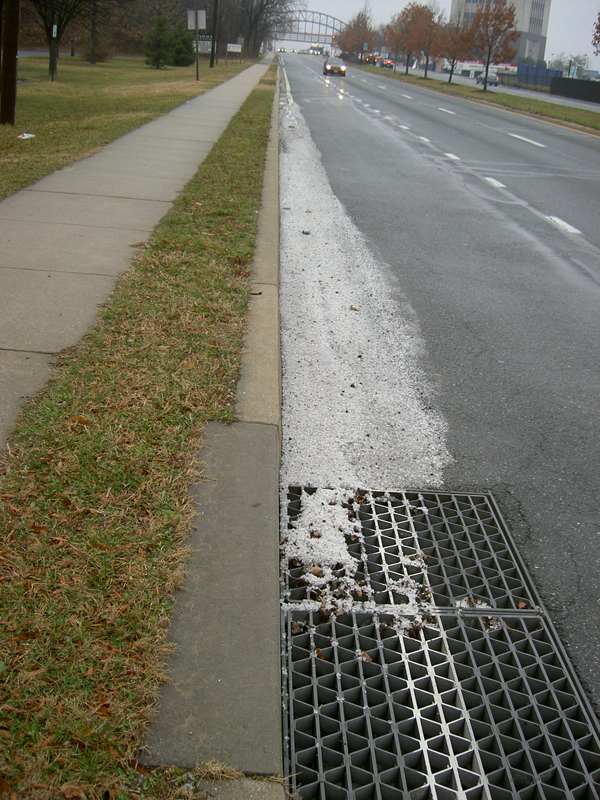
Road salt heading to the Chesapeake Bay.

One of the things I hate the most about living out here is the way they deal with winter weather. Or rather, the ways in which they don’t deal with it. During the first year we were here, there was a blizzard. A good old-fashioned three-feet-of-snow-shuts-the-city-down-for-a-week kind of blizzard, of the type that also shut down the east coast in February of 1996. Not surprisingly, DC didn’t have enough salt or sand or plows or trucks or workers to clear the streets in the days after the blizzard. I say not surprisingly not because DC government is a bunch of backwards eejits, but because no government could have had enough salt or sand or plows or trucks or workers to deal with this level of snow. I say this having lived in Pennsylvania during the blizzard of 1996 and having grown up in places where at least once per year two or three feet of snow can be expected; when these things happen, it takes a while to clear the roads. Period.

However, local residents’ expectations did not align with this reality, and so there was a lot of protesting and blaming and complaining and accusing following this blizzard, the result of which was overcompensation with regard to all future winter weather. In some ways, the overcompensation was amusing: schools were closed in anticipation of an inch of snow, snow which sometimes never materialized. As I was teaching at the time, I enjoyed frequent days off. The other way in which people in the area overcompensate, though, remains completely mind-boggling to me, and that is the coating of the roads and sidewalks with salt. Salt which is rarely needed at all, let alone to the degree it’s applied, and which therefore mostly ends up in the local soil and water system.

I can’t remember ever using salt on sidewalks except during an actual ice storm. Where I come from, we use a shovel and the sun: shovel the snow, let the sun do the rest. In the rare instances where patches of ice develop we either (1) walk around them or (2) use the shovel to break them up and clear them from the sidewalk. Out here, people either don’t shovel their walks at all or shovel them and then cover the damp surfaces with a layer of salt. Sometimes, as in the photo above, the surfaces are completely coated with salt in anticipation of the possibility of snow or freezing rain that never materializes. As a walker, this means I’m walking in the grass throughout most of the winter to avoid having my shoes deteriorate through constant exposure to chunks of salt. Which is annoying, but not nearly so annoying as seeing buckets of salt heaped at the side of the road and dripping into the storm drains, drains which flow to the Chesapeake Bay.

I took the above photo a month ago, on January 22nd, at the end of the day on which the salt was applied. Much of the pile of salt is still there, six weeks later. I suppose I could be glad that it’s still there, rather than all in the water system; mostly, though, it just makes me angry. I shudder to think what the water in our local creek must be like, and try to remember to fill the birdbath with fresh water each day. I know that other locals are concerned about the chemical runoff into the water system, including members of the Town Council. So I try not to let it get to me and focus on maintaining my little chemical-free soil haven for the local grubs and insects, which in turn feed the local moles and birds, which in turn feed the local hawks, possums, raccoons, and foxes.

turning the suburbs into a salt wasteland