garden : rain barrel


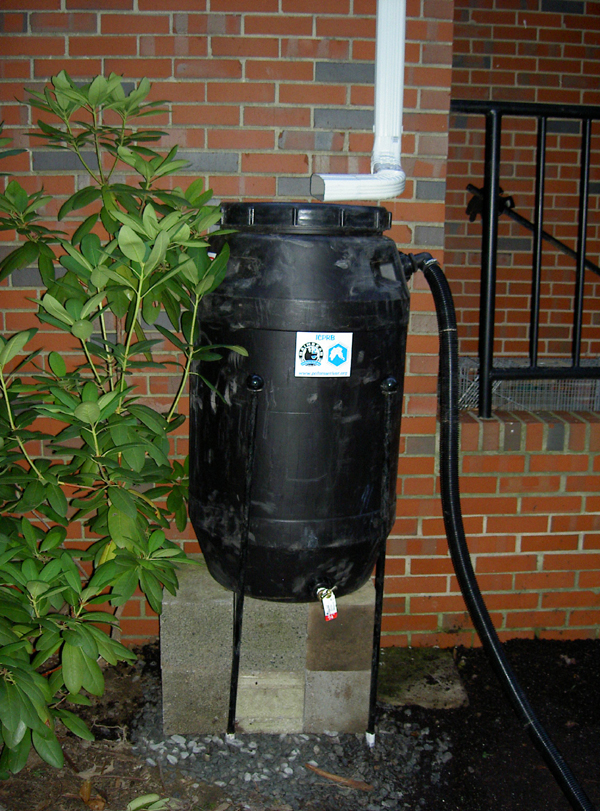
Freshly installed rain barrel, with rhododendron.

I have two overarching goals with regard to our house: (1) to make the entire enterprise of living here more energy efficient and (2) to make the yard and garden more pleasant and usable. Rain barrels address both of these aims to a certain degree, by reducing the amount of water used outside and taking away a favorite breeding ground for the nasty little daytime mosquitoes that proliferate in our town. While the rain barrel has an overflow tube, the tube can more readily be screened to prevent mosquitoes from breeding in the tube, since the water in the barrel is screened at the entry point.

I had been thinking about rain barrels for some time when I read about a local workshop in Organic Gardening magazine (something I probably never would have looked at but have greatly enjoyed since receiving a subscription with our composter). The workshop took place at the Accokeek Foundation, and was a collaboration with the Interstate Commission on the Potomac River Basin (ICPRB). ICPRB has commissioned Rain Bear Rain Barrels, which are well-suited to the hot mosquito-heaven that is our area during the summer; I thought we’d be making the barrels ourselves, but then learned that they are pre-assembled by volunteers onsite at the Accokeek Foundation. The workshop was more informative that hands-on, designed to make sure that we all knew how to install the barrels safely in order to not have them drown a raccoon or fall on a child. Once we’d gotten the information and signed a liability waiver (‘I will not sue you if my rain barrel drowns a raccoon or falls on a child’) we were free to go. A very nice man who lives two towns over from ours loaded one of my barrels into the back of his ginormovan SUV and dropped it off at our house after it was a surprise only to me that just one of the 60-gallon barrels would fit in our Saturn (now is the time when you’re impressed that any 60-gallon barrel would fit in our Saturn).

Once we got the barrels home, they stayed in the backyard against the house (upside down) for a month. Mostly because we hadn’t decided what modifications we’d make to the downspout and partly because I wasn’t that confident in my ability to level the ground. Even though I intellectually understand that paying the bank an obscene amount of money every month means that we can do whatever we like here, including lopping off the downspouts, I have a pretty large barrier to undertaking new projects of that sort. In the end, we decided to create a replacement short downspout that could be swapped out in the winter, thus avoiding having any flexible tubing that invariably turns into a mosquito Club Med. In the end, I mostly supervised and my partner did all the work of leveling, cinder block carrying and arranging, downspout cutting and reassembling, and barrel placement. It took us two days with the heat, some order of operations errors, and the fact that it was going to rain that night so it couldn’t stay half-assembled. In the course of getting the space ready, we had to cut the rhododendron back a bit; we dug up some of the rooted branch and passed along the section to a friend who was looking for something to replace an azalea that had died. By the time we got the segment into and out of the car again, it looked much scruffier than it had when we started digging it out. So far it’s survived, though, and we’re hoping that with some TLC and rain it will bush out and look like an actual plant.

The night we finished assembling the barrel—singular, as we still need to scrounge up some more cinder blocks and clear out some underbrush to create a space for the second barrel on the other side of the addition, a task delayed by having two wedding things, a pool party, and a 40th birthday party to attend last weekend—it poured rain. We ran outside to check on our barrel, all excited, only to discover that my partner had assembled the pieces of the spout inside-out and water was gushing out at each of the seams. So, in the middle of a lightning storm, he stood on a metal railing and dismantled the metal downspout, using metal pliers to reshape the pieces and make them fit back together the other way. After which our barrel filled up in about 39 seconds flat, and we were able to determine that yes, the overflow tube works just as it’s meant to. Since then, I’ve used the water for the ficus trees that are now out on the porch and some of the indoor plants; I need to get a watering can with a more narrow spout if I’m going to water the indoor plants from the barrel and not have to make a million trips out to the backyard with the plastic cups I typically use. Already I’ve noticed a marked downturn in the numbers of daytime mosquitoes on that side of the house and the water comes out as cool as promised.

I don’t know how many barrels we’ll end up with, although I did have this vision of a barrel at every downspout (which would probably not look the best at the front of our historic brick house, so is unlikely to happen). The barrels are $90 each, which is about half as much as those I found online, but if you’re buying more than a few it’s more economical to get a 400 gallon tank-style barrel. I’m not sure we have either the space or the watering needs for the larger barrel, so I keep reminding myself that the goal is not to collect every drop of water possible from our roof, but is instead to replace the tap water that I’d be using anyway. That isn’t actually a lot, as I don’t typically water my garden after the plants are established (the water is not recommended for car-washing, as it collects small grit from the roof and gutters). Having 120 gallons on hand at any given time seems pretty sufficient for our purposes, and we’ll just need to keep working on managing the water deluges in other ways.
garden : rain barrel

garden : nesting birds and a developing ecological balance

There have always been a lot of birds around our yard, but this year we seem to have hit a sweet spot in terms of cover and food because we’ve seen a greater variety of fledgling birds than ever before. It’s possible that these birds have been here every year and I just haven’t noticed because I haven’t been as active in the yard after April. It’s also possible that I was finally sufficiently threatening with regard to the neighbors’ cats being in the yard every other day for three years, as I haven’t seen them around in months. We’ve also sprayed the cherry trees for Eastern Tent Caterpillars for two years now, which has enabled them to fully foliate and have enough energy to actually produce cherries. Most likely the proliferation is a combination of all of those factors plus the near-constant rain keeping fresh water in the birdbath.

At any rate, I’ve seen rumpled no-tail-feathers wobbly-flying young of 13 species in our yard (or on the street in front of the house): American Crow, Blue Jay, Catbird, Eastern Phoebe, Hairy Woodpecker, House Sparrow, Northern Cardinal, Grackle, European Starling, Brown Thrasher, Mourning Dove, American Robin, and (just this morning) Carolina Wren. Of all of these, I was most pleased by the ones I hadn’t seen before. The phoebe was a wonderful surprise, as I’d read they were shy nesters; in addition to being a pretty little bird (I have a northerner’s affinity for the gray species) they eat mosquitoes almost exclusively. I was excited about the crow, too, mostly because it’s one of those large birds about which you joke of never seeing a juvenile. And, truly, the young one would have been indistinguishable from an adult were it not making such plaintive cries for attention and had I not witnessed its parent actually feeding it. Finally, the woodpecker was a treat just because it was so cute. Without tail feathers, it was the quintessential Weeble ™ fluffball as it tried to peck for bugs up and down the limbs of the red maple.

My father rightly observes that all of these birds are ‘the loud ones,’ which is likely related to being the large ones, which is definitely related to being the voracious insect-eating ones. After years of effort, I seem to be finally developing ecological balance. We have numerous predator bugs in the yard, most noticeably fireflies, and just this week I discovered a beautiful spider—I bet you never expected me to use those two words together—camped out in the daylilies and another of the same in the climbing rose in the backyard.

Now, if only the slugs would attract some toads, I’d be set.

garden : nesting birds and a developing ecological balance

garden : foundation bed, volunteer wildflower, and leaves on the twig


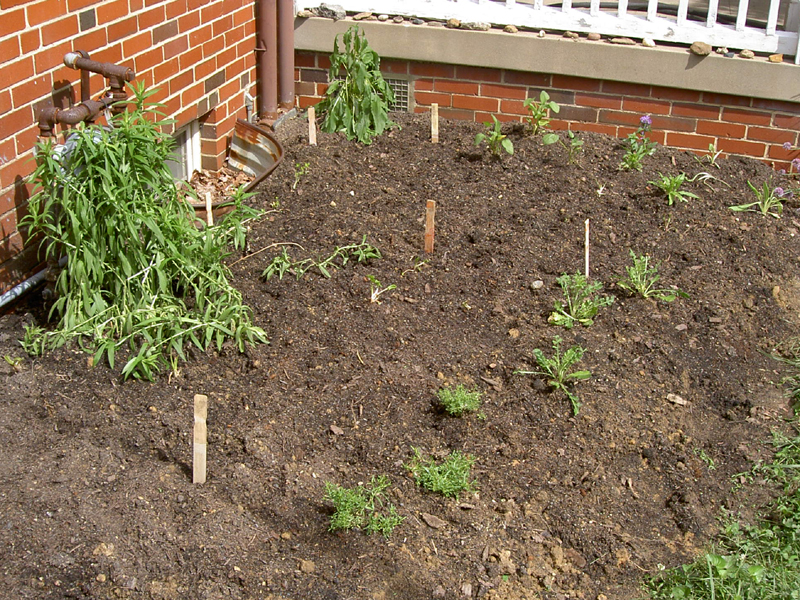
The front flower bed, newly planted.


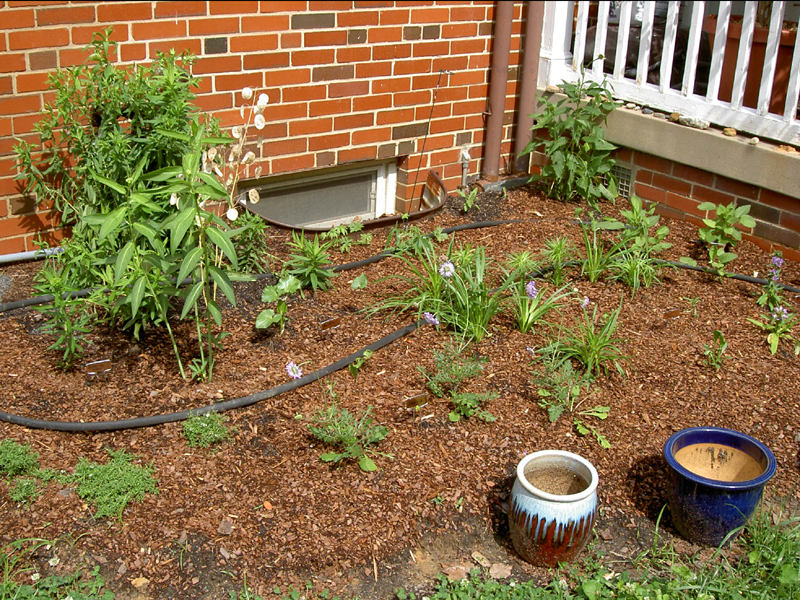
The front flower bed, one month later.

A month after planting the foundation bed with flowering perennials, we’re seeing all kinds of growth. It doesn’t look like a mature flower garden yet, but it’s showing signs of how it will be when it fills in. When the plants first arrived, I was disappointed; I had expected all of the plants to be in pots and all of the potted plants to be larger. Now that the bare roots have sprouted, we’ve been able to tell which had crown rot and need to be replaced and which are likely going to survive. I probably should have been prepared for how scraggly it looks with just sprouts, but I have never done this kind of planting before.


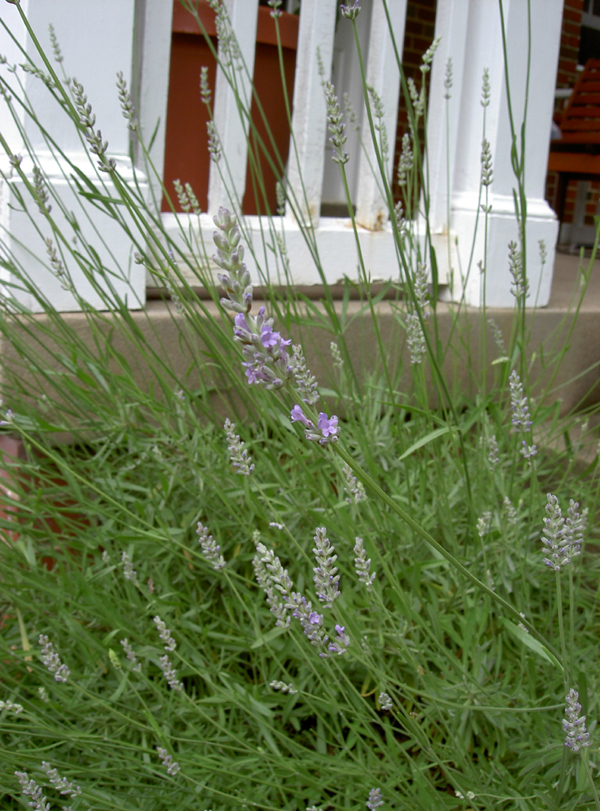
Lavender buds just opening.

In terms of flowers, the bellflowers were coming into bloom when they arrived, so they have been a nice splash of purple. The scabiosa took off, and they are also sprouting multiple pale purple blooms. While lovely, neither is the true blue that was advertised, and everything looks washed in purple with the lavender in full bloom next to the bed. The butterfly weed grew like, well, a weed, and several of the shoots have developed flower buds. I look forward to that splash of orange or yellow color. The dwarf aster bloomed as well, and I can’t remember whether it was supposed to bloom this time of year or whether it was just early because of the planting schedule. And, the small rudbeckia on the other side of the steps has bloomed, and looks quite cheery in that dark little patch. Besides those, everything else is still in the sprout stage; I’m not sure I’ll get any daisies at all this year at the rate they’re growing. I remind myself that it’s barely summer, and there’s plenty of time for them to shoot up and get established.


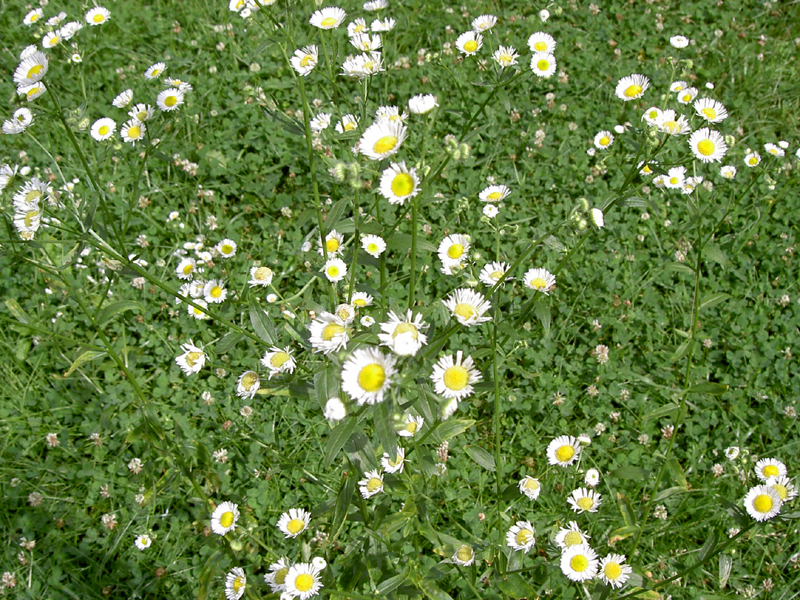
The volunteer aster.


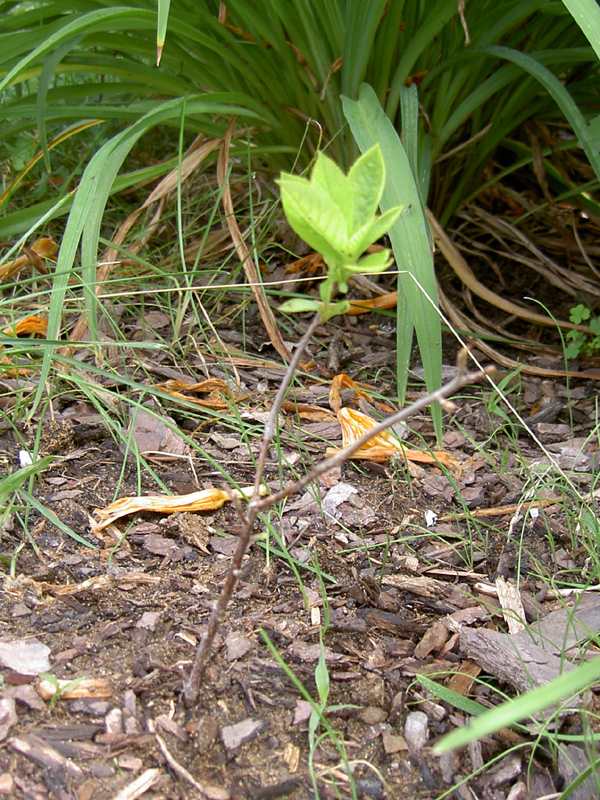
Leaves on the clethra.

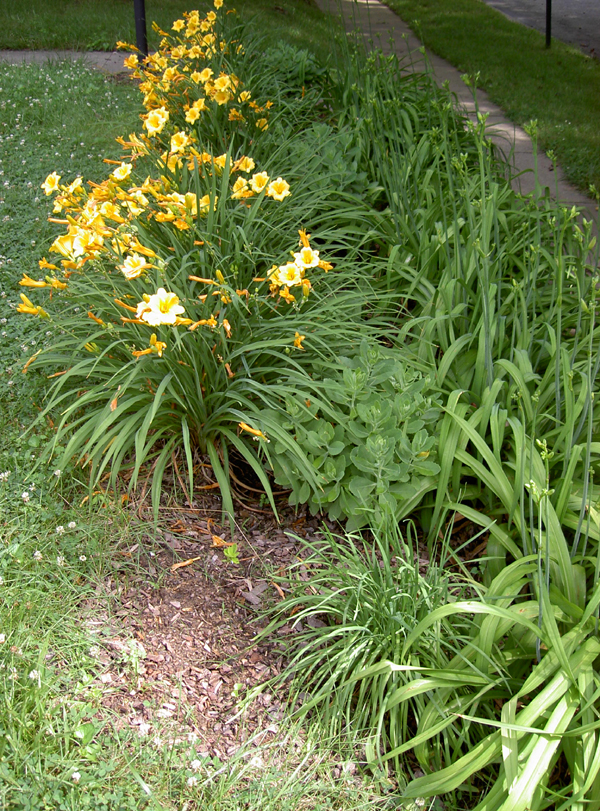
Elsewhere around the front yard everything’s loving all the rain and heat. The clethra now has a full set of leaves, and we’re hoping to see more shoots once it starts actually photosynthesizing. The aster that I left unmowed has bloomed all over with lovely yellow-centered white flowers. I kind of like it as an outpost at the property line, but I’m under some household pressure to relocate it into the flowerbed. The monarda has grown significantly, and now has a healthy colony of predator insects eating the healthy colony of aphids that discovered it within the first days of planting. It hasn’t bloomed yet, but I’m hopeful. The daylilies are bursting out all over, of course; they love this climate and have been reveling in the rain. I had been thinking of phasing them out in favor of more natives, as I wasn’t sure anything found sustenance in them; I’ve since seen some insects eating the pollen and at least one butterfly—possibly a Delaware skipper—drinking from a bloom.


The daylily bed, with the clethra in the lower left corner.

garden : foundation bed, volunteer wildflower, and leaves on the twig

garden : mystery flowers, lily refugees, and stumps


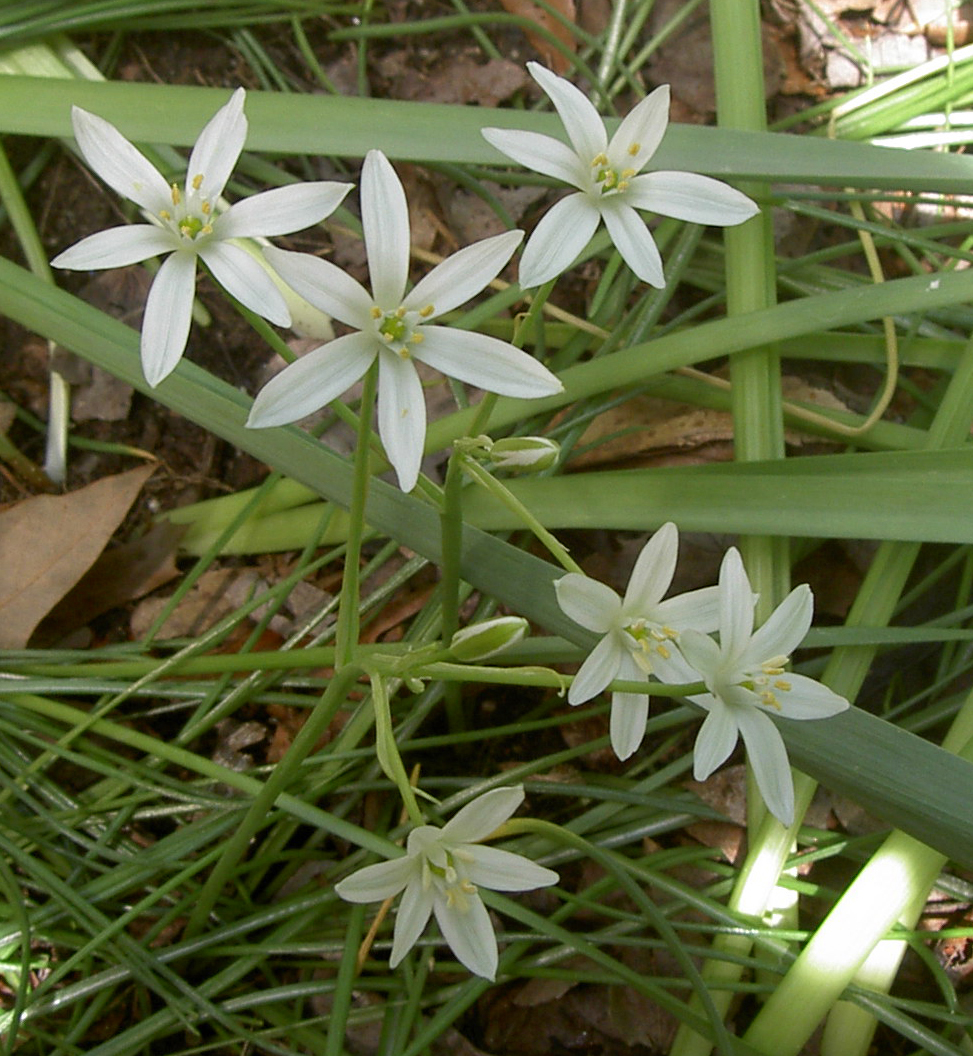
White mystery flowers.

There are these little white flowers that spring up all over our neighborhood in late spring. For a long time I thought they were spring star flower; now that I’ve received some ipheion from a neighbor I can see they’re different. I now believe they are zephyr lilies, however the most commonly described variety appears to be only one flower per bulb without branching stems and are listed as blooming in autumn. They could be a native regional variety in the same family; I haven’t been able to tell from photos whether this variety has a branching stem, although the habitat description certainly fits with our town. At any rate, I moved several clumps of them out of the lawn last year and into the small bed with the daffodils, on the right side of the porch steps. Only two bulbs sent up flowers but the greenery did quite well; as with the crocuses, I’m hoping to get many more flowers next year.

In addition to puzzling over these little white flowers, I spent some time this weekend transplanting perennial lilies from my neighbor’s front foundation beds. The folks who owned the house before her planted hundreds of spring bulbs through their flower beds a couple of years ago, and the lilies in particular are now coming up everywhere. True lilies are not my favorite flower—I find the scent overpowering—however, in the spirit of providing a refuge for the neighbors’ flowers, I took some and planted them along the back fence behind the peonies. Of course, as soon as I had them in the ground I became paranoid that they would bring black mold with them that would destroy the carefully nurtured peonies just as they’re ready to flower for the first time. This is the life of a novice gardener; never being quite sure that what you’re doing is really the best thing for the plants, always fearing that you’ve missed some crucial piece of information in the one gardening book you chose not to consult. In this case, nurturing the peonies has meant weeding around them, clearing the mulch off the crowns in early spring, and otherwise leaving them completely to their own devices. I’m sure it will be fine, and I can always resort to spraying toxins if things get completely out of hand. Not that I’m likely to go that route, but it sometimes helps to remind myself that the nuclear option is there, anchoring the other end of the continuum.

While I was busy moving lilies, my partner was hard at work removing stumps. You may remember that we are still in pioneer mode when it comes to the beds in the backyard, dedicating enormous amounts of time, energy, and sweat to clearing the various sapling stumps, pricker bushes, grapevines, English ivy, liriope, violets, Virginia creeper, and last but certainly not least, poison ivy. The way that works is that we work together with the spade to clear several yards of ground of anything that can be easily dug out, and then my partner spends hours toiling alone with the landscape bar and the tree saw to uproot the pricker bushes and tree stumps. Sometimes we invite friends over for this process, have a beer afterwards, and call it a party. Last weekend it was just us, and it was only the two stumps; nothing like two years ago when we did battle with the pokeweeds for what seemed like months and was really just days. As it has been every year, my goal is to have the side beds cleared of weeds and under mulch by the first frost. Why give it up? It’s a good goal!

We all have to have something to strive for, and my something is a yard bordered by flat brown stretches of bark chips. When that day finally arrives, I’ll be glad to move on to a goal involving actual plants. For now, the front yard is where I am able to fulfill my desire to have living, growing, flowering plants, and I let the backyard be where the killing happens.

garden : mystery flowers, lily refugees, and stumps

vacation : new life birds on Hilton Head

When we planned our trip to Hilton Head, I researched the refuges in the area and decided to stick with Pinckney Island NWR. It is close to the island, just over the bridge on the way to the mainland, and it promised miles of walking trails. Once we arrived in the area, I have to admit that the alligators put a bit of a damper on my enthusiasm for going hiking around in the marshes. I was nearly content to have spotted a Yellow-throated Warbler for the first time just across the street from our rental, in addition to Brown Thrasher, House Finch, Red-bellied Woodpecker, Blue Jay, American Crow, Common Grackle, Boat-tailed Grackle, Northern Mockingbird, Eastern Bluebird, Tufted Titmouse, Green Heron, Great Blue Heron, Downy Woodpecker, Mourning Dove, Rock Dove, and Carolina Chickadee just in the residential area where we were staying. In the end I manned up, and we went ahead with the plan and spent a productive Wednesday afternoon at the refuge, spotting several new life birds and revisiting some old favorites.

Just inside the refuge, there was a flock of migrating Whimbrels, with a Black-bellied Plover, a couple of Dunlins, and some Semi-Palmated Plovers mixed in. There was also a larger gray bird that was either a Willet or a Red Knot in winter plumage; having seen both of these birds before we chose not to spend all day squinting through our under-powered binoculars to make a firm identification. Shorebirds are the most frustrating to identify with the binoculars we have; they’re typically farther away with less distinctive coloring than woodland birds, so we’ve learned to do our best and then move on. Once inside on the paths we saw old friends—Northern Cardinal, Ruby-throated Hummingbird, Carolina Wren, Yellow-bellied Sapsucker, Blue-gray Gnatcatcher—but none of the tanagers that were rumored to be around. On the mudflats we saw our next new bird, a flock of White Ibis with brown-backed young. Further along, at the aptly named Ibis Pond, we found herons of all shapes and sizes, those we’d seen before (Great Blue Heron, Green Heron, Great Egret, Snowy Egret, Black-crowned Night Heron) and two lovely new additions: Little Blue Heron, Tri-colored Heron, and an adult male Anhinga (we later saw a female near our house). The Little Blue Heron wasn’t exactly the first sighting; we’d seen a young one the day before along the lagoons where we were staying, and I probably saw one during our trip to Chincoteague five years ago. Nonetheless, this was the first up close and confirmed sighting of an adult bird for me, and it was fun to watch it fly back and forth bringing bits of grass and twigs for a nest.

After hanging out at Ibis Pond for a while, we hiked a loop around what was advertised as Osprey Pond and Wood Stork Island, highly motivated to get a sight of the uncommon and elusive Wood Stork. We never did. What we did catch sight of, though, were gazillions of mosquitoes and a few alligators; the latter sighting led us to conclude that Pied-billed Grebes must not be very tasty, because on two occasions they were the only bird in the water near the enormous prehistoric reptile. During this trek we saw more Eastern Bluebirds, several Great-crested Flycatchers, an Eastern Phoebe, Red-winged Blackbirds, Brown-headed Cowbirds, the aforementioned Grebes, and a pair of Common Moorhens, but nary a stork. Nor an Osprey for that matter, but we had the excessive good fortune to have an Osprey nest in a palm tree behind the house next door, complete with young that plaintively cried out each morning as its parents harried it from the nest and into the air. Having booked it out the woods at the refuge and left the grass paths behind, we made another circuit of Ibis Pond in the hopes of finding a Wood Stork but only saw a couple more alligators, which apparently aid the nesting birds by eating predators like raccoons should they attempt to go for the nest. Or so the sign near the bench where we collapsed in a haze of citronella spray informed us. On the way out of the refuge, we did manage to see a male Painted Bunting at close range, which cheered our spirits greatly; they nest on the refuge and we’d been unable to flush one on the way in. I consider six new life birds to be a successful excursion, and I left happy; having to bark at some mating raccoons to get them off the path was just icing on the cake.

Overall, Hilton Head was a great place for wildlife sightings. In the lagoons around our housing development we saw several kinds of very large turtles, one of which we had to rescue from the middle of a road—Carolina Diamondback Terrapins, Eastern Mud Turtles, probably Chicken Turtles, and possibly Common Musk Turtles (I believe I saw the distinctive two lines on the head, but they dislike brackish water). We had Green Anoles around the house, and my partner startled a Five-lined Skink out of the bathroom when we visited Daufuskie Island on Thursday. During the boat ride over, we also spotted a couple of new birds—Royal Tern and what we are pretty sure was a White Pelican—and some familiar ones (Brown Pelican, Double-crested Cormorant, Least Tern, Forster’s Tern, Laughing Gull, Ring-billed Gull, Barn Swallow and Tree Swallow) in addition to several groups of Bottlenose Dolphins. We saw a whole flock of Black Vultures along the side of a road, with their white hands. Add to these the starfish, crabs, clams, and keyhole urchins we saw on the beach, plus the dead armadillos on the side of I-95 and the mystery snake we saw the heron eating behind our house, and it was quite the wildlife-filled vacation.

vacation : new life birds on Hilton Head