food : first attempts at canning cherry jam

The first attempt at making cherry jam did not go well, at least if you wanted the outcome to be cherry jam and not very sweet cherry sauce in a jar. There were a few things I did the first time that I did differently the second time that led to the second attempt being recognizable as jam (whether it’s still runny jam remains to be seen). One, I used frozen cherries and didn’t let them thaw first. Two, I didn’t cook the cherries long enough before adding the sugar. Three, I misoverestimated the volume of cherries I had and correspondingly added way too much sugar. As a result, I got cherry sauce, more cherry sauce than I have any idea what to do with as we regularly eat neither pancakes nor ice cream.

The second time around, I did all of those things differently. I used fresh cherries, cooked them until they were all coming apart, and then added a proportionate amount of sugar. Thus far what’s in the jars looks like jam and it’s already less runny than the cherry sauce; yes, I keep tipping the jars to the side even though you’re not supposed to touch them while they gel up for 24 hours. As I was boiling and stirring the second batch for what seemed like a really long time, I did some math in my head and concluded I could use four of the jars of cherry sauce and a quart of fresh cherries as the base for the cherry-walnut conserves that I’m planning to make tomorrow, and have just about the correct amount of fruit and sugar. That will leave me with only four jars of cherry sauce—a number that seems manageable and like an amount we could work into desserts over the course of a year—and with two quarts of fresh cherries to make another batch of jam.

The very last canning-related thing that happened today was that one of my pickle jars exploded when I put it in the hot water. Which was really frustrating because (1) pickles are supposed to be easier than jam and (2) I never know whether to boil the jars in sticky water or try to skim out the stuff and add fresh water or what. This happened with one of the jars of apple chutney in the fall, suddenly the pot was full of floating raisins and bits of onion, and I went with the skimming and dilution with fresh water approach. This time around I just boiled them in sticky water and wiped down the jars when they came out.

So, tomorrow we will redo today. I will prep the cukes first, so that the four hour soak happens early in the day, for which I will also prepare by refilling the ice cube trays before I go to bed. I will then one quart of cherries and make the cherry-walnut conserves, pit two more quarts of cherries and make another batch of jam, and then do another round of bread and butter pickles. I will then be done with all of the fresh cherries I have remaining and the cherry season will be behind us; I passed on the last few quarts were at the farmers’ market yesterday due to the many I already have. My shoulder will certainly be glad to move on to a tool besides the cherry pitter, that’s for sure.
food : first attempts at canning cherry jam

food : cherries, cherries, cherries


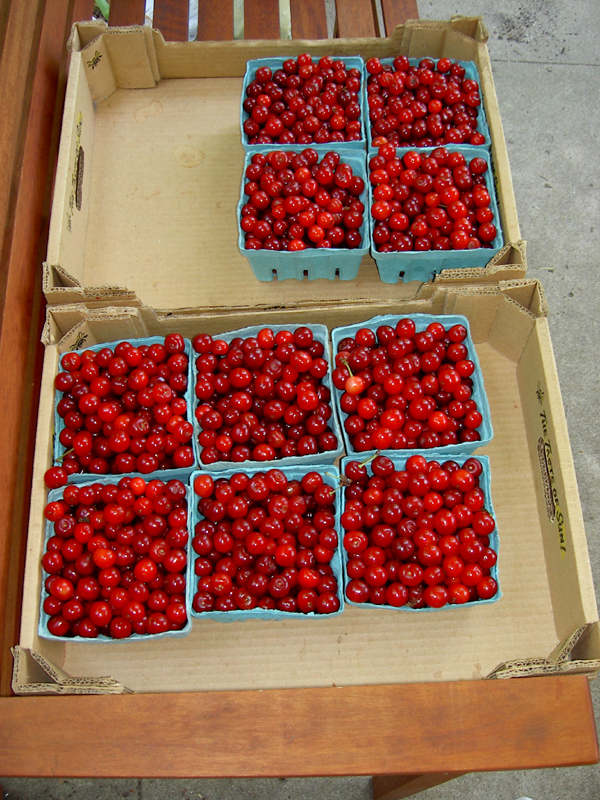
Cherries on the porch.

This is the time of year I’ve been waiting for: sour cherry season! I like sweet cherries fine, but you can’t bake with them, and it’s the sour cherry baked goods that I love. Pie, mainly, but also strudel and turnovers and muffins and croissants and danishes. When they’re well done, that is; there’s nothing I like less than a chemical-tasting dyed imitation of any of these fine products. Which is why I was so excited to discover a local source of sour cherries—besides the backyard of a woman I know, whose sour cherries are already spoken for—so that I can make all these things myself.

My first cherry pickup was ten quarts. That seems like a lot when you’re pitting and storing them, but really isn’t that much when you think about all the stuff you want to make with them. Including a recipe that I found online for something in between chocolate cake and brownies filled with cherries, which was absolutely mouthwateringly moist and delicious (I think all the naysayers must have just used sweet cherries, which we all know are for eating not baking). And jam. How could I forget jam? I didn’t forget jam, I just neglected plan for jam in the first round. Which meant that this week I picked up even more sour cherries at the market and continued the pitting through the week. Jam-making will be today (and possibly also tomorrow, depending on how many more cherries are available at today’s market). I plan to use David Lebovitz’s no-recipe recipe. While I’m making jam this week, I may as well also try the Cherry Walnut Conserve in the all-purpose Ball canning book, right? I mean, she gives me a discount if I buy in bulk, so it’s better to get more quarts than fewer. Having cherry jam in the dead of winter will make all the pitting worthwhile!

food : cherries, cherries, cherries

food : mojito pickle

One of my goals this summer is to use the produce I get from our CSA and the farmers’ markets in a greater variety of ways. In the past we’ve frozen baba ghanoush, cooked squash, diced rhubarb, blueberries, persimmon pulp, and sour cherries. We’ve canned applesauce, apple pie filling, apple jelly, apple chutney, and quince jelly. This year, I’m planning to branch out into pickles—using the mandoline slicer I acquired last year—and new types of jams, conserves, and chutneys.


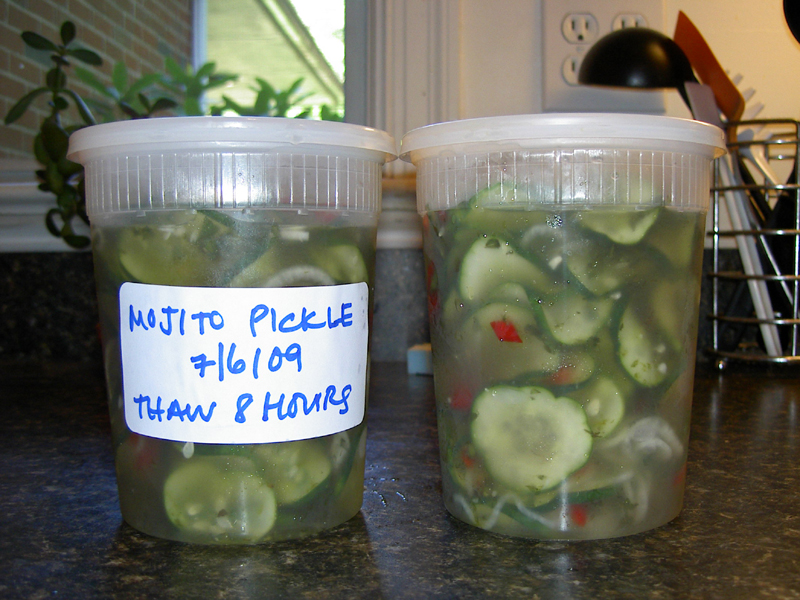
Pickles ready to go in the freezer.

It was my intention to start the pickling with bread and butter pickles, using a lower-sugar recipe from The Joy of Pickling (of which there’s a new edition with fifty more recipes, which would explain why the one I have was in the bargain bin). Then my neighbor showed up at the door with armfuls of mint that she was ‘thinning’ from her garden, so I went with what we’re calling the mojito pickle instead. This is a freezer pickle, and uses lime zest and fresh mint as flavors (in addition to the traditional red bell pepper, onion, and garlic). As far as I could tell by sampling it as I packed it into quart tubs this morning, it’s pretty great. I’m still going to do bread and butters, and if I find other cucumber-based pickles that sound appealing I’ll pick up more at the farmers’ market on Thursday.

Equipment-wise, the mandoline turned out to be much less complicated and dangerous than I’d feared, and was a breeze to use for the cucumbers. We do need to sharpen our knives before veggie slicing season really heats up, but I couldn’t get 1/8 inch slices with a knife if my life depended on it. For the bread and butters, I might even use the ripple cut option.

food : mojito pickle

burned on the Fourth of July

The good news about the Fourth of July is that, as I did last year, I made another delicious cherry pie and shared it with my friends. I’m stocking up on fresh sour cherries at the farmers’ market while they’re in season; most of them are going into the freezer, but a goodly number are going into things we can eat right away. Being, you know, from the north and all, I grew up on cherry pie and am more than happy to bake pies myself just so I can have my favorite dessert whenever I want. This year, I used Gourmet‘s recipe and didn’t bother to make a lattice top as I did last year with the Bon Appétit version. (Both can be found on Tastebook or Epicurious; I prefer Tastebook but not every likes to create a login in order to search.) So, cherry pie, that was good.

The bad news about the Fourth of July is that I went to the College Park fireworks on the University of Maryland’s campus and got hot ash in my eye. We had already moved our blankets farther away from the barrier because a flaming piece of debris caught our bag on fire after nearly landing on my partner’s upturned face. (Not that we were particularly close to start, as I don’t really enjoy fireworks that much; I’m with the eight year old who walked by and said, ‘Mommy, that sounds like guns!’) Anyway, when the ash blew into my eye I poured half my water bottle over my face to try to flush it, but it was still burning and stinging so we went to the paramedics (or EMTs, whichever are the firefighter ambulances rather than the hospital ambulances). A very nice firefighter named Lauren and an older guy whose name I didn’t catch flushed my eye with the official eye-flushing stuff and it went from burning to just feeling like I’d gotten a stick in my eye. Once home—at this point we left, as you might imagine I wasn’t in the most nationalistic of moods anymore—I called our medical advice nurse and she told me that I would be fine since I didn’t have either searing pain or loss of vision, but just to be safe I should stand in the shower and let the water run into my eye while blinking for five minutes. Five minutes is a crazy long time to have water running over your eyeball; I managed two. The first minute I was distracted by the burning in my previously non-flushed eye, which was parched from the smoke at the fireworks and the chlorine at the pool earlier. After that, it was just a matter of white-knuckling it through the creepy feeling for as long as possible, which wasn’t very long in my case.

Happily, my fear that I would wake up the next day not able to see did not come to pass. I can see, and my eye feels no worse than when a twig of a low-bridge town tree gets me in the eye in the dark. (You would think glasses would provide a tad more protection, but apparently not.) However, attending local fireworks displays will now join driving on the Garden State in the category of Never Doing That Again As Long As I Live So Help Me God.

burned on the Fourth of July

Food, Inc. screening

A couple of weeks ago, we went to a pre-release screening of Food, Inc., downtown at the E Street Theater. We’d never been; it’s nice and worth the trip downtown to be able to see limited run films in a contemporary setting. Old theaters have a lot of charm, however there’s a lot to be said for being able to feel your kneecaps when you get up to leave.

The film itself was well done. There wasn’t much new information in it, although I was pleased to see that my favorite parts of Pollan’s book—the bit about the pastured chickens and the section about corn corn corn—were apparently everyone’s favorites, as they were the basis for a large segment of the film. I had a reaction similar to my response to The Omnivore’s Dilemma, which was to think that either I was even more unusual than I realized (there is at least one person in our household who is a proponent of this view) or the authors really misunderestimated their audience’s knowledge. In support of seeing the film even if you already know everything it’s telling you, it’s definitely more striking seeing an aerial view of factory cow farms and an up close view of chickens that are simultaneously too big and underdeveloped to be able to hold themselves up than just reading the book (or watching Chicken Run for the gazillionth time). It’s easy to see footage of bushels of potatoes rolling down assembly lines being cleaned and sorted and be lulled into an easy contentment about how nearly Jetson-like our current era is; it’s nearly impossible to do the same when the potatoes are chickens. Similarly, while reading anything about Monsanto is enraging, the segment covering their persecution of an old Hoosier over his seed-cleaning business made me feel more loyalty to where I grew up than ever before. Also, I wanted to fly back home and personally beat to death (this is hyperbole, FBI) the schmuck of a lawyer who was willing to get his minute of fame stating on camera that losing this case would set a terrible precedent, but wasn’t willing to see it through to the end pro bono. [Insert your favorite ass-word derived expletive here.] Yes, it’s true that every time I see an old guy operating somewhat arcane machinery I think of my grandfather, and that makes me sentimental; it’s also true that the Indiana I grew up in may look the same—miles and miles of corn and soybeans destined for industrial processing—but it’s been totally transformed socioeconomically by Monsanto and that idiotic Thomas-driven decision. (If you’re reading this, Supreme Court, that one is high on the list of ‘stupid things that never should have happened, that we can get down to work reversing just as soon as humanly possible.’)

Besides rousing my ire, only moderately soothed by having had the foresight to wear my ‘Food for people, not for profit!’ t-shirt from the UMD food coop, the film did a decent job of highlighting the way in which our food choices are about more than just the concentration of pesticides in our toddlers’ urine. They are about the way the workers who harvest our food are treated, the health of the communities uphill from the slaughterhouses and downstream from the CAFOs, the economic solvency of the farmers who buy the seeds and rent out the chickens, and the preservation of the natural variety that makes our ecosystems more resilient when faced with pests and disease. This is the part where my partner believes I’m the unusual one, because I think about all those things when I decide how to spend our money, and at this point I’m feeling pretty confident about our mish-mash of choices. I know that we are privileged to have the marginal income to choose to spend on food rather than cable TV, and still pay for health care as well. I know that, and I’m not talking about personal economic choices made by the working poor. I’m talking about the choice to take the time to cook something from scratch, rather than buy the thing that’s full of corn syrup made from the corn grown by a guy in Indiana under the yoke of Monsanto and dependent on federal subsidies. I’m talking about the choice to pay more per gallon of milk to know that the money is going to farmers who are treating their animals well rather than to the shareholders of an enormous company that buys up farms and consolidates them just as soon as organic food starts to look profitable. I’m talking about making this balance work by eating less meat and processed food, and shifting the savings toward the budget for organic vegetables and dairy.

Really, I’m talking about putting your money where your mouth is and making a commitment to a way of participating in the food provision system in this country that reflects your core values about workplaces, environmental impacts, and product quality. Yes, I know not everyone cares as much as I do about whose pockets the profits from my dollars go into at the end of the day (or the quarter), and that’s fine. But everyone cares about something that can be reflected in how we spend our money and obtain our food, and that’s really the larger point that Food, Inc. is making. Figure out what that thing is for you, and let it guide the way you shop and eat, whether it be workers or green spaces or farmers or pesticides. It may take longer and appear to cost more than the alternatives, but we’ll all be part of a happier and healthier society for it.

Food, Inc. screening