bad milk from J-Wen Farms

After my excitement last week to have a dairy vendor at the Riverdale Park Farmers’ Market, I’m ticked off that the milk I purchased from J-Wen Farms was bad when we opened it, five full days before the sell-by date. It wasn’t totally rotten, but it was putting off an odd smell that my partner thought was maybe just the grass aspect. Of course, he now has a headcold and I wasn’t here with my non-chemistry-lab-damaged nose to tell him the smell was definitely the milk going bad, so he had some. And now he’s feeling it. Probably I shouldn’t have bought milk that was not labeled pasteurized and was being sold out of a plastic tub filled with ice cubes; so much for assuming that the online comments I found about the milk’s inadequate shelf life had probably been addressed. However, I understood the vendor’s explanation of heating to 145F to be pasteurization, and the jug was labeled with a date of April 25th. At any rate, I emailed the Farmers’ Market coordinator and have saved the milk in case they need it to test for salmonella or whatever makes milk bad other than improper heating and/or storage.

Thus ends my foray into local milk sold from something other than refrigerated cases and labeled something other that PASTEURIZED.

bad milk from J-Wen Farms

good finds at the farmers’ market


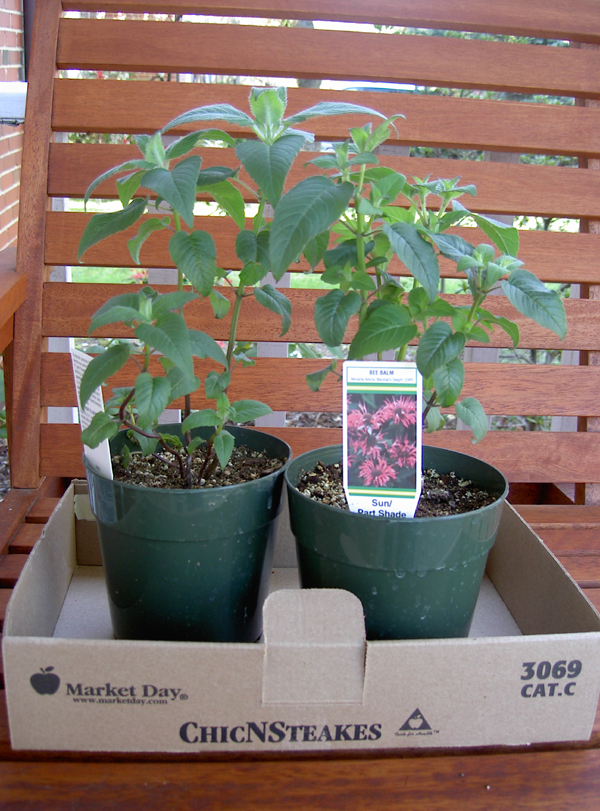
Two plants waiting for their spot in the ground.

This week was the second of my local farmers’ market, and I found much to tempt me. You might think that having 70 plants on order would have satisfied the desire for flowers; you would be wrong. I managed to escape with only two Bee Balm plants; if I’d had more cash and an actually-developed plan regarding where the culinary herbs are going to go it would have been a lot worse. However, I was glad to find the Bee Balm, as it’s a plant I wanted to include in the garden and hadn’t found in the catalogue from which I ordered. And, I have that little spot around the corner that needs filling in; I think the Bee Balm will nicely bridge the gap between the (soon to be two varieties of) irises and the wee white azaleas.

In addition to the flowers, I bought dairy products from the new dairy vendor, J-Wen Farms. The cheese looked too good to pass up, and my choice was (what’s turned out to be) a nice sharp cheddar. I’ll definitely be trying their various goat milk selections in the future. I also bought milk for my partner, and we’ll see if he likes it. I’m happy to support a local option for pastured hormone-free not-ultra-pasteurized milk if the quality is there. All those things plus organic would be ideal, but cows that rotate into a fresh paddock every day all summer are close enough to the mark for me to give it a try.

I didn’t buy any produce as we’re still working our way through the last of our winter CSA greens, and I won’t be buying much next week since we’re going out of town for a week just two days after the market. No doubt there will be many more options when I return in the first week of May; asparagus is nice, but I’m more looking forward to the appearance of sugar snap peas.

good finds at the farmers’ market

gratitude for a chicken life well-lived

It’s only been since participating in our CSA plan that I’ve cooked whole chickens. We signed up for the chicken option since we do eat chicken, and I liked knowing that the birds would either come from the farm (laying hens) or from local Mennonites with whom our farmer has an arrangement (roasters). I wasn’t prepared, though, for how emotional I got the first time I had the little naked bird carcass in my house. I cooked it, but it was hard; we ate it, and had a long moment of gratitude for the chicken’s life. It was delicious; we appreciated each bite.

It’s less difficult for me to cook a chicken now, mostly because I know what I’m getting into. I reevaluate each year whether I want to continue to receive chickens, and two more times now I’ve chosen yes. While the roasters are delicious, it’s the stewing hens that I feel an affinity for. I, along with nearly 100 other families, have eaten the eggs they’ve lain over the past three years. I have eaten the vegetables grown with the potent addition of their waste and kept free of many insect pests by their daring predation. I accept that their lifetime is limited, and that they won’t be able to lay eggs forever. I also accept that our farmer has chosen not to be driven by a chicken’s schedule, and won’t be replacing this flock. So I choose to accept the last gift of not one but many meals, in the form of the chicken stock I make and the meat full of all the flavors of what passes for wild living for a chicken.

Today I picked up the first of this winter’s chickens, and I feel a bit sad for it. I appreciate it and am looking forward to the meals it will provide, but I’m grieving a little bit as well. In a moment of the kind of timing that was completely absent last week, my replacement stockpot arrived yesterday, so the hen is already stewing. I have ambivalence about eating her, but that ambivalence is only one part of the multifaceted evaluation I make each time I choose my food. On balance, I would choose the same way again. Still, she deserves her moments of recognition, and today I will take time to make sure that this one chicken’s life has not passed unnoticed.

Thank you for the eggs, and the predation, and the poop. Thank you for your years of avian service. Thank you, in advance, for the delicious soups we will enjoy this year, flavored with your years of chicken experiences. Never let it be said that I forgot my food was once a living being.

gratitude for a chicken life well-lived

food : all things quince


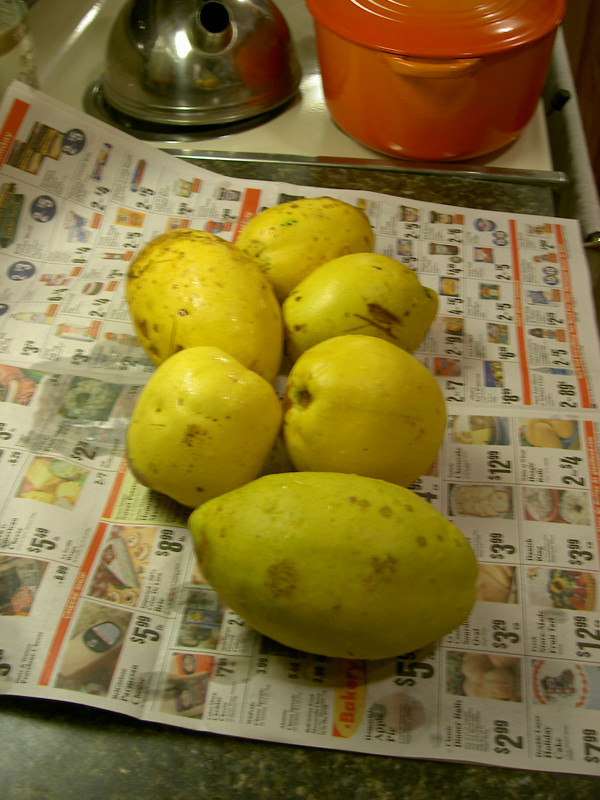
Quinces from our backyard.

One of the best surprises we’ve had as we’ve gotten to know our house and yard was the discovery of quince trees in the rear corner of our neighbor’s yard, along the border between our two properties. Because we are the neighbor to the south, and there are other trees to the north in our neighbor’s yard, the trees grow toward the sun, overhanging our rear sidewalk and garage. During the first year we were here, we saw one or two yellow things on the ground by the back fence, and commented to each other that an animal must have dragged an apple or something into the yard and left it there. That was the sum total of the interest we paid in the situation and the energy we expended in addressing it: very little. We were busy with other parts of the yard, and a bit overwhelmed by the sheer amount of work it would take to clean up the property; the last thing we wanted to do was investigate mysterious happenings out by the garage.

The second year we were here, we spent more time in the yard during the autumn clearing the ivy, pruning the trees, and covering the weed-laden garden beds with a thick leaf mulch. During all that time in close proximity to the rear yard, we noticed that the yellow fruits were actually growing on the trees, and were littering our rear sidewalk by early November. This piqued our curiosity, and we consulted one of my partner’s colleagues who grows quite a lot of his own fruits and vegetables on a lovely piece of land that used to be part of a dairy farm. He told us we had quinces, a fruit of which I had only heard vague and mysterious references to before that point. Nonetheless, I gathered them up and set them on the back steps to cure while I figured out what to do with them.
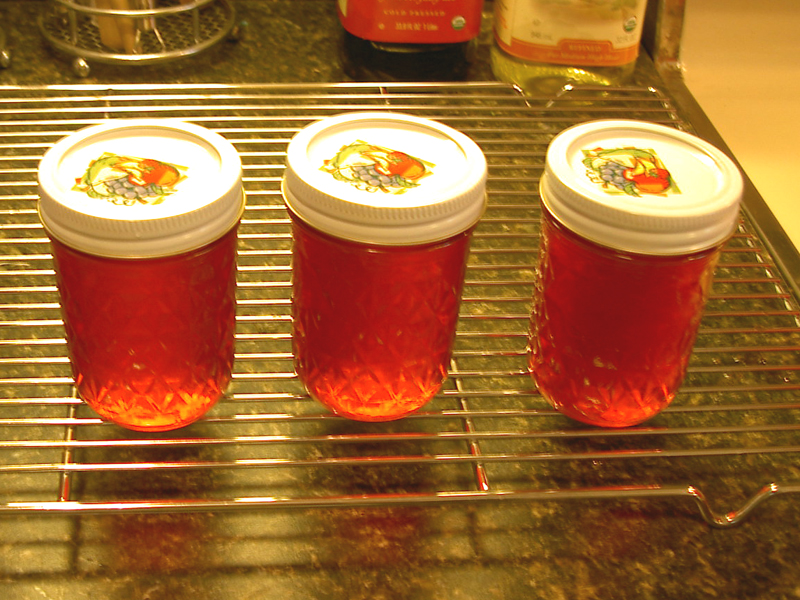

Quince jelly.
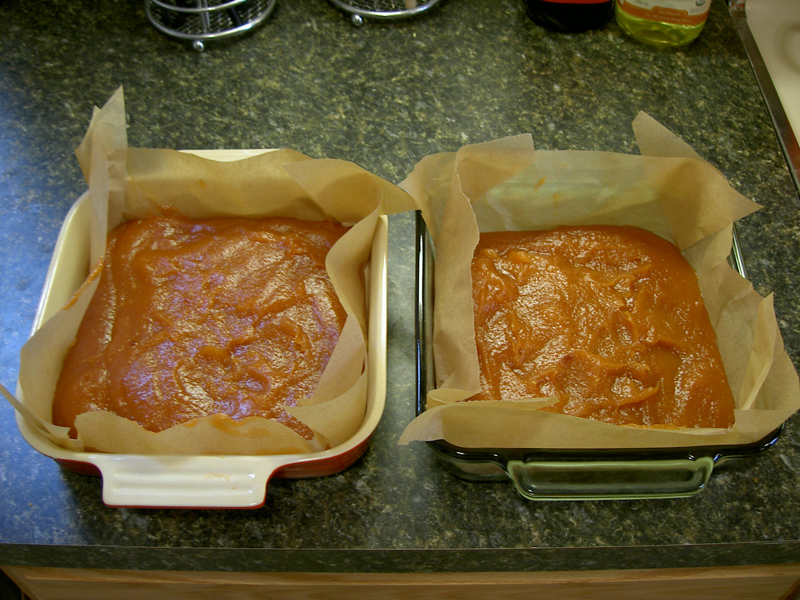

Quince paste.

There are, it appears, two things to do with quinces. You can make jelly or you can make membrillo, a thick paste that is a favorite dessert in Spain that’s served with manchego cheese. You can also bake and poach them, mixing them in with apple desserts for additional flavor, which we tried as well. With two dozen enormous yellow fruits having literally dropped from the sky into our yard and folks all over the internet raving about the glory of the flavor of the quince, I decided there was nothing for it but to make jelly…and membrillo, since it would be a shame to have all the pulp just go to waste. This was my first foray into canning, and I had to improvise somewhat. I used a stockpot for the boiling water bath (which, by the way, I don’t recommend) and set to work chopping and boiling and draining and boiling and skimming and stirring and pouring, ending up with about a dozen half-pints of jelly and about 20 pieces of membrillo. Happily, everybody I know seems to love membrillo, a delicacy I had never heard of before embarking on this new culinary path. We were able to give away the membrillo, in addition to serving it to guests at every opportunity, and enjoyed the jelly for much of the year. I also learned that canning is actually not that hard — although quince jelly is arguably the easiest product to start with, containing just the right amount of natural pectin to gel on its own and turning a lovely deep rose color to let you know when it’s done.

Following this roaring success, we made a concerted effort to help the trees this year. We cut back the ivy that surrounds them and pruned all the not-inconsiderable deadwood. Once we knew what to look for, the trees became incredibly easy to identify, and we were pleased to discover two small saplings at the sides of the main grove, no doubt sprung up from fruits left to lie under the thick ivy ground cover. Later in the spring we were rewarded first by flowers and then by little green fruits. Little green fruits which soon littered the ground when the gale-force winds of the early summer storms blew through. This autumn, there was not a single yellow fruit on any of the trees, much to our disappointment. We are hopeful that quinces are like some varieties of pears, with large and small production years, and that next year will be a banner year. In the meantime, I have been combing the internet for a mail-order source of quince fruits, to no avail, having learned the hard way that their floral flavor is truly as addictive as quince fans claimed!
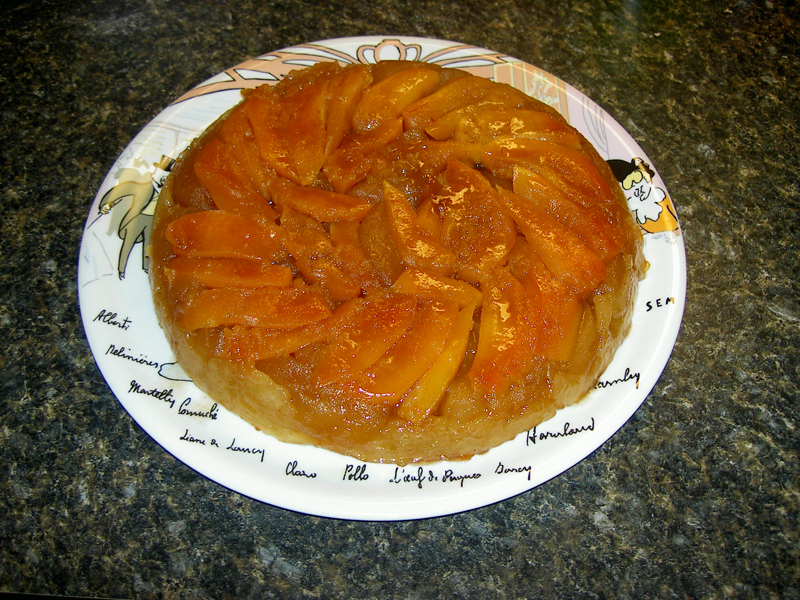

Tarte tatin, with a layer of quince slices — magnifique!
food : all things quince