gay marriage and the US Constitution

The past few weeks have been exciting ones for gender parity in civil marriage, and it looks like there’s more to come. Iowa and Vermont have joined Massachusetts and Connecticut in ending the use of gender as a qualifier for marriage eligibility, and the legislatures of New Hampshire and Maine have passed their own bills that await the signatures of the Governors to become law.

These developments are great for people who want to be legally married, there’s no doubt about that. They are also great for law nerds in love with the Constitution, as a full-blown constitutional crisis is brewing with all these changes. Closer to home, and most significantly from a legal perspective, the District of Columbia just passed a bill (expected to be signed into law by Mayor Fenty in the next few days) that joins New York and makes explicit a recognition of all marriages performed in any state in the country. I say ‘makes explicit’ because the Full Faith and Credit Clause of the federal Constitution requires that states recognize the legal acts and proceedings of other states, which includes legal marriages and adoptions, as well as debts, wills, and the transfer of deeds to things like cars and houses. You wouldn’t, for example, expect to drive over a state line and no longer be the owner of your car. Every time a person has moved to a new state and filed their taxes as part of a married couple or enrolled their adopted child in school, they’ve relied on this provision.

Before the furor over people of the same gender marrying each other, it would have been ludicrous to suggest that a person could be married in one state but not the next one over, or could be the legal guardian of a child here but not there. Freedom of movement would be greatly constrained by such a position, and the Privileges and Immunities Clause would be similarly undermined. Yet this is the position that several states, Virginia among them, took in their zeal to block people of the same gender from marrying each other (many more states passed amendments limiting marriage to persons of opposite gender without explicitly denying recognition of the acts of other states). Instantly, a constitutional conflict was born, one that has only become more nuanced with time. When Massachusetts modified their marriage laws last year to grant licenses to non-residents, the Full Faith and Credit Clause moved front and center; what would happen to same-gender couples when they returned to their home states? (Opposite-gender couples would still be married, as they’d always been, as a matter of course.) New York was the first state to move to recognize all out-of-state marriages, via court rulings; the District of Columbia is the first jurisdiction to recognize all out-of-state marriages via legislation.

From a nerdy legal perspective all of this adds up to, I think it’s fair to say, the most interesting bundle of legal decisions to be made regarding the interpretation of the Constitution and the reconciliation of federal and state legislation since the Jim Crow era. There are, of course, the state-level conflicts regarding the granting of certain privileges to some while depriving others, both within a given state via amendments restricting marriage to people of opposite genders, and between two states as described above. Beyond those concerns, there remain the Equal Protection Clause issues of whether DOMA discriminates on the basis of gender and whether the federal recognition of some legal marriages and not others is a prima facie violation regardless of any gender stipulations (and of course, the even nerdier question of whether the clause can be addressed directly to federal legislation). May we live in interesting times, indeed!

Sadly, for those hoping to have their marriages recognized by the federal government and any state in which they might want to live and work, we’re not likely to have resolution to these questions for some time now, I’d say on the order of years. First, we need some test cases; the Massachusetts case challenging the federal recognition of some legal marriages but not others is a start. Getting a plaintiff with standing to challenge the violations of the Full Faith and Credit Clause is trickier from a practical standpoint; it’s asking a lot for a family to move to a place where their marriage rights (or better yet, the legal adoption of their child) will be summarily removed, and theoretical restrictions on movement are not enough to bring a case. Next, there will have to be conflicts for the Supreme Court to hear the case; in the instance of a direct challenge to the constitutionality of DOMA, that will probably happen. In the instance of differential state-level provisions, a Circuit-level difference of interpretation would normally be required; in this situation, the Court might choose to speak to that question while addressing DOMA, but realistically that would only happen if the Court were going to rule that DOMA violated the Equal Protection Clause. Which brings us to the last and most crucial step, having the case be heard by a Court committed to ruling on the legal questions rather than the social ones. It is no doubt the preference of the Court to leave marriage eligibility to the states, as has historically been done with voting eligibility, but the overt conflicts will require a ruling at some point.

Everything could be sped up and made easier for the Court if Congress were to overturn DOMA, as the Full Faith and Credit issues are the most clearcut. Without DOMA, the federal government would recognize all legally married couples regardless of gender. The laws in Massachusetts and Iowa, which grant licenses to out-of-state couples, create a situation where anyone with the means to travel to one of these states may become legally married and could gain access to federal marriage privileges. This course of action would leave to the Court the need to rule only on the relatively mundane legal issue of requiring states to recognize the actions of other states; as this is made explicit in the Constitution, it need not be controversial at all.
gay marriage and the US Constitution

vacation : beach

I love the beach. Any beach, any weather. I love the pebble beaches of Lake Erie, the quicksand swampy beaches on Cape Cod, the cliff-lined beach in Carlsbad, and the rocky beaches in County Donegal. It is safe to say I haven’t met a shoreline I didn’t like. Hilton Head is no exception, which is no surprise, as everyone loves the beach there. The sand is hard-packed and easy to walk on, the high tidemark is (seeming) miles from the water at low tide, and there are all kinds of sea creatures great and small wherever you turn. Since this wasn’t my first trip to the ocean, I didn’t insist on going in the (still quite cold) water for hours on end; instead we walked the beaches nearly every night and participated in a ritual dunking on the last morning of our trip.


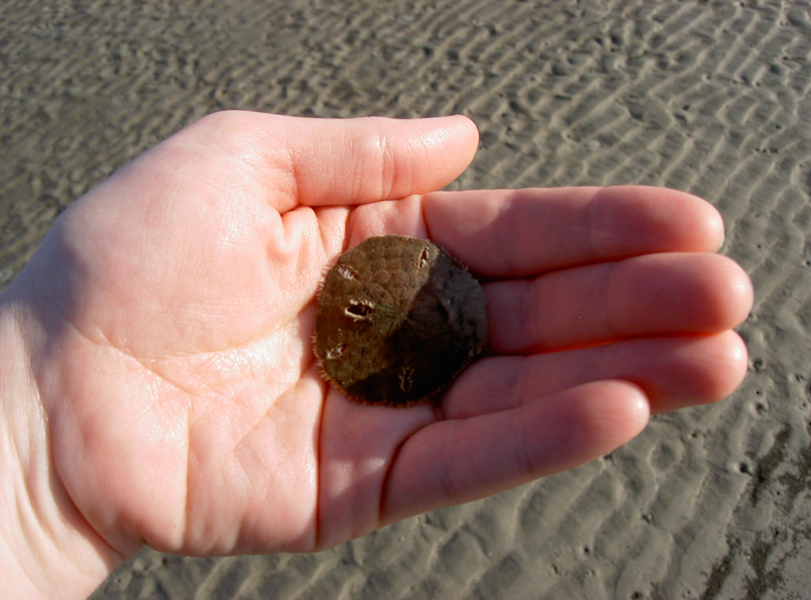
Keyhole urchin.

I had very few goals on this trip, and one of them was to acquire a sand dollar. Acquiring a sand dollar of a consequential size from the beach is harder than I realized, for a few reasons. First, it’s illegal to take them from the beach when they’re still alive. Second, they usually live along the bottom of the ocean. Third, if and when they do wash up onto shore, the gulls peck at them and break them, especially the larger ones (which I imagine are the only ones that have enough food inside to make breaking them worth the trouble). This adds up to lots of pieces of larger sand dollars, which are the skeletons of dead keyhole urchins, and lots of smaller living keyhole urchins washed up on the beach at high tide, and quite a few pecked at and soon-to-be-both-dead-and-broken keyhole urchins, but very few of our target item of suitably-dead-but-neither-broken-nor-tiny sand dollars. In the end, we collected a handful of what could best be described as urchin corpses: urchins that were in a relatively advanced state of decay but had not yet dried to a full sand dollar skeleton. In the end I was glad that I took this approach, as there were hundreds of sand dollars washed up on the beach that night and none any of the other days we were there. We also saw two starfish that night, floppier than the ones in the Northeast and beige-speckled like the crabs we came across; no pictures of either of those, as I was busy trying to throw them back out into the water.


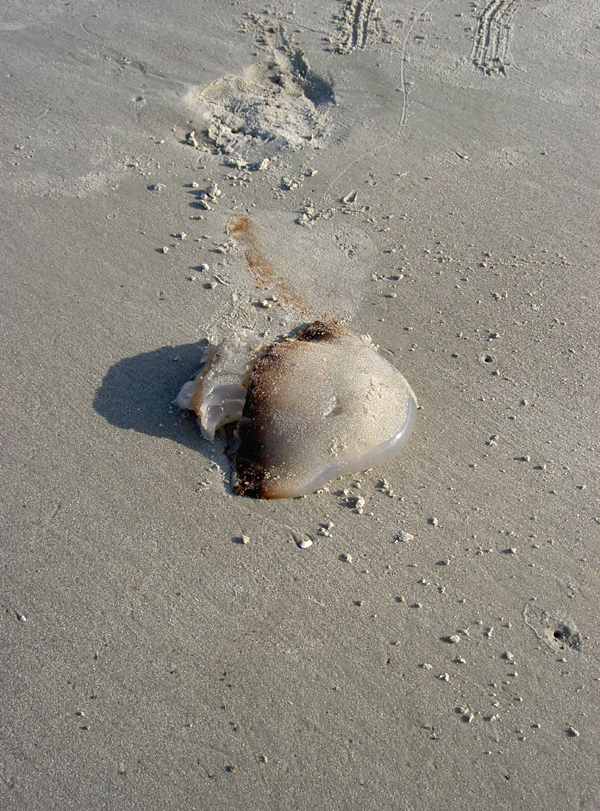
Jellyfish, washed up.


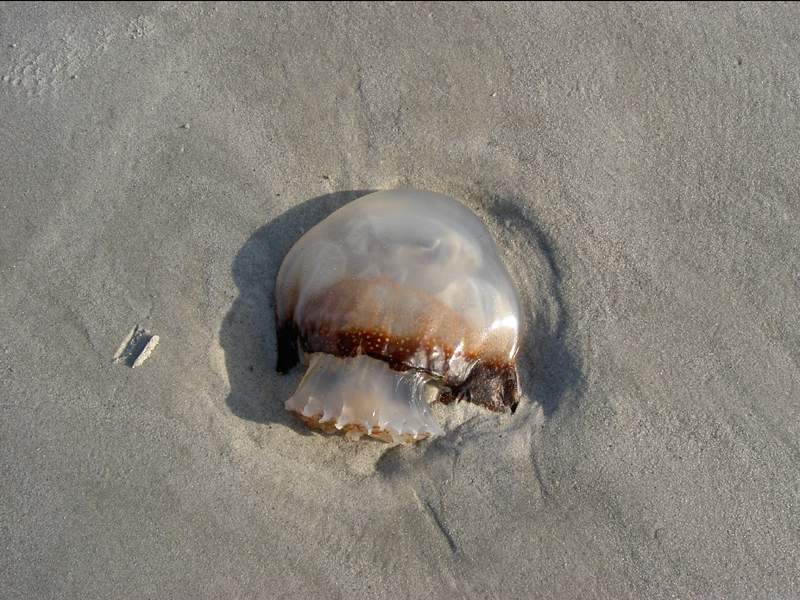
Different jellyfish, washed up and kicked around by children.

I think it’s safe to say that the most disturbing part of our vacation for my partner was the jellyfish. Since Hilton Head is where I first visited the ocean, and my first visit was following relatively major storms, the jellyfish that were washed in with the tides were exactly as I remember jellyfish. Enormous. Which is why I’ve always been trepidatious about them, and have stood in awe of those friends from the Northeast who poo-poo jellyfish and talk about ‘just brushing them aside’ should you happen to encounter them in the water. Apparently, this awe has been totally unearned all these years, because jellyfish in the Northeast are about two inches big. Yes, two inches. No wonder they thought I was a silly land-lubbing Midwesterner for being just the teensy bit afraid of getting stung and not terribly confident in my ability to ‘just brush them aside.’ Because the jellyfish on Hilton Head are quite literally as big as my head, that’s why. Once my partner realized this he pretty much refused to go in the water at all, and most definitely refused to go in the water along the stretch of beach where we were seeing a jellyfish corpse about every 10 feet or so.


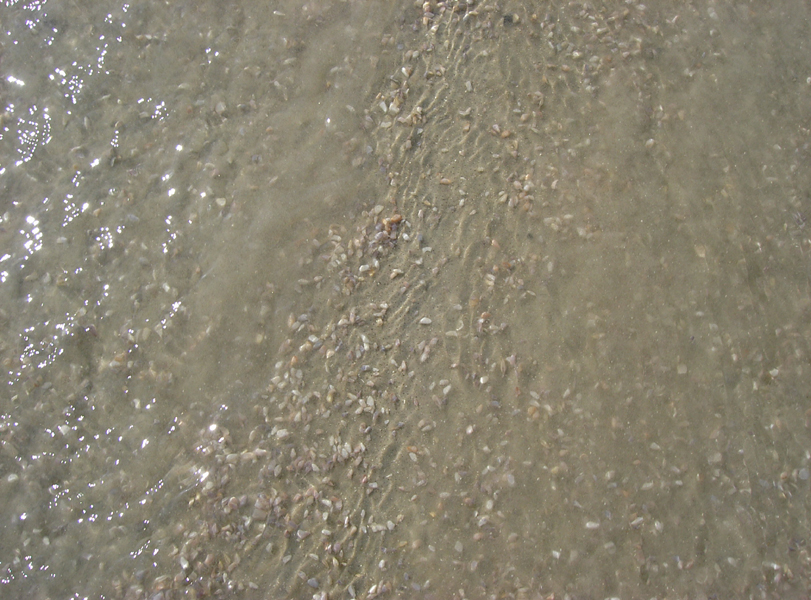
Little clams exposed by the tide.

One of the many creatures on Hilton Head that aren’t on the north Atlantic beaches, as far as I’ve been able to tell, are little tiny multi-colored clams that live on the shoreline with only a thin covering of wet sand. They are exposed in massive numbers by the tide washing in and receding, and then promptly wiggle around and dig themselves back under the sand. Which makes them darn hard to take a picture of. At first I thought they were just getting washed back out, but after digging around with our feet we realized that the sand was laden with them. Also, if you stand on the mass of them you can feel them wiggling their way back under cover; it’s a weird and compelling feeling. You begin to see why I love the beach, I could do things like stand around on pile of little tiny clams for hours and continue to be entertained. Not so much my partner, which is why we have other experiences to report than ‘I went on vacation and stood on clams.’


Jack’s sand castle.

Walking in the evening after the kids have been taken in for dinner and the tide is just coming back in, we came across many abandoned sand castles. This was the best one, for a few reasons. One, it had a functional moat. Two, it incorporated keyhole urchins, which we liberated into the moat after this photo was taken. Three, it clearly stated next to it ‘Jack only, no Mom!’ Which I’m sure was heartbreaking for Jack’s mom, after she brought him to the beach and all; we, of course, found it hilarious.

Because of the late winter this year, there were not yet any Loggerhead turtles coming up onto shore to lay their eggs. We would have been at the very beginning of the nesting season and lucky to have seen one around the first of May during any year, and the folks at the Coastal Discovery Museum relayed that not a single nest had yet been reported by anyone. This was one of the other things I really wanted to see, it just wasn’t meant to be on this trip.

vacation : beach

vacation : all I ever wanted

Last week we took a vacation, our first in four years. It got off to a bit of a rocky start, as we went directly from a family funeral to a full day of driving. Nonetheless, we were glad to be out of town and glad to be seeing someplace new; I’d been only once, about twenty years ago. We spent the week in a house in Kingston Cove, a development in the Shipyard section of Hilton Head Island, which we rented from a neighbor who was unable to use their timeshare week for the first time in twenty-odd years. The house was nice, the block was quiet, and the noisy frogs on the lagoon behind us were excellent; I only wish I had been able to see them in addition to hearing them, but the alligators were quite the disincentive to approaching the bank and peering into the water at dusk. When we weren’t on the screen porch drinking coffee or on the couch watching cable TV, we were on our rented one-speed cruisers riding around. We rode back and forth to the beach and around to various strip malls for lunch, breakfast, and more bottled water from the Piggly Wiggly. I will admit that when I first saw the cruisers I regretted not bringing Pearl, but once I realized that (a) you’re not legally allowed to ride in the road there and (b) cars have the right of way if they hit you and (c) the sand and salt water are uber-bad for a bike, I was glad I left her at home.

Although we weren’t following any set schedule, the week was a full one. We went birding in Pinckney NWR, adding several exciting new birds to my lifelist, which was a trip deserving of its own post. We sat through a timeshare-hawking presentation, and endured various (and seemingly endless) frustrations when attempting to use the Exciting Prizes we received for our trouble, an experience also worthy of its own writeup. At the end of the week, we returned with sunburns, several small keyhole urchin skeletons, and a variety of arts, crafts, and preserves. While we were gone, the yard turned into a blooming green jungle, thank you April showers, and the house is bursting out at the seams with papers to be recycled and belongings to be put away. Everything in its own time: we’re glad we went, and we’re glad to be home.

vacation : all I ever wanted